How Much Does It Cost to Build a Pádel Court?
A single padel court costs €20,000–€90,000 to build. Here's the full cost breakdown by component, indoor vs outdoor, and what drives the price.
Quick Answer
Building a single padel court costs between €20,000 and €90,000. The biggest cost variable is the foundation — an existing concrete slab saves up to €35,000. The steel-and-glass court structure runs €16,500–€35,000, artificial turf adds €1,000–€5,000, and lighting costs €1,800–€8,000. Indoor courts cost more upfront but generate revenue year-round.
Last updated: March 2026 · Prices verified from multiple court manufacturers and industry sources.
Cost Breakdown by Component
Here's where the money goes, per court:
| Component | Cost Range |
|---|---|
| Foundation (earthworks + concrete) | €0–€35,000 |
| Steel and glass structure | €16,500–€35,000 |
| Artificial turf | €1,000–€5,000 |
| LED lighting | €1,800–€8,000 |
| Transport and assembly | €5,000–€15,000 |
| Additional equipment (doors, netting, scoreboard) | €1,600–€8,200 |
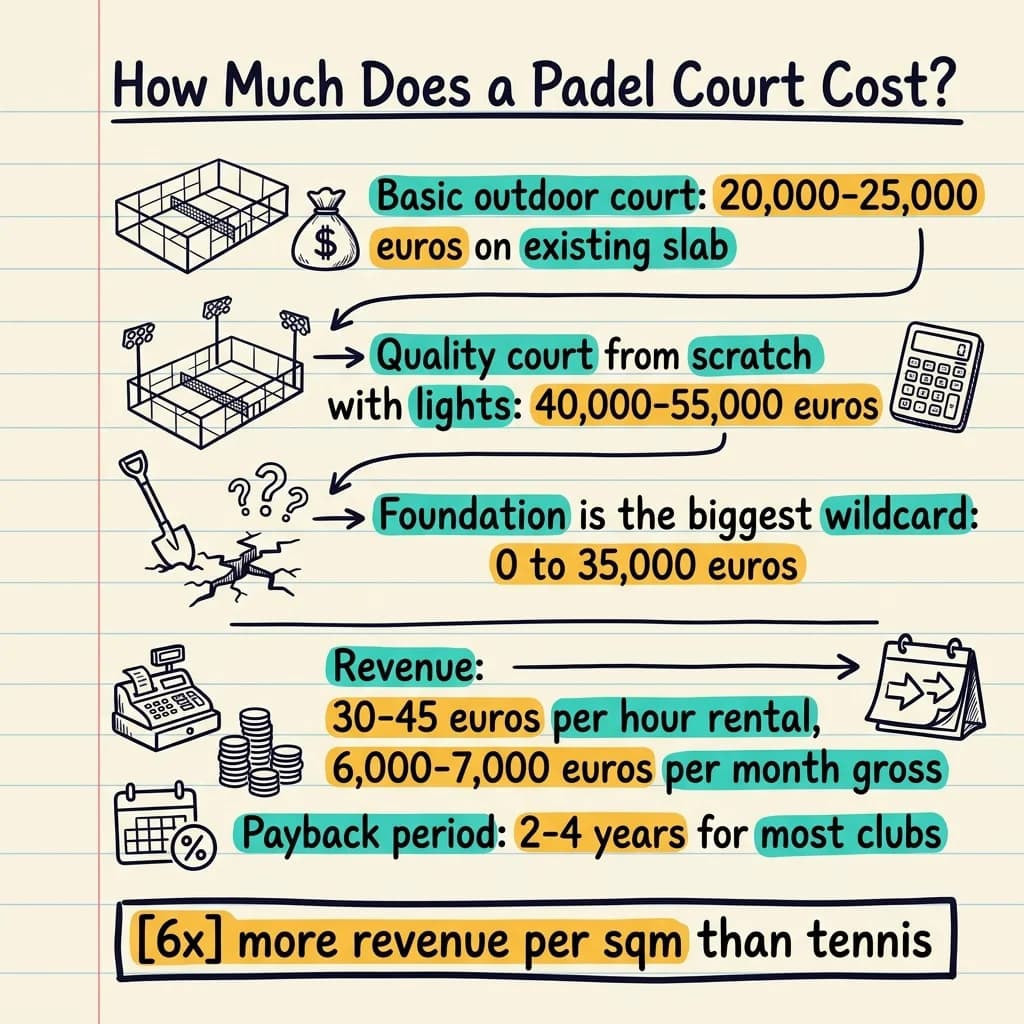
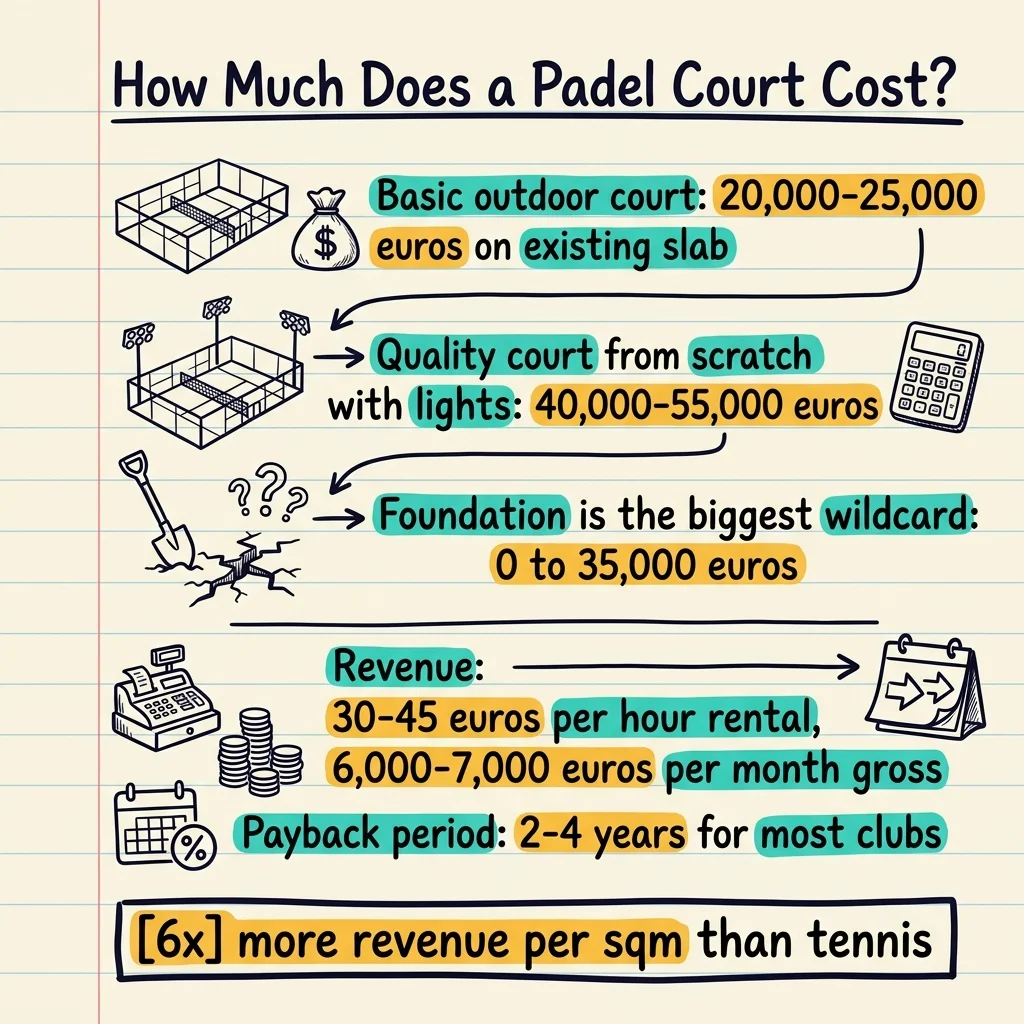
Foundation is the wildcard. If you're converting an existing tennis club with a solid concrete base, you might skip this entirely. Building from scratch on raw land? Budget €20,000–€35,000 for earthworks, drainage, and a reinforced slab.
The court structure itself is a steel frame with glass walls. Panoramic courts — the ones used on the Premier Padel tour with no metal beams blocking the glass — cost more because they require thicker, precision-fit glass panels.
Indoor vs Outdoor: What's the Real Difference?
The court structure costs roughly the same either way. The gap comes from everything around it.
Outdoor courts need weather-resistant materials, drainage systems, and wind protection. Budget €25,000–€50,000 per court all-in.
Indoor courts need a building. A warehouse conversion runs €15,000–€30,000 per court in structural adaptation. Purpose-built facilities cost significantly more. You also need 6 meters of minimum ceiling height (FIP regulation) and a full lighting system since there's no natural light.
The trade-off is straightforward: indoor courts cost 40–60% more to build, but they operate 12 months a year. In northern Europe or rainy climates, that's the difference between a viable business and a seasonal hobby.
The Foundation Problem
Tennis court slabs aren't strong enough. Padel court walls weigh roughly 3.6 tons, and they need a rigid base drilled into concrete.
Two common foundation types:
Ring beam strip foundation — concrete poured in an exterior ring to support the wall load. Cost-effective and works in most climates.
Reinforced concrete slab with slope — a full slab with built-in drainage. Not ideal in cold climates where frost can cause cracking.
A local contractor handles this part. It's separate from the court manufacturer's scope, and it's the component most likely to blow your budget if you don't get quotes early.
Real-World Example: 2 Courts
Here's what a two-court outdoor facility actually costs, based on industry data from Padel.fyi:
| Item | Unit Cost | Qty | Total |
|---|---|---|---|
| Foundation | €30,000 | 1 | €30,000 |
| Court structure | €20,000 | 2 | €40,000 |
| MONDO turf (€16/sqm) | €3,200 | 2 | €6,400 |
| LED flood lights | €600 | 4 | €2,400 |
| Transport + assembly | €5,000 | 1 | €5,000 |
| Total | €83,800 |
That's €41,900 per court. A solid mid-range benchmark for outdoor courts with quality turf and lighting.
What About Revenue?
Padel courts are doubles-only — 4 players per booking by design. That changes the math compared to tennis.
Court rental runs €30–€45 per hour across most European markets (€20–€30 off-peak, €30–€45+ peak hours). At roughly 5 hours of daily use, a single court generates €6,000–€7,000 per month gross — or roughly €72,000–€84,000 per year. Net profit after management costs sits at 20–30%, around €1,200–€2,000 per month per court.
Add coaching, leagues, and food-and-beverage on top, and the payback period for most clubs is 2–4 years.
That revenue density — 4 paying players on 200 sqm — is why clubs from Madrid to Miami are converting tennis courts to padel. A padel court produces roughly 6x more revenue per square meter than a tennis court in comparable conditions.
Hidden Costs to Budget For
Permits and planning. Many jurisdictions require planning permission for padel courts, especially for the glass walls and lighting poles. Budget 2–4 months for the process.
Anti-corrosion treatment. Coastal locations need galvanized or stainless steel frames. Saltwater exposure wrecks standard steel within 3–5 years.
Sand infill. Artificial turf needs silica sand — roughly 15kg per sqm. It settles over time and needs topping up every 6–12 months.
Insurance. Glass walls mean glass breakage risk. A single tempered glass panel replacement costs €500–€1,500 depending on size and type.
Turf Options and Cost
The surface affects both cost and playability.
Straight-fiber turf is the budget option at €5–€10 per sqm. It plays fast, drains well, and works for recreational facilities.
Curled-fiber turf (like MONDO, used on the Premier Padel tour) costs €12–€20 per sqm. It provides more cushioning, better ball response, and lasts longer under heavy use.
At 200 sqm per court, that's a €1,000–€4,000 difference. Worth the upgrade for any club planning serious play.
The Bottom Line
A bare-minimum outdoor padel court on an existing slab: €20,000–€25,000.
A quality outdoor court built from scratch with lighting: €40,000–€55,000.
A premium indoor court with panoramic glass and MONDO turf: €70,000–€90,000.
The sweet spot for most clubs is 2–4 outdoor courts at €35,000–€50,000 each. At that scale, shared foundation and transport costs bring the per-court price down, and you have enough courts to run leagues and events.
Frequently Asked Questions
Never miss an edition
Weekly Monday issue. 3-minute read. Free. EN + ES.
Related Articles
Why Is Pádel the Fastest Growing Sport in the World?
35 million players, 77,000+ courts, 150 countries — pádel is the fastest growing sport in the world. Here are the 5 reasons why.
Pádel Court Dimensions: Size, Measurements & Layout Explained
A pádel court is 20m long by 10m wide with 3-4m glass walls, an 88cm net, and service lines at 6.95m. Here are all the FIP-certified measurements.
Related Newsletter Editions
Coello and Tapia Reach Ten Titles in Rotterdam as Sánchez and Ustero Repeat
Arturo Coello and Agustín Tapia beat Franco Stupaczuk and Jon Sanz 6-3 6-2 for their tenth title of 2026, while Ari Sánchez and Andrea Ustero win a second straight crown.
The Streak is Over: Coello & Tapia Fall at Pretoria
Coello and Tapia's 27-consecutive-final streak ends at Pretoria P1 as Galán/Chingotto and Triay/Brea claim titles in two thrilling three-set finals.
Nike enters padel?
Nike's Swoosh appeared on padel rackets at Drake's NOCTA Manor. Three rumors, no official statement. Plus: the biggest week ever for padel in US business media.