How Technology Is Changing Padel in 2026: AI Coaching, Smart Courts and Sensors
How AI coaching, racket sensors, smart cameras, and booking apps are changing padel in 2026 — with verified numbers, tools, and court tech, updated August 2026.
Quick Answer
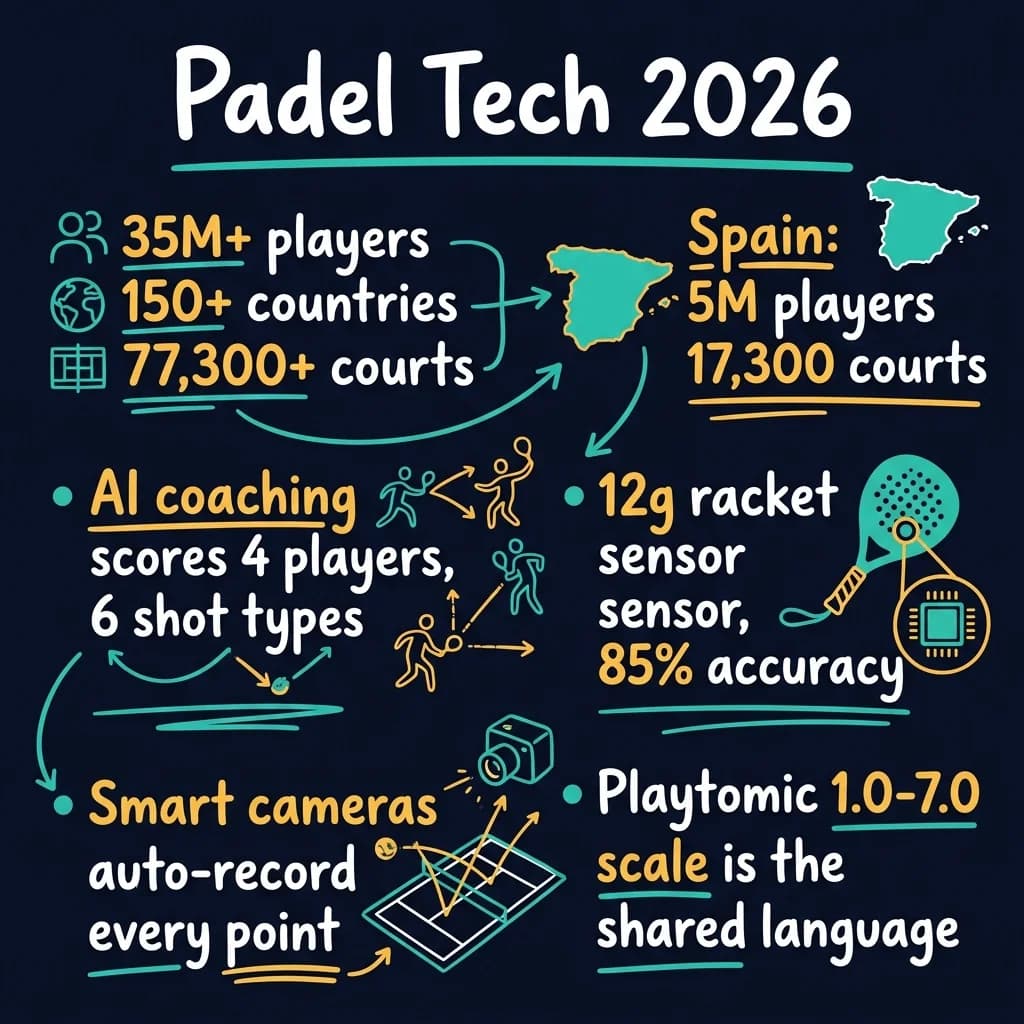
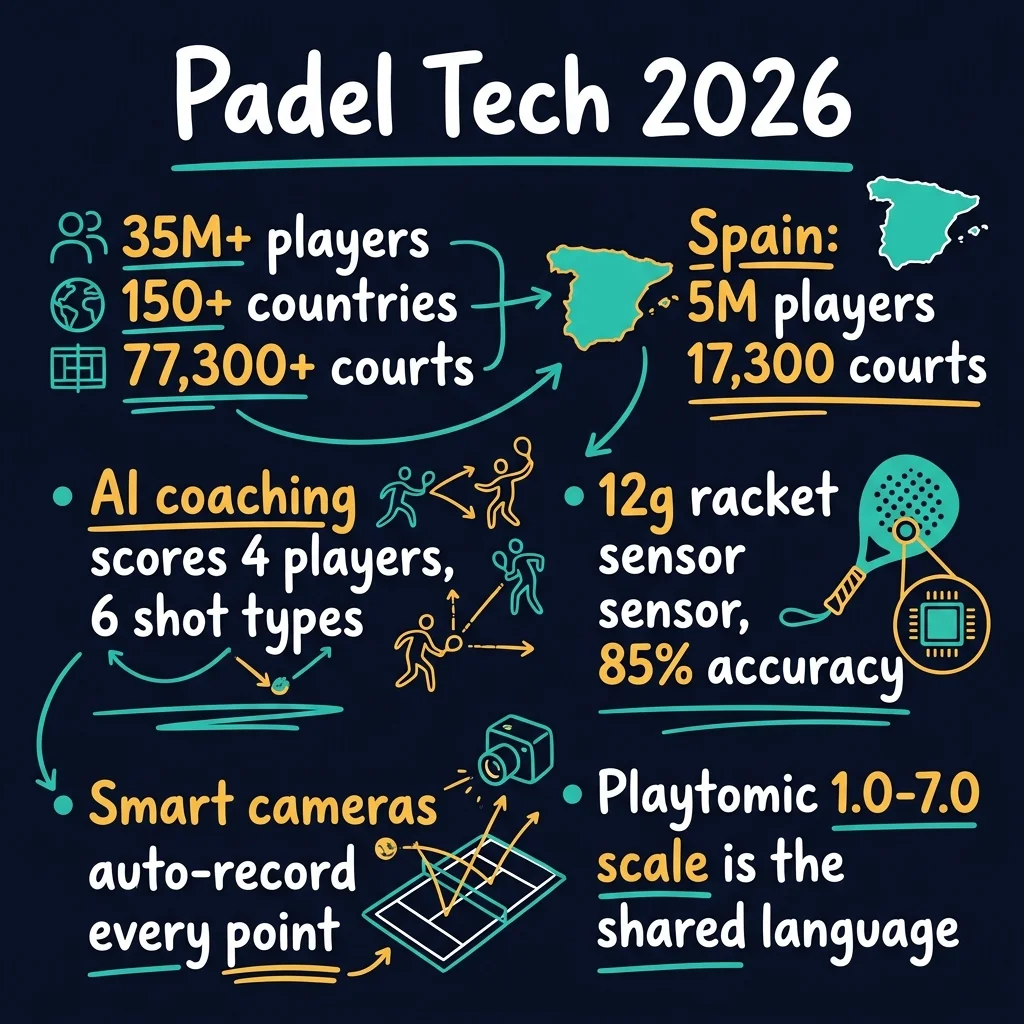
Technology is changing how players compete, train, and book courts. AI video tools return shot-by-shot feedback within minutes, racket sensors classify your strikes in real time, and club cameras record every match automatically. FIP counts the sport in more than 150 countries, more than 35 million players, and more than 77,300 courts.
Last updated: August 2026 · Prices and availability verified at time of writing.
The quickest way padel has changed: AI coaching tools
You used to wait days for a coach to review a match. Today you upload the video and get AI feedback in minutes. Tools like Padel AI score all four players from a single upload and run on iOS and Android.
Padel AI grades six shot categories. It maps each score to Playtomic's 1.0–7.0 skill scale. That scale already works as the common language across the sport's booking infrastructure.
The demand makes sense. FIP counts more than 35 million players worldwide. Each one of them is a potential user of this coaching layer.
The feedback loops stay tight. Six categories capture the core of the game, from smashes to lobs. A player sees a real weak spot instead of a vague review.
Smart cameras record every point automatically
Clubs now install camera systems that handle the recording. Clutch serves more than 125 clubs worldwide and delivers automated match recording, instant highlights, player analytics, and a club dashboard. GameTraq offers the same class of features.
A Swedish camera setup tracks all four players with 4K cameras. It measures metres run, shot counts, error rates, and movement. Coaches pull those numbers straight off the club's dashboard after a session.
Members skip the phone-on-a-fence setup. Every point gets captured, so players review a full match without asking anyone to film it. The highlights compile themselves.
A single 4K system monitors four players at once. The club gains a library of usable footage without hiring staff to film. Players share those clips, which markets the club for free.
Racket-mounted sensors track your shots in real time
A 12-gram sensor lives in your racket's buttcap and links to an app over Bluetooth. Padelplay detects and classifies forehands, backhands, volleys, smashes, bandejas, lobs, and slices. It hits roughly 85% shot-classification accuracy.
The app breaks a session into shots per stroke type. You see which stroke falls apart under pressure. Coaches use those same numbers to plan the next training block.
The sensor also flags stroke balance. A player who leans on the smash sees that ratio on screen. Frequency data tells the story that feel alone cannot.
What's happening inside the racket and on the court
Inside the racket, adjustable balance defines 2026. Adidas puts up to 11.2g of removable plates across head and grip on the Metalbone 2026, using its Weight & Balance System. Nox adds a bridge counterweight, its Weight Balancer, to the AT10.
On the court, materials set the standard. Pro turf blends PE and PP fibres with silica sand and rubber granules to FIP specs. Pro courts use 12mm tempered glass walls, budget builds drop to 10mm, and a panoramic all-glass perimeter marks the premium tier.
Advanced courts integrate further. They embed cameras, add intelligent LED lighting, and tie access doors to bookings. LED scoring displays round out the package.
Booking apps and the digital club
Playtomic runs the de-facto global booking infrastructure. Millions of players book through it across thousands of venues, and its 1.0–7.0 scale unifies matchmaking. MATCHi and Playless provide alternatives in regional markets.
Club-management suites track the business side. They monitor utilisation, maintenance, and revenue per court hour. That data shapes pricing and court allocation.
Open-match formats fill slots that would sit empty. A player books a game with strangers at a chosen skill level. This keeps courts fuller and clubs earning.
What's coming next in padel tech
Broadcast already matches established racket sports. Premier Padel uses multi-camera infrastructure, slow-mo analysis, player-tracking overlays, and direct streaming to social channels. Enclosed glass courts make the sport TV-friendly.
Red Bull TV streams all 26 Premier Padel stops live in 2026, from quarter-finals to finals. The next court generation connects every layer. Cameras, lighting, scoring, and booking will share one digital backbone.
Weights shift too. The adjustable-balance trend moves rackets toward custom setups. Sensors and apps just gave players a way to measure whether those changes work.
Spain still leads the wave. FIP counts about 5 million players and roughly 17,300 courts there, close to half of Europe's fans. Those courts modernise first, and the tech follows.
Frequently Asked Questions
Never miss an edition
Weekly Monday issue. 3-minute read. Free. EN + ES.
Related Articles
Best Padel Gifts in 2026: 11 Ideas for Players and Superfans
The best padel gifts in 2026 for every budget — from affordable padel mugs and stocking fillers to rackets, bags, and shoes. Honest picks for the padel obsessive in your life.
Best Padel Newsletters in 2026: 7 Worth Subscribing To
The best padel newsletters in 2026, picked by what you want: overall news, business, gear, coaching, US padel, and the best free bilingual (EN/ES) option.
Best Padel Players in 2026: The Top 10 Men's and Women's World Rankings
The FIP top 10 padel players for 2026 — men's and women's. Who's number one, the points, the partnerships, and the rising stars, updated June 2026.