How Big Is the Padel Market? Growth Statistics and Key Numbers in 2026
Padel market size, player numbers, court counts, and investment data for 2026 — sourced from FIP, Playtomic, and industry reports.
Quick Answer
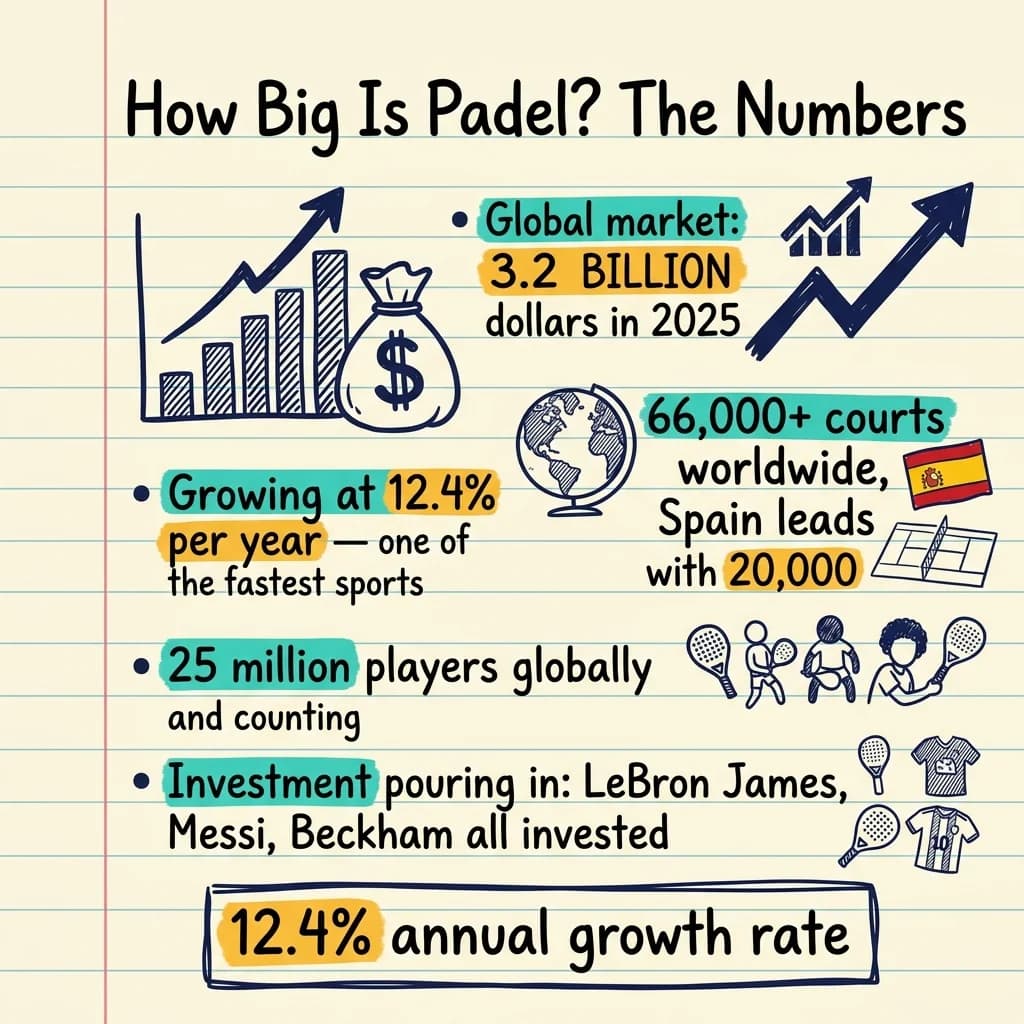
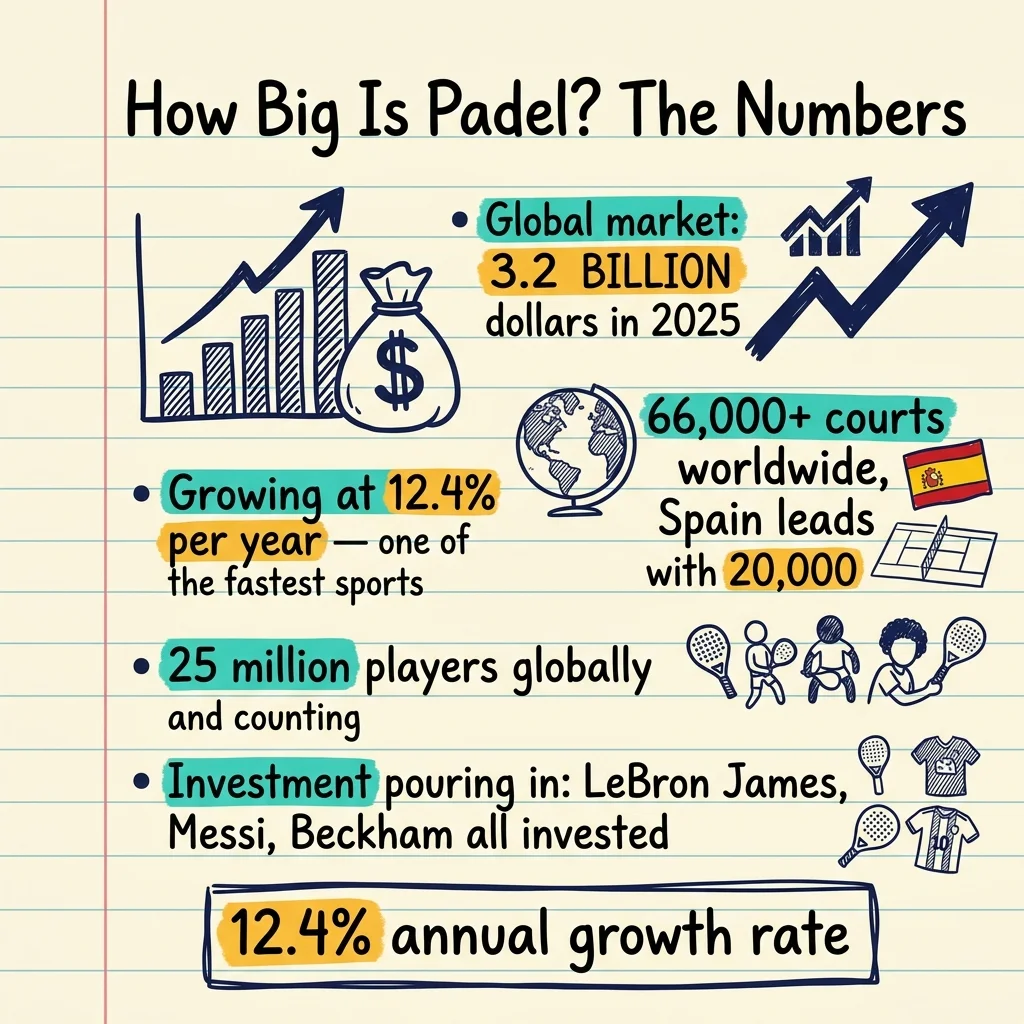
The global padel market is worth approximately €6 billion in 2026, tripling from €2 billion in 2022. Over 35 million people now play across 150+ countries on 77,300+ courts worldwide. The U.S. market is in early-stage acceleration — from fewer than 20 courts in 2019 to 650+ by mid-2025 — with projections of 6,800 courts by 2030. Investment is flowing in from Qatar Sports Investments (Premier Padel), PPL franchise owners (valuations up to $10 million), and Saudi Arabia's PIF, making padel one of the most investable sports on the planet right now.
Last updated: March 2026 · Data sourced from FIP, Playtomic, Misitrano Consulting, and industry reports at time of writing.
The Numbers at a Glance
Before diving in, here's where padel stands globally in 2026:
- Market value: ~€6 billion (Global Padel Report)
- Players worldwide: 35+ million (FIP World Padel Report 2025)
- Countries with active players: 150+ (up from 90 in ~2020)
- Courts globally: 77,300+ across 24,600+ clubs
- Year-over-year club growth: 16.1% increase in clubs, 15.2% rise in courts (FIP data)
- Federation membership growth: 42% increase in registered players vs. prior year
Those aren't just big numbers — they represent a sport that's compounding faster than pickleball, CrossFit, or any other recent fitness phenomenon.
Where the Money Lives: Market Breakdown
The €6 billion padel economy isn't monolithic. It breaks down across three major revenue segments, each with different dynamics.
Clubs and Infrastructure
Club operations are the financial backbone of padel. In France — one of Europe's fastest-growing markets — a single court generates an average of €80,000 in annual revenue, with operating margins between 15% and 25%.
The demand-supply gap drives these returns. France has 850,000 players, but only 57% report being satisfied with court availability. That booking pressure is money in the bank for operators.
The market is consolidating. In France, 22% of padel infrastructure already belongs to structured networks like 4Padel, PadelShot, and Casa Padel. These groups run integrated models — coaching, events, catering — that push margins higher than standalone clubs.
Equipment
The equipment segment was worth €550 million in 2022 and has grown substantially since, driven by a simple math: every new player needs a racket, shoes, and balls.
Historical tennis brands (Babolat, Head, Wilson) are competing head-to-head with padel-native brands (Bullpadel, Nox) in a market defined by fast product cycles and innovation, including connected rackets and higher-durability balls.
Professional Circuit and Media
The professional segment is the smallest in revenue (€50 million in 2022 for tickets and media) but has the most dramatic growth trajectory. Qatar Sports Investments' acquisition of the World Padel Tour and merger with Premier Padel created a unified global circuit that attracted major sponsors.
In 2026, Premier Padel runs 26 tournaments across 18 countries — up from 24 tournaments in 16 countries the previous year — with nearly 75% held indoors. Saudi Arabia's Public Investment Fund (PIF) has also entered the sport, signaling that sovereign wealth sees long-term value in padel.
The U.S.: From Zero to Acceleration
The American market tells the most dramatic growth story in padel right now.
The trajectory:
- 2019: Fewer than 20 courts in the entire country
- Mid-2025: 650+ courts across 180 facilities in 31 states
- 2030 projection: 6,800 courts at 1,774 facilities (Misitrano Consulting)
The "State of Padel in the U.S." report from Misitrano Consulting describes the sport as having "irreversible momentum." Real acceleration is projected for 2027, but the infrastructure buildout is already happening.
Key milestones include Padel N9NE in San Diego — the first adidas flagship club in the U.S. — featuring eight adidas "165 MPH" courts. The North American Pro Padel League (PPL) has franchise valuations reaching $10 million, with a dual media strategy targeting both the established international audience and the American mainstream through YouTube and Tennis Channel broadcasts.
Spain: Still the Capital
Spain remains padel's center of gravity by a wide margin: over 17,300 courts and more than 6 million players. Spanish Google Trends data for "padel" scores 100 — the maximum possible — while the next-closest country (Sweden) scores 39.
The top countries by search interest tell you where padel culture is most embedded: Spain, Sweden, Portugal, Paraguay, Argentina, Denmark, Belgium, Italy, Chile, and the Netherlands. Northern Europe's presence in that list — Sweden, Denmark, Belgium, Netherlands — reflects the sport's rapid uptake in markets that barely had courts five years ago.
The UK: Late Start, Fast Catch-Up
Britain went from 15,000 players and under 70 courts in 2019 to a rapidly expanding market in 2026. The UK now has over 1,000 courts concentrated in London, the Midlands, and the South, with Scotland and Wales still underserved. The growth mirrors the trajectory Spain followed 15 years ago — once courts reach a critical density, player adoption accelerates non-linearly.
What's Driving the Growth?
Three structural forces are behind padel's expansion:
-
Accessibility: The enclosed court, underhand serve, and doubles format make padel dramatically easier to pick up than tennis. Most beginners can rally within 2–3 sessions.
-
Social format: Padel is inherently social — played in doubles on a small court where conversation happens naturally. This drives retention rates that individual sports can't match.
-
Real estate economics: A padel court requires roughly 200 m² — about one-third of a tennis court. Clubs can fit 3 padel courts in the space of 1 tennis court, tripling their per-square-meter revenue potential.
What to Watch in 2026–2027
- U.S. infrastructure buildout: The gap between player demand and court supply will close fast once institutional capital enters at scale.
- Premier Padel media rights: The next round of broadcast deals will set the tone for the sport's media trajectory.
- Asian expansion: The Middle East and Asia-Pacific are the next frontiers, with padel courts appearing in hotels, corporate campuses, and gated communities.
- Club consolidation: Expect M&A activity to intensify as regional networks acquire independent clubs to build scale.
Padel's economic story isn't speculation anymore — it's a €6 billion market with sovereign wealth backing, 35 million players, and infrastructure growing at 15%+ per year. The question isn't whether padel will be big. It's how big.
Frequently Asked Questions
Never miss an edition
Weekly Monday issue. 3-minute read. Free. EN + ES.