How Much Do Pro Padel Players Earn? Prize Money, Sponsorships, and the Reality
Breakdown of professional padel player earnings in 2026 — prize money by ranking tier, sponsorship deals, and the real cost of going pro.
Quick Answer
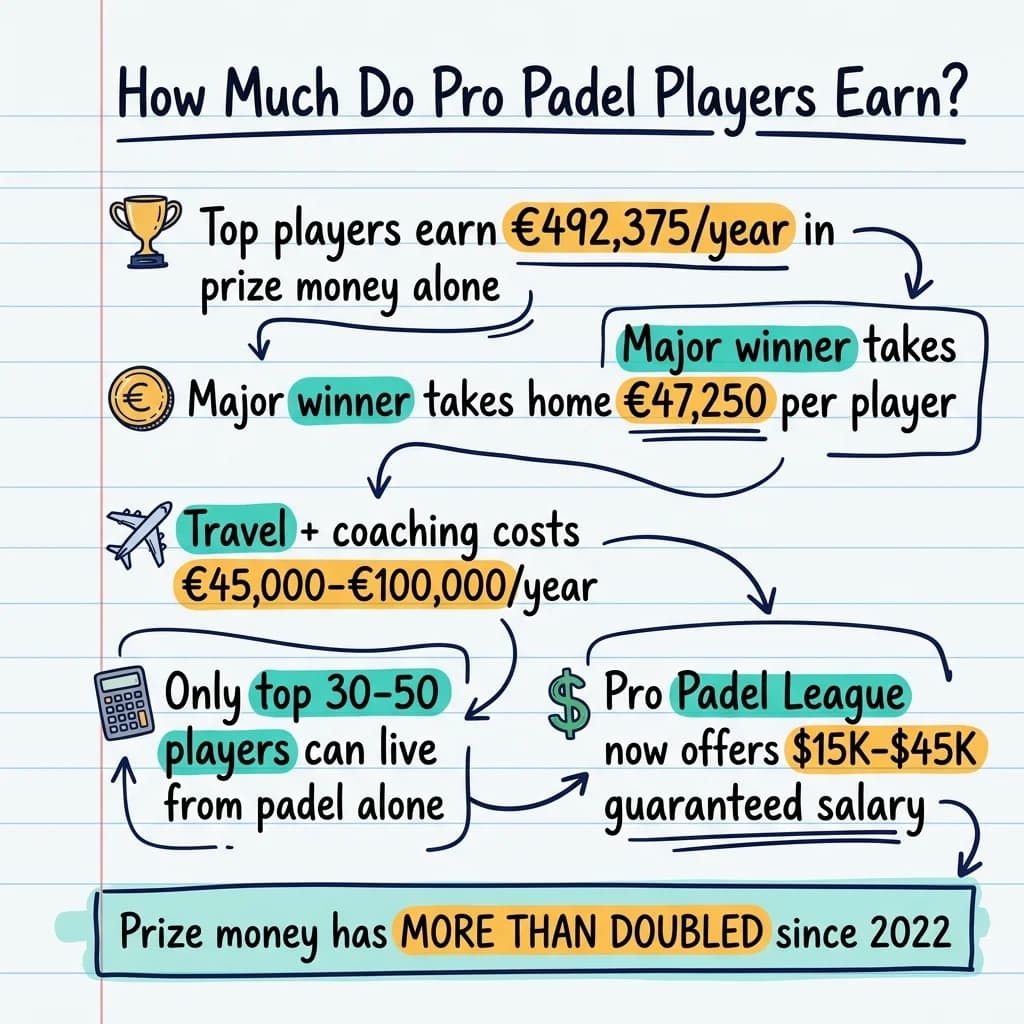
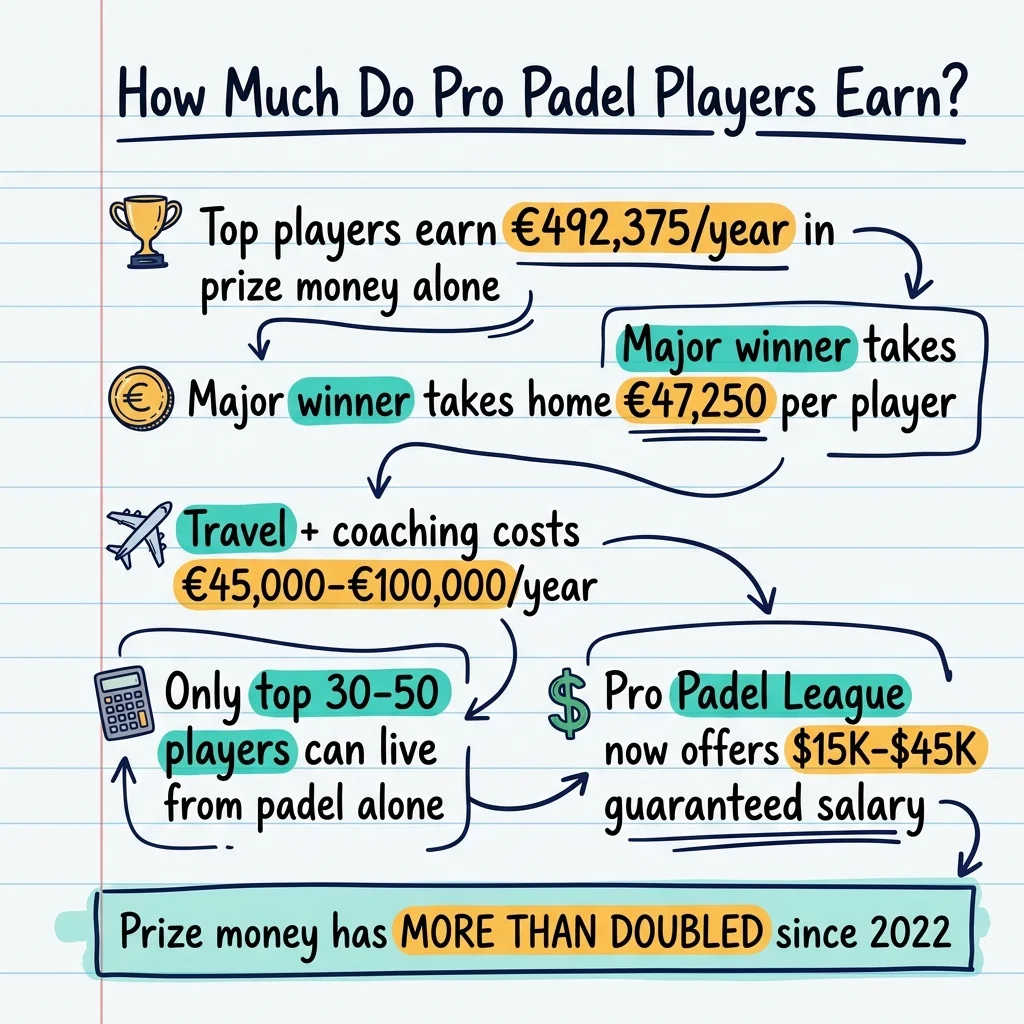
The top padel players in the world earn €400,000–€800,000+ per year from prize money and sponsorships combined. Agustin Tapia and Arturo Coello each took home €492,375 in prize money alone in 2024, winning 14 of 21 tournaments. But drop below the top 30–50 in the world rankings and the math flips: travel costs of €25,000–€35,000 per year plus coaching fees often exceed what players win. Only a thin slice of professional padel players can live from the sport alone.
Last updated: April 2026 · Prices and availability verified at time of writing.
The Top Earners: What the Best Players Make
Agustin Tapia (Argentina, FIP #1, born 1999) and Arturo Coello (Spain, FIP #1, born 2002) dominated 2024. Each earned €492,375 in prize money after winning 94 of 101 matches and claiming 14 titles in 21 tournaments.
Those numbers are prize money only. Add sponsorships and the picture changes. Tapia signed a deal with Commvault (NASDAQ: CVLT) for the 2025–26 season. Coello carries equipment and clothing deals. Industry estimates put total earnings for a top-5 men's player at €800,000–€1 million per year when prize money, equipment contracts, clothing deals, and corporate sponsorships are stacked together.
On the women's side, Ariana Sanchez (Spain, FIP #3, born 1997) leads the all-time career prize money database at €1,302,344 according to Padelearnings. Gemma Triay and Delfi Brea are right behind her.
Prize Money by Tournament Tier
Premier Padel runs three tiers. The money jumps at each level.
Major (total pool: €525,000 per category)
- Winner: €47,250 per player
- Finalist: €23,625
- Semifinalist: €13,125
- Quarterfinalist: €8,531
- Round of 16: €5,250
P1 (total pool: ~€260,000 men's / ~€235,000 women's)
- Winner: €25,500 men's / €17,000 women's
- Finalist: €13,500 / €9,350
- Semifinalist: €7,125 / €5,100
P2 (total pool: ~€197,000–€235,000)
- Winner: €15,000 men's / €8,500 women's
- Finalist: €8,250 / €4,675
Data from Relevo and Padelalto. Prize pools vary slightly by host country.
The Gender Pay Gap in Padel
At Major level, men's and women's prize money is equal: €525,000 per category. That's a strong floor.
Below that, the gap appears. A women's P1 winner takes €17,000 — 33% less than the men's €25,500. At P2 level, the gap widens: €8,500 versus €15,000.
The gap is shrinking. Prize pools across all tiers have more than doubled since 2022. But parity at P1 and P2 hasn't arrived yet.
The Cost of Going Pro
Here's where the dream collides with spreadsheets. A player ranked around #80 in the world earns roughly €15,000–€30,000 in annual prize money.
Now subtract costs:
- Travel: €25,000–€35,000 per year (flights, hotels for 15–20 international tournaments)
- Coaching: €10,000–€20,000 per year
- Equipment and physio: €5,000–€10,000 per year
- Total annual expenses: €45,000–€100,000
A player ranked 50th to 80th in the world often runs a deficit on prize money alone. Many supplement income through coaching, private lessons, and clinics. Some depend on family support or small regional sponsors just to stay on tour.
Only the top 30–50 players earn enough from tournaments to cover costs and live comfortably. Everyone else needs sponsorships or a second income.
The US Factor: Pro Padel League
The Pro Padel League (PPL) is trying to change the economics — at least in North America. After raising $15 million in Series A funding led by Charlotte Hornets co-chairman Rick Schnall, the PPL announced guaranteed player compensation for the 2026 season.
Players pick one of five salary tiers: $15,000–$45,000 guaranteed in 2026, doubling to $30,000–$90,000 in 2027 when the schedule expands. Add prize money and bonuses on top.
The PPL's 2026 season runs five events across North America starting July 9, with over $350,000 in total compensation and prize money. PPL II, a developmental circuit, launched separately with its own $350,000 pool.
Guaranteed salaries are new for padel. The Premier Padel circuit operates on prize money only — no base pay.
Sponsorships: Where the Real Money Lives
For top players, sponsorships dwarf prize money. Equipment brands (Bullpadel, Wilson, Adidas, Babolat, Head, Nox) sign the top 20–30 players for equipment and clothing deals. Corporate sponsors are entering too: Commvault's deal with Tapia, Qatar Airways as Premier Padel's title sponsor.
Players outside the top 20 get smaller deals — free equipment, travel support, maybe €10,000–€30,000 per year. Past the top 50, most players have no sponsorship income at all.
The sponsorship market is growing with the sport. Padel equipment alone was a €550 million market in 2022, and brands are fighting for visibility on the highest-ranked players.
Padel vs. Tennis: The Earnings Gap
Padel's top earner makes roughly €500,000 in prize money per year. Tennis's top earner? Over $15 million. Novak Djokovic has earned more than $180 million in career prize money.
A top-100 tennis player earns €300,000–€800,000 per year in prize money. A top-100 padel player earns closer to €15,000–€50,000. The gap is massive — but padel prize money has more than doubled since 2022, and the trajectory is steep.
Tennis has a 50-year head start in prize money growth. Padel is compressing that timeline.
What's Changing
Three forces are pushing padel earnings up:
- Prize money growth: More than doubled since 2022 across all Premier Padel tiers
- New leagues: The PPL's guaranteed salary model could become a template for other regional leagues
- Corporate sponsors: Tech companies (Commvault), airlines (Qatar Airways), and betting firms (Betsson) are entering padel — that money flows to players
The sport is at the stage where tennis was in the 1980s: prize money is real but concentrated at the top, sponsorship money is growing fast, and the professional middle class is still struggling.
Frequently Asked Questions
Never miss an edition
Weekly Monday issue. 3-minute read. Free. EN + ES.
Related Articles
The Greatest Women's Padel Pairs of All Time, Ranked
From Navarro and Reiter to Ariana Sánchez and Paula Josemaría: the greatest women's pairs in padel history, ranked by titles, ranking dominance, and impact on the game.
Who Is Agustin Tapia? Padel's No. 1 Magician, Explained
Agustín Tapia's story: from Catamarca to world No. 1 — his records, his partnership with Coello, how much he earns, and how he plays.
How to Watch Premier Padel: Streaming Guide 2026
Where to watch every Premier Padel match in 2026: free options, country-by-country broadcasters, and which rounds stream where.
Related Newsletter Editions
Coello and Tapia Reach Ten Titles in Rotterdam as Sánchez and Ustero Repeat
Arturo Coello and Agustín Tapia beat Franco Stupaczuk and Jon Sanz 6-3 6-2 for their tenth title of 2026, while Ari Sánchez and Andrea Ustero win a second straight crown.
Goñi In, Salazar Out; Guerrero & Leal Answer the Snub with Lyon Gold
The Spanish Padel Federation unveiled its 16-player roster for the FIP World Padel Championships in Doha (Nov 2-7). Aimar Goñi (20) earns a shock call-up while Alejandra Salazar, 7-time world champion, is left out. Hours later, the snubbed Fran Guerrero and Javi Leal delivered the perfect on-court response: defeating top seeds Franco Stupaczuk and Jon Sanz 4-6 6-4 6-1 to claim FIP Platinum Lyon. Bea Caldera and Carmen Goenaga won the women's draw without dropping a set.
Golden at Roland Garros: Tapia & Coello's Four in a Row, and Ustero Makes History
On Philippe-Chatrier, Tapia and Coello pulled off one of padel's great escapes. Trailing 2-5 in the third against Galán/Chingotto, they clawed back and won the tiebreak 7-1 to seal a fourth consecutive Roland Garros title. In the women's final, Ari Sánchez and 19-year-old Andrea Ustero were ruthless: 6-2 6-0 in 71 minutes. Ustero is now the youngest Paris Major champion in history. A record 81,000 fans packed Roland Garros across the week.