What Is the Star Point in Padel? The New 2026 Scoring Rule Explained
The Star Point system caps deuce games at 2 advantages before a sudden-death point. Here's how it works in 2026.
Quick Answer
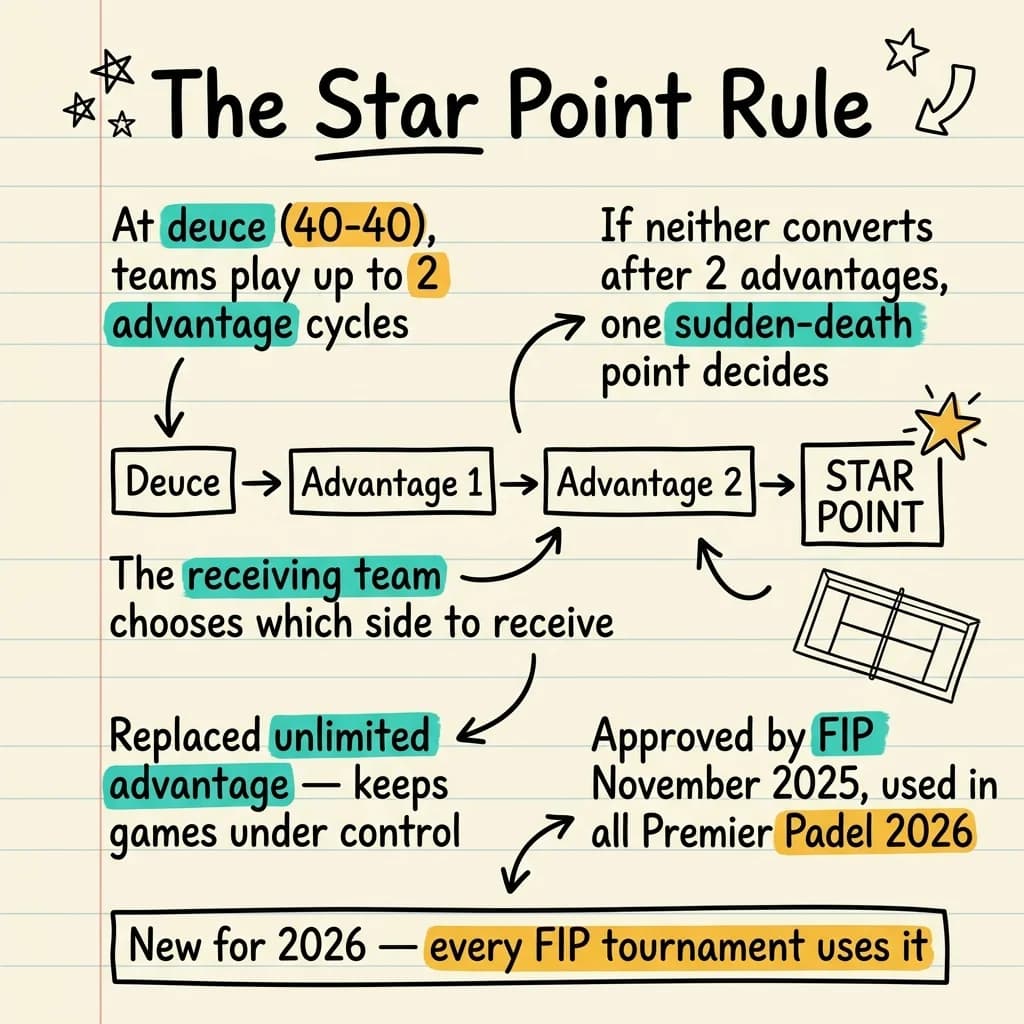
The Star Point is padel's new scoring rule for 2026. When a game hits deuce (40–40), teams play up to two normal advantage cycles. If neither side converts after two advantages, one sudden-death rally — the Star Point — decides the game. The receiving team chooses which side to receive the serve. The FIP General Assembly approved it unanimously on November 28, 2025, and it now applies across Premier Padel, CUPRA FIP Tour, FIP Promises, and FIP Beyond.
Last updated: March 2026 · Rule details verified against FIP official announcements at time of writing.
Why Padel Changed Its Scoring
Padel borrowed its scoring from tennis: 15, 30, 40, game. At deuce, teams traded advantages back and forth until someone won two in a row. No limit.
That created a problem. A single game could stretch past 10 minutes. Broadcasters couldn't predict match length. Players burned energy on marathon deuce battles that didn't move the scoreboard.
Two solutions existed before 2026:
- Advantage (traditional): Unlimited deuce cycles. Used in most club play.
- Golden point: One point at deuce wins the game. No advantage at all. Used on the World Padel Tour and early Premier Padel events.
Golden point fixed the length problem but created a new one. Players and coaches argued it was too random — one lucky shot could decide a tight game with zero margin for recovery.
The Star Point splits the difference.
How the Star Point Works
The system kicks in at the first deuce of any game. Three stages:
Stage 1 — First advantage. Exactly like traditional scoring. One team earns advantage. If they win the next point, they take the game. If they lose it, back to deuce.
Stage 2 — Second advantage. Same rules. Another chance to close out the game on advantage.
Stage 3 — Star Point. If two advantages have been lost (by either team, in any combination), the next point is sudden death. One rally. One winner. Game over.
A quick example: the score is 40–40. Team A wins a point and gets advantage. Team B fights back — deuce again. Team B then earns advantage but loses the next rally — back to deuce a second time. Two advantages have now been lost. The umpire calls "Star Point." The next rally decides everything.
The Receiver's Choice
On the Star Point, the receiving team picks which side of the court the serve comes from — left or right. This matters because it lets the returners position their stronger player to receive the pressure serve.
In mixed doubles, there's an extra rule: the receiver must be the same sex as the server. So if a male player is serving, a male player must receive.
Where It Applies
The Star Point is now the default for all FIP-governed competitions:
- Premier Padel — debuted at the Riyadh P1 (February 9–14, 2026)
- CUPRA FIP Tour — debuted at the FIP Bronze Melbourne (January 5–11, 2026)
- FIP Promises — junior circuit
- FIP Beyond — amateur circuit
It's listed as Rule 1, Option 2 in the official FIP rulebook. Club matches and social play can still use traditional advantage or golden point — the Star Point is an official option, not the only option.
Star Point vs Golden Point vs Advantage
| Advantage | Golden Point | Star Point | |
|---|---|---|---|
| At deuce | Unlimited cycles | Instant deciding point | Up to 2 advantages, then deciding point |
| Max points at deuce | No limit | 1 | 5 |
| Receiver chooses side | No | Yes | Yes (on Star Point only) |
| Used in 2026 pro tour | No | No | Yes |
The key number: a Star Point game can have a maximum of 5 points after deuce (advantage, back to deuce, advantage, back to deuce, Star Point). Traditional advantage has no cap.
What This Means for Players
For pros: Matches are shorter and more TV-friendly. The FIP consulted 100 national federations, players, coaches, and broadcasters before the vote — and it passed unanimously.
For club players: Nothing changes unless your club or tournament adopts the Star Point. Most social play already uses golden point or traditional advantage. But if you enter FIP-sanctioned amateur events (FIP Beyond), you'll play with the Star Point.
For strategy: The two-advantage buffer means serving teams still have a real chance to convert. But once that Star Point arrives, the receiving team holds a tactical edge — they pick the side.
Frequently Asked Questions
Never miss an edition
Weekly Monday issue. 3-minute read. Free. EN + ES.
Related Articles
How Does Padel Scoring Work? Points, Games, Sets, and Tiebreaks Explained
Padel scoring uses 15-30-40-game points inside best-of-3 sets with tiebreaks, golden point, and the 2026 star point rule.
What's New in Padel for 2026? Every FIP Rule Change Explained
The FIP's 2026 rulebook brings the Star Point, a stricter serve, a safety-cord penalty, new racket holes, and a faster clock. Here's every change.
How Long Does a Padel Match Last?
Padel matches last 60-90 minutes on average — here's what determines whether yours wraps up fast or drags into a third set.
Related Newsletter Editions
Coello and Tapia Reach Ten Titles in Rotterdam as Sánchez and Ustero Repeat
Arturo Coello and Agustín Tapia beat Franco Stupaczuk and Jon Sanz 6-3 6-2 for their tenth title of 2026, while Ari Sánchez and Andrea Ustero win a second straight crown.
Goñi In, Salazar Out; Guerrero & Leal Answer the Snub with Lyon Gold
The Spanish Padel Federation unveiled its 16-player roster for the FIP World Padel Championships in Doha (Nov 2-7). Aimar Goñi (20) earns a shock call-up while Alejandra Salazar, 7-time world champion, is left out. Hours later, the snubbed Fran Guerrero and Javi Leal delivered the perfect on-court response: defeating top seeds Franco Stupaczuk and Jon Sanz 4-6 6-4 6-1 to claim FIP Platinum Lyon. Bea Caldera and Carmen Goenaga won the women's draw without dropping a set.
Golden at Roland Garros: Tapia & Coello's Four in a Row, and Ustero Makes History
On Philippe-Chatrier, Tapia and Coello pulled off one of padel's great escapes. Trailing 2-5 in the third against Galán/Chingotto, they clawed back and won the tiebreak 7-1 to seal a fourth consecutive Roland Garros title. In the women's final, Ari Sánchez and 19-year-old Andrea Ustero were ruthless: 6-2 6-0 in 71 minutes. Ustero is now the youngest Paris Major champion in history. A record 81,000 fans packed Roland Garros across the week.