Quick Answer
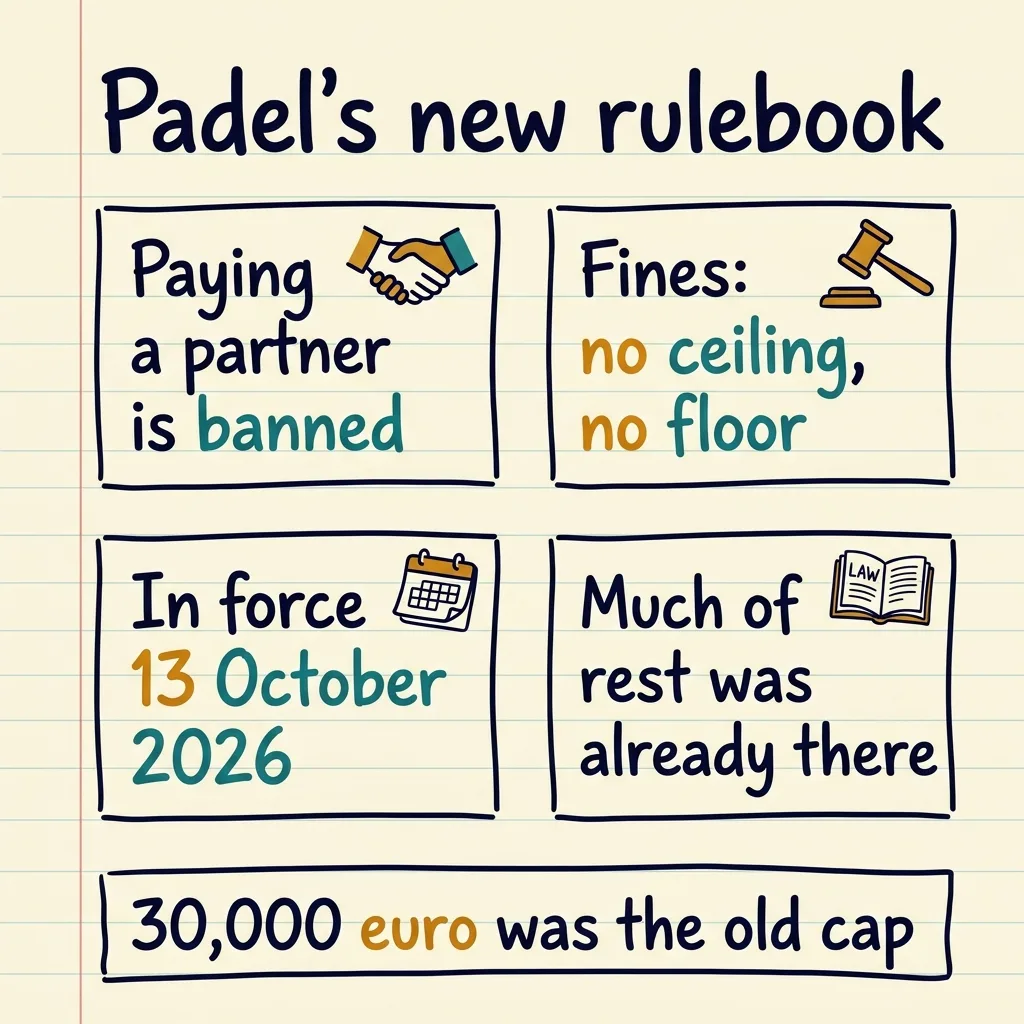
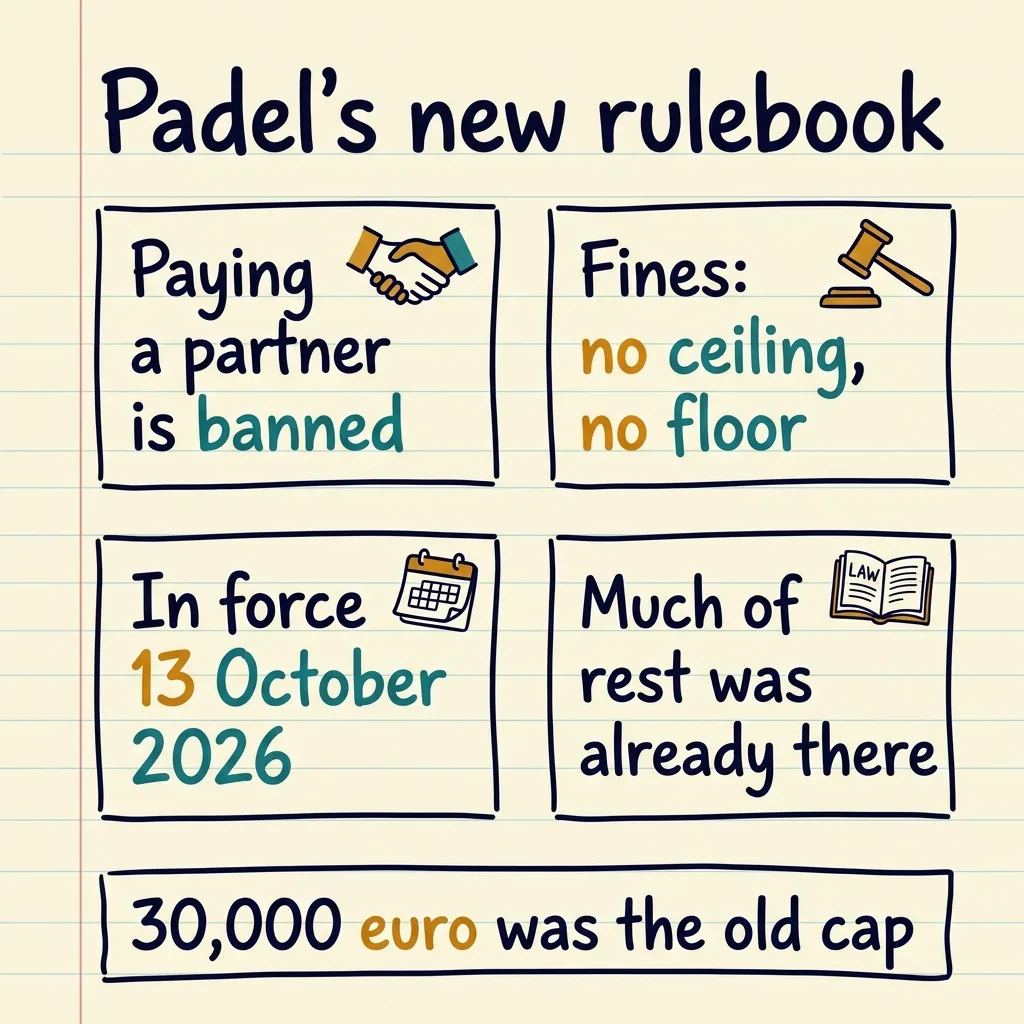
The International Padel Federation (FIP) approved new codes at its 36th General Assembly in Madrid on 12 October 2026. Two changes are genuinely new:
- Paying a partner is banned. A new final paragraph of Code of Ethics §4.8 prohibits both paying a partner and being paid to partner someone.
- Fines have no limit. The previous Disciplinary Code capped fines at €30,000. The 2026 code names no figure at all.
Much of the coverage called other items new. They are not. The €250 appeal fee, the medical-certificate power and the catch-all sanction clause were already in the previous code.
Last updated: October 2026 · Checked against the FIP's approved PDFs of the Code of Ethics, Disciplinary Code and Statutes.
You Can No Longer Buy a Partner
We found no FIP text that forbade it before 12 October. A player could pick any partner, and pay them if both sides agreed.
That has changed. The approved Code of Ethics adds an unnumbered final paragraph to §4.8:
"Dado que el pádel es un deporte que se practica en parejas, remunerar a la pareja, o recibir una remuneración para participar como pareja de un jugador en un torneo, pone en riesgo la integridad de las competiciones y la ética deportiva y, en consecuencia, dará lugar a sanciones disciplinarias."
In English: padel is played in pairs. Paying a partner, or being paid to partner a player in a tournament, endangers competition integrity and sporting ethics. It will lead to disciplinary sanctions.
Three points follow from the wording:
- Both sides are covered. The player who pays and the player who accepts are each named.
- The FIP frames it as integrity. The clause gives a general reason and refers to no incident.
- No sanction is fixed in the clause. It only says sanctions will follow.
The route to a sanction runs through the Disciplinary Code. Art. 11.1.m lists "Incumplimiento del Código Ético" as a muy grave (very serious) offence. Art. 12 then supplies the menu of sanctions, and Art. 14.1 sets a three-year prescription period for very serious offences.
The Disciplinary Code takes effect the day after approval, so 13 October 2026. The Code of Ethics has no start date of its own, so that date is an inference from the companion code.
The clause leaves gaps. It does not define "remuneración". It does not say whether prize-money splits, tournament appearance fees or sponsorship deals count. Those questions will be settled by cases, not by the text.
The Fine Ceiling Is Gone, and So Is the Floor
The previous Disciplinary Code, approved in Acapulco on 28 November 2025, set explicit limits in Art. 12.2:
- Legal persons: fines "no inferiores a 600 euros ni superiores a 30.000 euros".
- Natural persons: "Multas hasta 30.000 euros".
An earlier draft of that code went further and set a €3,000 floor for individuals.
The approved 2026 code lists only "Multa" for both groups. A text search for "600", "3.000" and "30.000" returns nothing.
In practice, the disciplinary bodies can now set any amount. There is no maximum, and no minimum either. The FIP has not published a reason for the change, so we cannot say how it intends to use the freedom.
For players, the menu of sanctions in Art. 12.2 runs from a warning to disqualification. Art. 12.2.p allows exclusion from FIP competitions for between two months and five years.
What Did Not Change
Press coverage of the new codes listed several items as novelties. The FIP's own previous codes show otherwise. This section matters as much as the two above.
- The €250 appeal fee is not new. Art. 15.2 of the previous Disciplinary Code, approved on 28 November 2025, already required "la tasa de recurso de € 250". Art. 19.1 repeated it. PadelSpain wrote that the fee "antes era totalmente gratuito". We could not find an older code that supports that.
- The medical-certificate power is not new. If a player submits a certificate to justify missing a competition, the disciplinary bodies may ask for more information or send it to an external doctor. That sentence appears word for word in Art. 7.1 of the previous code.
- The catch-all clause is not new. Art. 2.2 lets the disciplinary bodies deal with any conduct "contraria a los principios de fair play, lealtad e integridad" that no specific rule covers. It is identical in the previous code.
- Retroactivity is not new. Code of Ethics §3 applies the code to conduct whenever it happened. It also bars sanctions for acts that were not breaches at the time, and bars penalties above the maximum then in force. The 2024 code has the same three safeguards.
Several outlets, including PadelSpain and PadelHoy, presented the medical and catch-all items as changes. The primary texts do not support that.
The Smaller Changes That Are Real
A diff of the 2026 Disciplinary Code against the previous one shows a handful of procedural changes:
- Ranking at sentencing. Art. 6.2 adds a new factor. When the offender is a player, their ranking position at the time the sanction is imposed is considered.
- Narrower appeals. Art. 7.1 limits an appeal to what was argued at first instance. New matters are inadmissible, unless the facts arose later.
- Hard deadlines. The same article makes procedural deadlines peremptory. A missed deadline means losing the right. Public holidays count, and a deadline that lands on a Sunday moves to the next working day.
- A new appellate judge. Art. 3.1 adds the "Juez Único de Apelación" as a second-instance body.
- A refund condition on the fee. Art. 15.2 now says: "La tasa de apelación se reembolsará si el recurso tiene éxito." The text does not say in words that the fee is kept when an appeal fails. That outcome is implied, and the code is silent on partial success or withdrawal.
Where Match-Fixing Went
The previous Code of Ethics had a long section 5 on how to establish a match-fixing offence. It is gone. The old section on jurisdiction, "Competencia", moved up to become section 5.
Art. 4.11 is now one sentence. It refers to the "Código de la FIP para la Prevención de la Manipulación de Competiciones en vigor". That is a separate code, listed in the FIP document library. Art. 4.4 adds the same cross-reference, together with the anti-doping regulations.
Who This Actually Binds
Not the Sunday club player. Code of Ethics §2, "Destinatarios", covers federation members, athletes competing in FIP activities, coaches, representatives, support staff and officials connected to FIP events.
The Disciplinary Code reaches the same sphere. Art. 2.1 covers official FIP competitions, meaning events on the FIP calendar. It also covers breaches "fuera de competición", a phrase the code does not define. Art. 2.5 names national federations and their officials, players, coaches and match officials.
Art. 2.4 adds that the FIP "puede abstenerse de incoar procedimientos para casos con efectos únicamente a nivel nacional". Purely domestic matters can be left alone. If you play only local leagues, the ban is not aimed at you. Whether it reaches a given case will depend on how willing the FIP is to open one.
The Rest of the Assembly
The 36th General Assembly, held at the Spanish Olympic Committee in Madrid and chaired by FIP president Luigi Carraro, also decided the following:
- 15 new federations joined, bringing the total to 115. The FIP names them: Afghanistan, Angola, Bahamas, Barbados, Belarus, Colombia, Libya, Mauritius, Namibia, Peru, Singapore, Sri Lanka, Tanzania, Uzbekistan and Zambia.
- A FIP World League will give national teams that miss the FIP World Cup more international matches. The FIP says details will follow.
- Adapted padel was named a priority.
- Nationality rules were debated and voted. PadelSpain reports near-unanimous support and says the change is for 2027. That is a direction, not written law. The approved 2026 Statutes contain no such tightening and delegate eligibility to a separate instrument.
Sources
Primary, from the FIP (all approved 12 October 2026 unless noted):
- Code of Ethics 2026
- Disciplinary Code 2026
- Statutes 2026
- Previous Disciplinary Code (28 November 2025)
- Previous Code of Ethics (28 October 2024)
- FIP release on the General Assembly (13 October 2026)
Press: