What Is Padel? The Sport Everyone Is Playing, Explained
Padel explained in plain language: how it works, why the walls matter, what you need to play, and why 35 million people are hooked.
Quick Answer
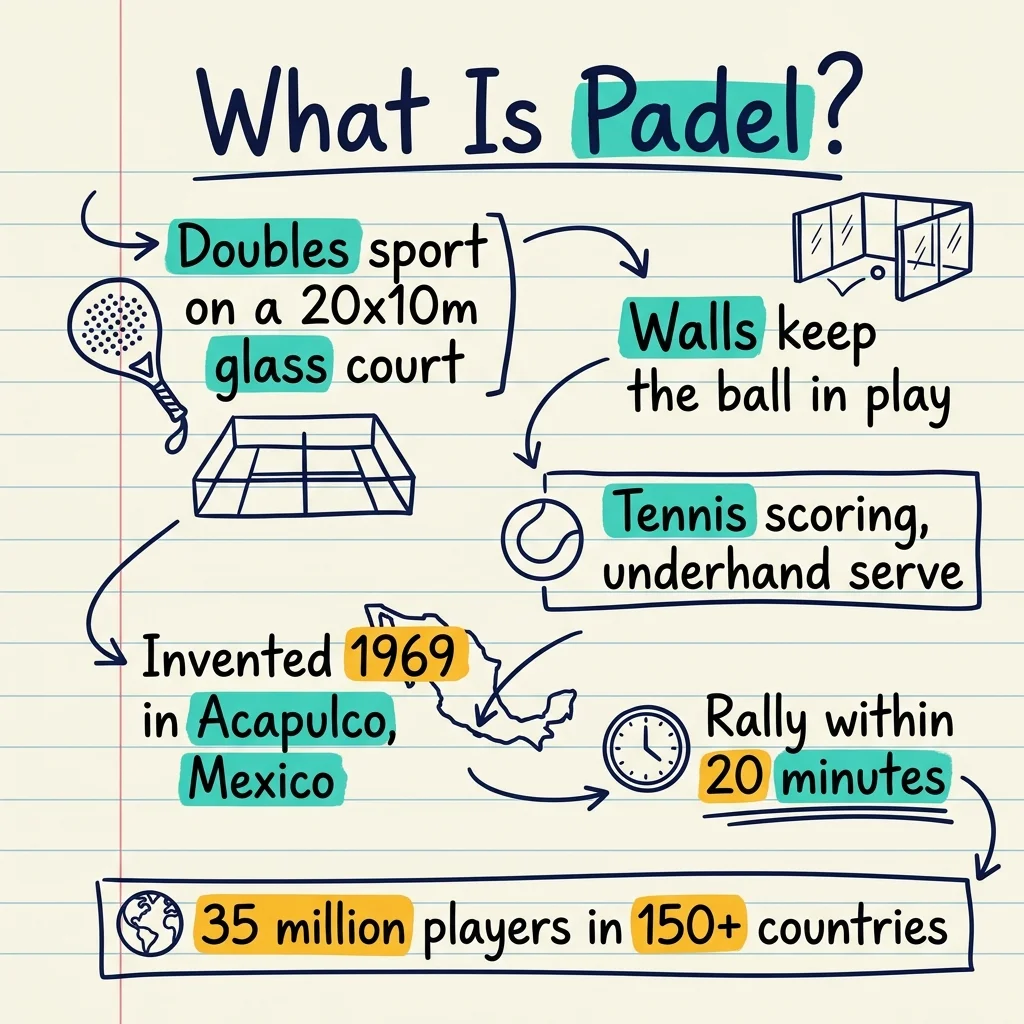
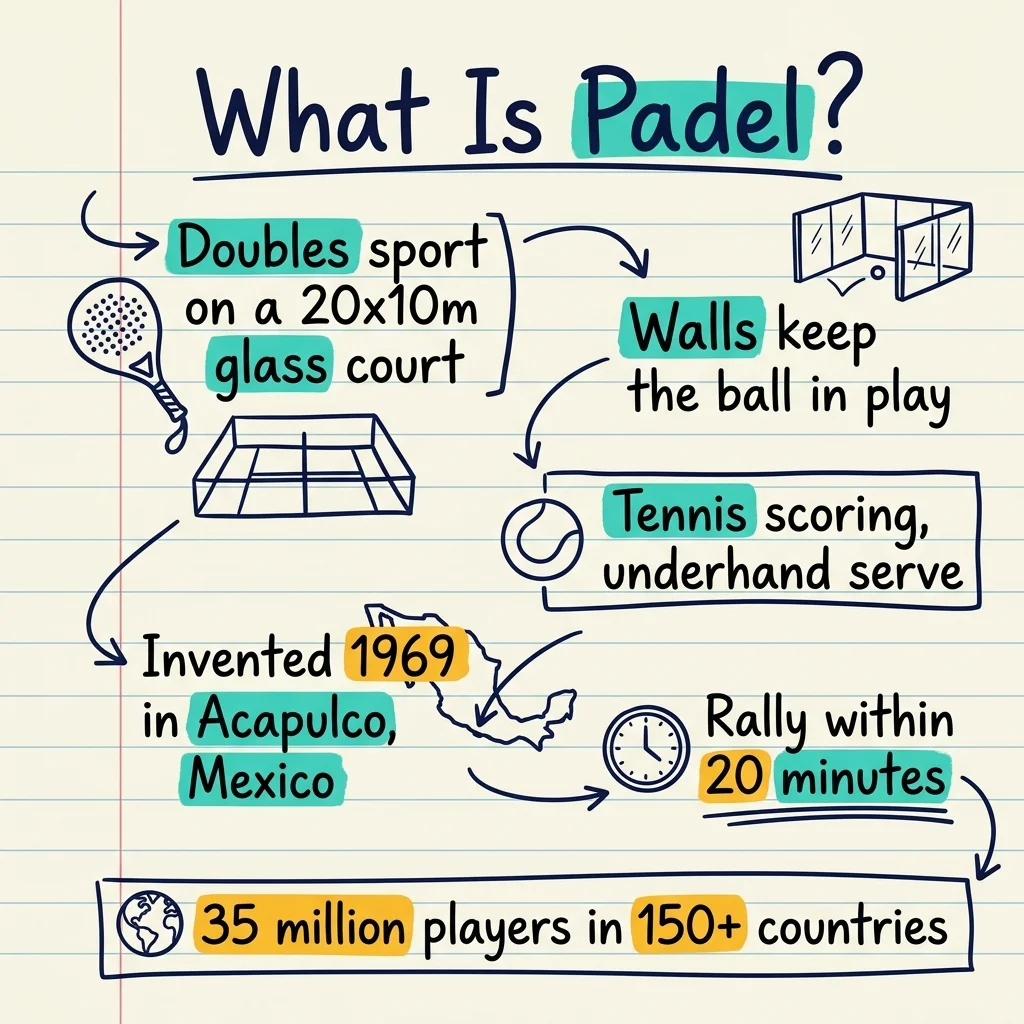
Padel is a doubles racket sport played on an enclosed court about half the size of a tennis court, with glass walls that are part of the game. Scoring works like tennis, the serve is underhand, and the rackets are solid with no strings. Invented in Mexico in 1969, it now has over 35 million players in more than 150 countries — making it the fastest-growing sport in the world.
Last updated: July 2026 · Statistics from FIP and the Padel Global Search Report 2026.
Tennis Meets Squash — With a Twist
Picture a tennis court shrunk to 20 by 10 meters, wrapped in glass and metal mesh. Now imagine the ball bouncing off those walls and staying in play, like squash. That's padel.
Two teams of two face each other across a net. You score exactly like tennis: 15, 30, 40, game. The serve is underhand, hit at waist height or below. And when your opponent smashes the ball past you, it isn't over — you can play it off the back glass and send it back.
That last part changes everything. Walls keep rallies alive, so points in padel run longer than in tennis. Beginners get real exchanges in their first session instead of picking balls out of the net for a month.
How You Play
The rules take about five minutes to learn. The full details are in our beginner's rules guide, but here's the short version:
- Serve underhand, diagonally, after one bounce — the serve rules explained
- The ball must bounce on the ground first before it can touch a wall
- One bounce maximum on your side, then the ball is dead
- Scoring is pure tennis — games, sets, deuce — how padel scoring works
The court itself is standardized worldwide: 20m long, 10m wide, glass back walls, and a net in the middle. We break down every line and measurement in our court dimensions guide.
How does that compare to the sports you already know? We've done the side-by-sides: padel vs tennis and padel vs pickleball.
What You Need to Start
Three things, and two of them are cheap:
- A racket (pala): solid, perforated, no strings. A quality beginner racket costs €50-120 — see our beginner racket guide
- Balls: they look like tennis balls but have slightly less pressure — here's the difference
- Court shoes: grippy soles matter on artificial turf — our shoe guide
Most clubs rent rackets for a few euros, so your first session can cost almost nothing beyond the court fee. Booking usually happens through apps like Playtomic, where courts split four ways.
Where Padel Came From
Padel was born in Acapulco, Mexico, in 1969. A businessman named Enrique Corcuera didn't have room for a full tennis court at his house, so he built a smaller one — 20 by 10 meters. He enclosed it with walls to stop balls escaping into the neighbors' gardens.
His friends took the idea to Spain and Argentina in the 1970s, and both countries fell hard for it. Spain alone built thousands of courts, and for decades padel was a Spanish-speaking secret. Then the 2020s happened.
Why Everyone Is Suddenly Playing
The numbers are hard to ignore. Padel counts over 35 million players across 150+ countries, with more than 77,000 courts worldwide — around 14,000 of them built in 2025 alone. Global search interest grew 49% year over year, according to the Padel Global Search Report 2026.
Three reasons keep coming up:
- It's easy to learn. Most beginners enjoy their first real match within 20 minutes. The underhand serve and forgiving walls remove tennis's brutal learning curve.
- It's social by design. Always doubles, small court, constant chatter. Playing padel with strangers ends with a WhatsApp group — finding partners is easy.
- Famous money moved in. David Beckham and Andy Murray have invested in the sport, and clubs from London to Silicon Valley can't build courts fast enough.
The full breakdown is in why padel is the fastest-growing sport.
The Pro Game
Padel has a professional tour, Premier Padel, run with the International Padel Federation (FIP). The men's world No. 1 is Arturo Coello, a 24-year-old Spaniard who with partner Agustín Tapia has reached 27 consecutive finals as of July 2026. Top pros earn six-figure prize money plus sponsorships — here's what pros actually make.
Watching the pros is the fastest way to understand what padel becomes at the highest level: chess at 100 km/h, played off glass.
Your First Session
Book a court, rent a racket, and bring three friends — or let an app find them. Learn the five rules that matter, skip the classic beginner mistakes, and you'll have real rallies within the hour.
Fair warning: the second session books itself. Nobody plays padel once.
Frequently Asked Questions
Never miss an edition
Weekly Monday issue. 3-minute read. Free. EN + ES.
Related Articles
Padel vs Pickleball: What's the Actual Difference?
Padel and pickleball are not the same sport. Court size, ball, walls, scoring, and player numbers all differ — here's a side-by-side breakdown.
How Does Padel Scoring Work? Points, Games, Sets, and Tiebreaks Explained
Padel scoring uses 15-30-40-game points inside best-of-3 sets with tiebreaks, golden point, and the 2026 star point rule.
Can You Leave the Court in Padel? Out-of-Court Play Explained
Yes — padel players can sprint through the doors and return the ball from outside the cage. Here are the official FIP rules for out-of-court play.