Padel Racket Shapes Explained: Round vs Diamond vs Teardrop
Round, teardrop, or diamond? The shape of your padel racket determines power, control, and sweet spot size. Here's how to pick the right one for your level.
Padel Racket Shapes Explained: Round vs Diamond vs Teardrop
Quick Answer
Your padel racket's shape determines where the sweet spot sits and how head-heavy the racket feels — which directly affects power vs. control. Round rackets have the largest sweet spot and suit beginners. Teardrop rackets balance power and control for intermediate players. Diamond rackets are head-heavy weapons for advanced players who want maximum power on smashes and overheads.
Last updated: March 2026 · Prices and availability verified at time of writing.
When you browse padel rackets, you'll see three numbers in every spec sheet: weight, hardness, and balance. Most people obsess over weight and ignore balance. That's a mistake.
The shape dictates where the balance sits. And balance — not weight — is what determines whether you're holding a precision tool or a battering ram.
Here's what the four shapes actually mean.
Round Shape: The Beginner's Best Friend
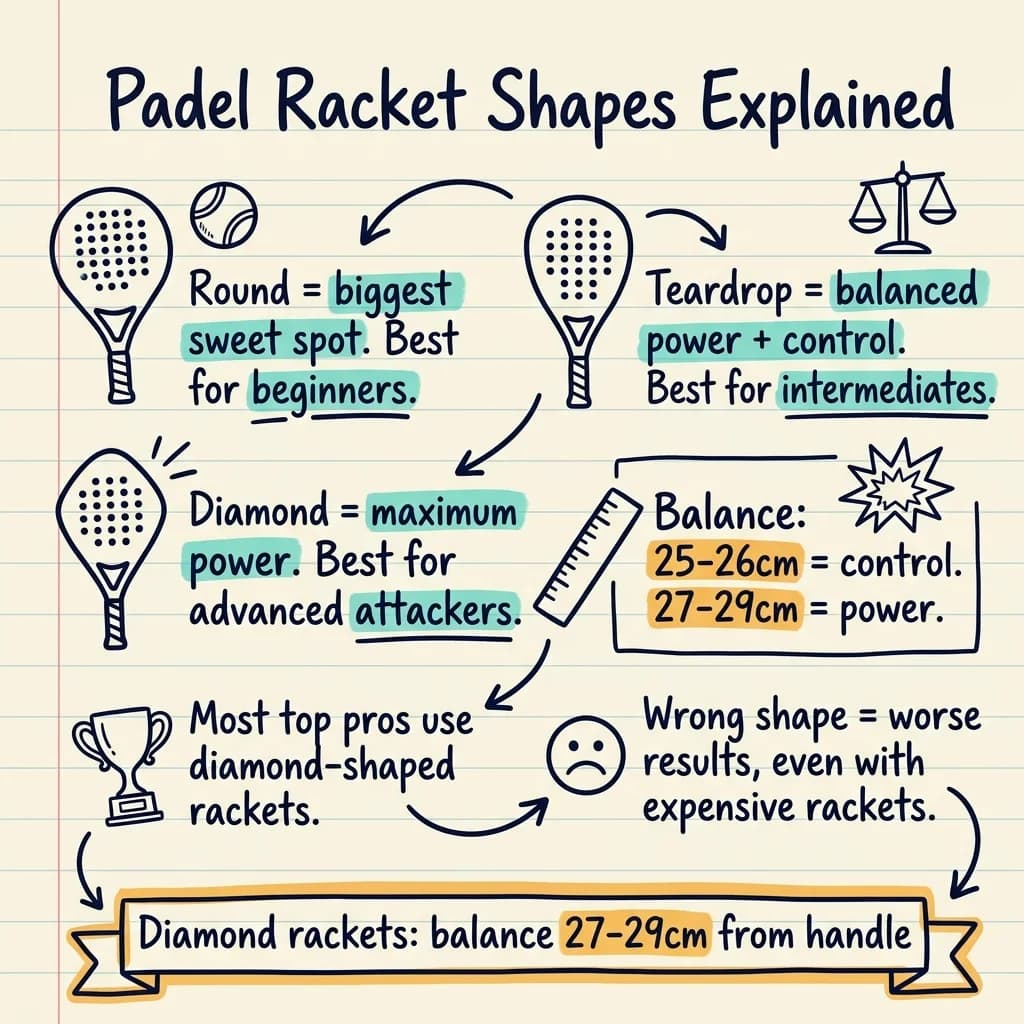
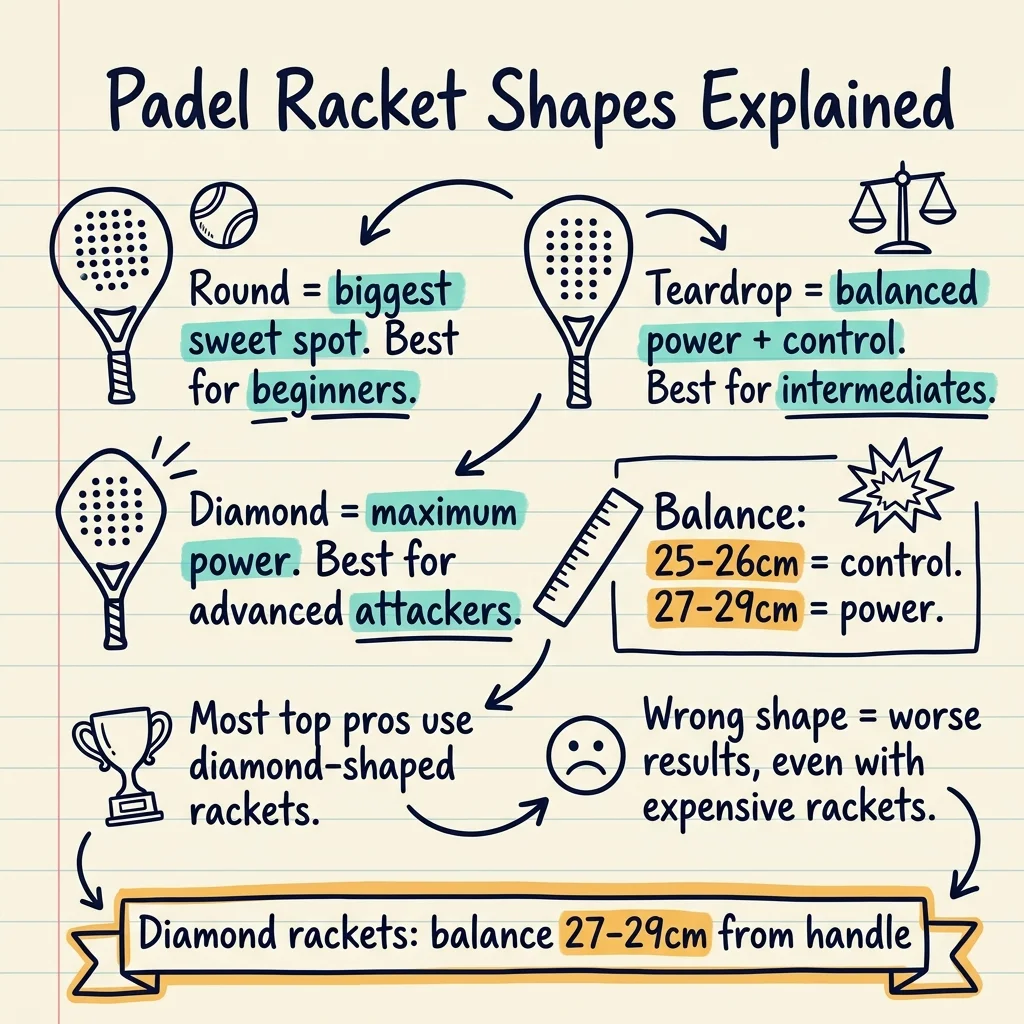
A round padel racket puts the sweet spot dead center on the hitting face. That's the biggest possible sweet spot of any shape.
The payoff: you can mis-hit and still get the ball back cleanly. A ball hit 2-3 centimeters off-center on a round racket still travels roughly where you intended. On a diamond, the same mis-hit generates a weak, uncontrolled response.
Round rackets also carry a low balance point — typically 25-26 centimeters from the handle bottom (per Padel.fyi's spec database). That handle-heavy feel makes them easier to swing quickly for defensive shots and net volleys.
Who should use round:
- Players in their first 1-2 years of padel
- Defensive players who prioritize consistency
- Anyone who gets frustrated when balls fly randomly off the frame
The trade-off is clear: less raw power. You won't put explosive pace on your smashes with a round racket. But if you're not yet generating aggressive overhead opportunities, that rarely matters.
Teardrop Shape: The Intermediate Sweet Spot
The teardrop is the most popular shape among club padel players — and for good reason.
It pushes the sweet spot slightly higher on the face compared to round, which means slightly more leverage and pop when you connect well. Balance typically sits at 26-27 centimeters, somewhere between round and diamond.
You get meaningful power on attacking shots without the punishing forgiveness penalty of a full diamond. Off-center hits feel worse than on a round racket, but not catastrophic.
Who should use teardrop:
- Players with 6+ months of regular play
- All-round players who play both defense and attack
- Anyone stepping up from round who wants more punch
Most padel schools in Spain issue teardrop rackets to their intermediate group. The shape is versatile enough to accommodate different positions on the court without forcing a specialist style.
Diamond Shape: The Attacker's Weapon
Diamond rackets concentrate weight at the top of the frame. Balance runs 27-29 centimeters from the handle — firmly head-heavy.
That weight distribution creates a pendulum effect on overhead smashes. When the ball is above your shoulder and you're looking to finish the point, a diamond puts more momentum behind the shot than any other shape.
The cost: the sweet spot shrinks and moves toward the top of the face. Miss it by 2-3 centimeters and you know immediately — the ball dumps into the net or sails wide with no pace.
Who should use diamond:
- Advanced players (2+ years, playing regularly)
- Players who predominantly attack and finish from the back
- Anyone with solid enough technique to consistently find the sweet spot
Most of the Premier Padel top 10 compete with diamond-shaped rackets. Arturo Coello — currently ranked number one in the world — plays with a diamond Head model. Agustín Tapia's signature Nox AT10 Genius Attack is a diamond with a high balance point specifically engineered for his aggressive smashing game. Juan Lebrón's Babolat Technical Viper is also a diamond, chosen for power and offensive volleys.
This isn't coincidence. At the top level, every player generates enough spin and technique to find the sweet spot consistently — so they optimize for raw power output.
Hybrid Shape: The Best of Both?
Hybrid rackets blend teardrop and diamond geometry. The sweet spot sits higher than a teardrop but lower than a full diamond. Balance is usually around 27 centimeters.
These are popular among competitive club players who attack regularly but don't want to fully commit to a diamond's demands. Adidas uses hybrid geometry in several of their Metalbone variants, which have become some of the best-selling rackets in Spain and the UK.
Who should use hybrid:
- Competitive players who want diamond-adjacent power with more margin for error
- Players transitioning from teardrop to diamond
- Anyone who plays multiple positions in doubles
How to Pick Your Shape
One clean decision tree:
Playing less than 1 year? → Round. Playing 1-3 years, still building technique? → Teardrop. Playing 3+ years, attacking most points? → Diamond or Hybrid. Playing 3+ years, predominantly defensive? → Teardrop or Round.
The biggest mistake recreational players make is buying a diamond because they see it on a pro's rack. Those players hit 300+ balls per week and have trained for years to find that small sweet spot every time. Giving a beginner a diamond is like giving a learner driver a Formula 1 car — theoretically more powerful, practically slower.
Balance Numbers to Know
Since balance determines a lot of the feel:
| Balance | Shape | Feel |
|---|---|---|
| 25-26 cm | Round | Handle-heavy, maximum control |
| 26-27 cm | Teardrop | Neutral, versatile |
| 27-28 cm | Diamond / Hybrid | Head-heavy, power-oriented |
| 28-29 cm | Full Diamond | Very head-heavy, smash specialist |
Most specs are listed on retailer pages like Padel Nuestro, Zona de Pádel, or Padel Kiwi. If the balance isn't listed, the shape is a good proxy: diamond = high balance, round = low balance.
What the Pros Actually Use
A quick snapshot of top Premier Padel players and their racket shapes (2025-2026 season):
- Arturo Coello (#1) → Diamond (Head Coello Pro)
- Agustín Tapia (#2) → Diamond (Nox AT10 Genius Attack)
- Juan Lebrón → Diamond (Babolat Technical Viper)
- Alejandro Galán → Teardrop/Hybrid (Adidas Metalbone)
- Federico Chingotto → Teardrop (Bullpadel Neuron)
The pattern holds: most attackers choose diamond for power output. The handful of players with more defensive or all-round styles often lean teardrop.
The Bottom Line
Shape is the single most consequential decision in racket selection — more than brand, more than frame material, more than price. A €50 round racket in the hands of a beginner will produce better results than a €300 diamond.
Start with round. Move to teardrop when your shots are consistently landing where you intend. Switch to diamond only when you're regularly attacking and finishing points from the back of the court.
Frequently Asked Questions
Never miss an edition
Weekly Monday issue. 3-minute read. Free. EN + ES.
Related Articles
How Long Does a Padel Racket Last? Signs It's Time to Replace
A padel racket lasts 12-24 months of casual play, but as little as 4-9 months if you play five times a week. How to spot a dead core before you buy.
How Heavy Should a Padel Racket Be? Weight Guide by Level
Padel rackets weigh 340-385g. Lighter means faster hands; heavier means more power. Here's how to pick the right weight for your level and playing style.