How Heavy Should a Padel Racket Be? Weight Guide by Level
Padel rackets weigh 340-385g. Lighter means faster hands; heavier means more power. Here's how to pick the right weight for your level and playing style.
How Heavy Should a Padel Racket Be?
Quick Answer
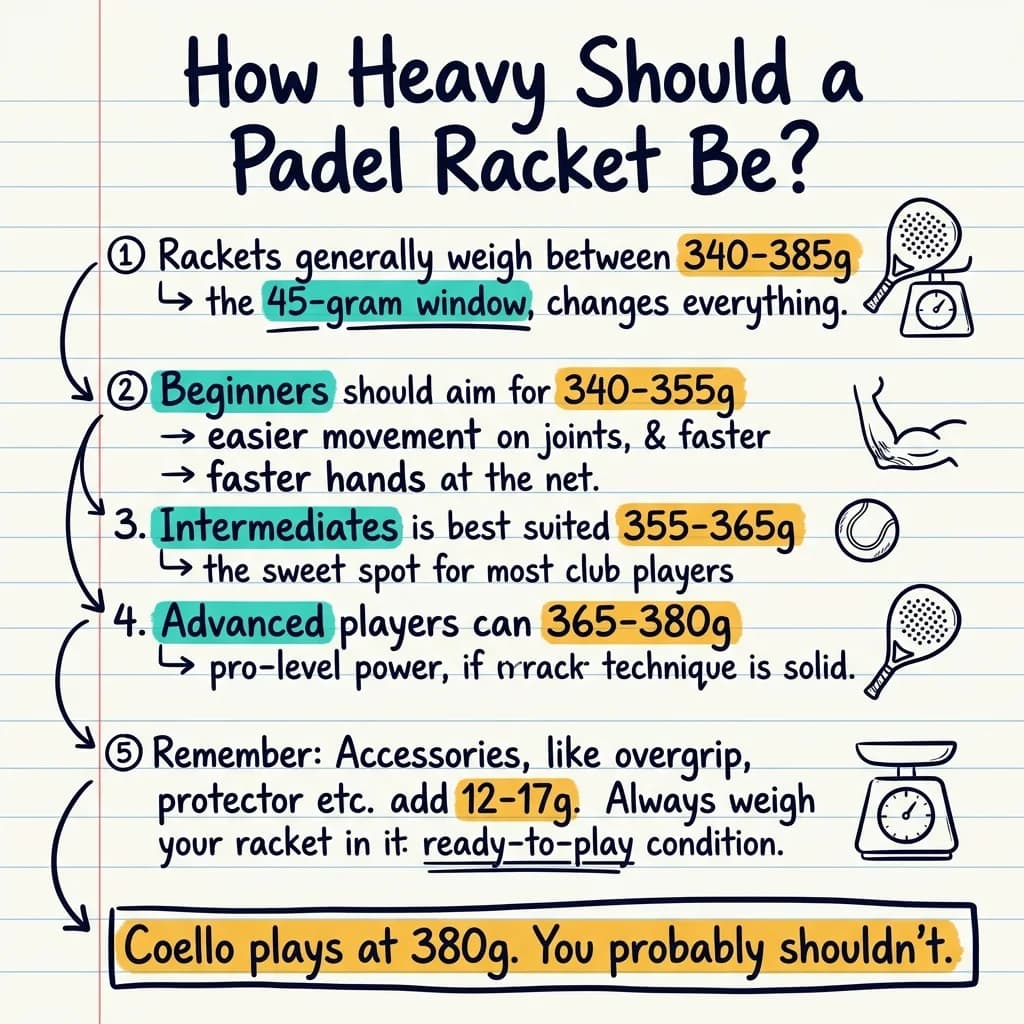
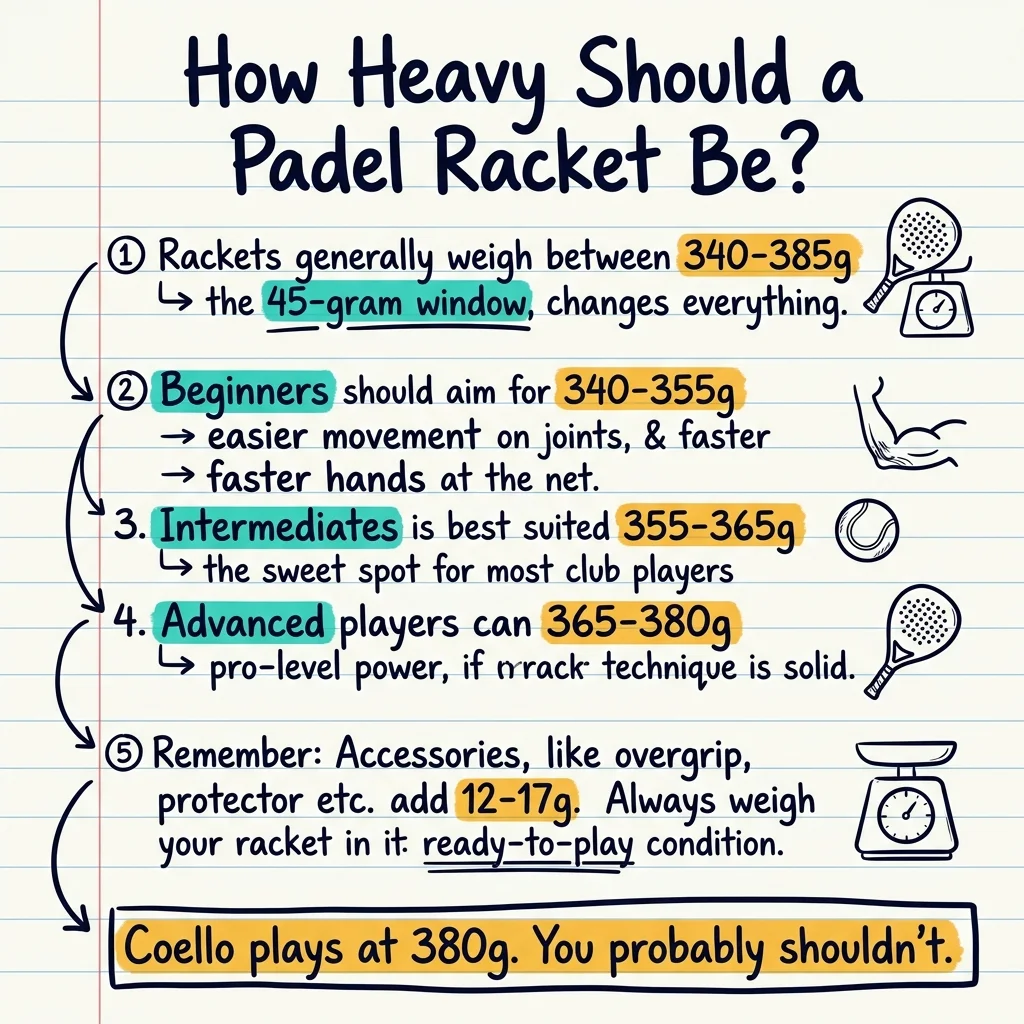
Padel rackets weigh between 340 and 385 grams without accessories. Beginners should stick to 340-355g for easier handling and injury prevention. Intermediate players do well at 355-365g. Advanced players typically go 365-380g for extra power. The right weight depends on your strength, match frequency, and whether you have any joint issues — not on what the pros use.
Last updated: April 2026 · Prices and availability verified at time of writing.
Everyone obsesses over racket shape. Diamond or round? Carbon or fiberglass? But ask most padel coaches what kills a beginner's progress fastest, and the answer is simpler: wrong weight.
A racket that's too heavy slows your reactions at the net. A racket that's too light robs you of power on smashes. And unlike shape — which affects your style — weight affects whether you can play a full match without your elbow screaming afterward.
Here's how weight actually works.
The Weight Spectrum: 340g to 385g
Every padel racket falls into a 45-gram window. That sounds tiny. It isn't.
Hold a 340g racket in one hand and a 380g racket in the other. The difference is obvious after ten seconds. After 90 minutes of match play, it's the difference between fresh hands and dead arms.
Light (340-355g): Fast to swing, easy on the joints. Less raw power. Best for beginners, players with injury history, and anyone who plays 3+ times per week.
Medium (355-365g): The sweet spot for most club players. Enough mass for solid smashes without tiring you out. Decathlon's Kuikma PR 990 series sits at 355-360g, and it's the most popular intermediate racket in Europe for a reason.
Heavy (365-380g): Serious power, serious demands. Your swing speed needs to be high enough to use the extra mass. Most advanced club players and semi-pros land here.
Very heavy (380g+): Pro territory. Arturo Coello plays at roughly 380g total. Few recreational players benefit from this range.
Why Weight Matters More Than You Think
Weight affects three things directly.
1. Swing speed. A lighter racket moves faster through the air. That means quicker volleys at the net and faster reaction time on bandeja shots. The math is simple: if two players swing with equal force, the lighter racket moves faster.
2. Power transfer. A heavier racket transfers more energy to the ball on contact. Physics wins here — more mass at the same speed means more momentum. But the key phrase is "at the same speed." If the extra weight slows your swing, you lose power.
3. Joint stress. Rackets above 365g put measurably more stress on the elbow, wrist, and shoulder. A 2024 analysis by Padel Vibes UK found that heavier rackets (365g+) correlated with higher incidence of tendon injuries in the elbow and muscle injuries in the shoulder. Lighter rackets (350-365g) reduced joint load enough to be recommended for injury-prone players.
Weight by Playing Level
Beginners (0-12 months): 340-355g
Your technique isn't grooved yet. Off-center hits happen constantly. A light racket lets you recover faster between shots and puts less strain on joints that aren't conditioned for padel movements.
Specific options at this weight: the Kuikma PR 530 (345g), Head Coello Vibe 2026 (355g), or Bullpadel Flow (350g).
Intermediate (1-3 years): 355-365g
You're hitting consistently and starting to attack. A bit more mass helps your smashes land with authority. You can handle the extra grams because your technique absorbs vibration better.
The Adidas Metalbone CTRL at 360g is a popular pick here. Head's Coello Motion 2026 also sits at 360g, designed as a more playable version of Coello's pro model.
Advanced (3+ years): 365-380g
You play regularly, your technique is solid, and you want maximum power on your attacking shots. At this level, the extra weight translates directly into harder smashes and more stable volleys.
The Head Coello Pro 2026 sits at 370g out of the box. The Adidas Metalbone HRD+ 2026 — Ale Galán's signature racket — runs at a similar weight with a high balance point that amplifies the head-heavy feel.
The Hidden Weight: Accessories Add Up
Manufacturers list the "naked" weight — no overgrip, no frame protector. But nobody plays naked.
Each accessory adds mass:
- Overgrip: 5-7 grams per wrap
- Frame protector: 7-10 grams
- Lead tape (for customization): 2-5 grams per strip
A 360g racket with one overgrip and a protector becomes 372-377g. That's a jump from "medium" to "heavy" territory. Reddit's r/padel community regularly reports playing weights of 390-400g after accessories on rackets listed at 365g.
Always weigh your racket ready-to-play, not out of the box. A kitchen scale works fine.
Weight vs Balance: The Real Story
Two rackets can weigh 360g and feel completely different. The reason is balance — where that weight sits.
A racket with 360g and a 272mm balance point (like the Head Coello Pro) feels head-heavy and powerful on overhead shots. A racket with 360g and a 255mm balance point feels handle-heavy and whippy at the net.
The Adidas Metalbone 2026 includes a "Weight & Balance System" that lets you move small weights inside the frame to shift balance without changing total weight. This is a growing trend — several 2026 models from Nox and Bullpadel offer similar customization.
Think of weight as the "what" and balance as the "where." Both matter. A heavy racket with low balance can feel lighter than a medium racket with high balance.
Injury Risk: The Weight You Shouldn't Ignore
Padel elbow is the sport's most common overuse injury. And racket weight is one of the main contributors.
The mechanism: a heavy racket that you can't swing fast enough forces your arm to absorb more vibration on every hit. That repeated stress inflames the tendons in your elbow (lateral epicondylitis) and can take weeks or months to heal.
Red flags that your racket is too heavy:
- Elbow soreness after matches that lasts more than 24 hours
- Shoulder fatigue in the second set
- Wrist pain on backhand volleys
- You're compensating by pushing shots instead of swinging through
What to do: Drop 10-15 grams. Remove the frame protector (saves 7-10g immediately). Switch to a lighter model if needed. A 350g racket that you can swing properly will produce better shots — and fewer injuries — than a 375g racket you're muscling through.
What the Pros Use (And Why You Shouldn't Copy Them)
Pro padel players use heavier rackets than recreational players. That's not opinion — it's measurable.
- Arturo Coello (#1, Head): 380g playing weight (370g racket + overgrip). Diamond shape, 272mm balance.
- Alejandro Galán (Adidas): Metalbone HRD+ 2026, diamond shape, high balance. Estimated 375g+ playing weight.
- Head Coello Team 2026 (the "accessible" version): 360g, same shape, softer feel. Designed for advanced club players, not pros.
These players train daily, have physio teams, and generate enough swing speed to use the extra mass. Copying their racket weight without their conditioning is like running a marathon in sprint shoes — wrong tool for your fitness level.
Quick Decision Guide
Pick 340-355g if:
- You're new to padel (under 1 year)
- You play once a week or less
- You have elbow, wrist, or shoulder issues
- You're over 50 or have limited upper body strength
Pick 355-365g if:
- You play 2-3 times per week
- Your shots land where you want most of the time
- You want more punch without sacrificing too much control
- You're injury-free and physically active
Pick 365-380g if:
- You play 3+ times per week and train regularly
- Your technique is consistent enough to find the sweet spot
- You want maximum power on smashes and bandeja
- You have no history of arm or shoulder injuries
When in doubt, go lighter. You can always add an overgrip or protector to gain 10-15 grams. Taking weight off a racket is much harder.
The Bottom Line
Weight is the most practical spec on a padel racket. Shape is about style. Materials are about feel. But weight determines whether you can actually play your best for a full match.
Start light. Move up only when you're sure your body and technique can handle it. Your elbow will thank you.
Frequently Asked Questions
Never miss an edition
Weekly Monday issue. 3-minute read. Free. EN + ES.
Related Articles
Padel Racket Shapes Explained: Round vs Diamond vs Teardrop
Round, teardrop, or diamond? The shape of your padel racket determines power, control, and sweet spot size. Here's how to pick the right one for your level.
How Long Does a Padel Racket Last? Signs It's Time to Replace
A padel racket lasts 12-24 months of casual play, but as little as 4-9 months if you play five times a week. How to spot a dead core before you buy.