Padel vs Pickleball: What's the Actual Difference?
Padel and pickleball are not the same sport. Court size, ball, walls, scoring, and player numbers all differ — here's a side-by-side breakdown.
Quick Answer
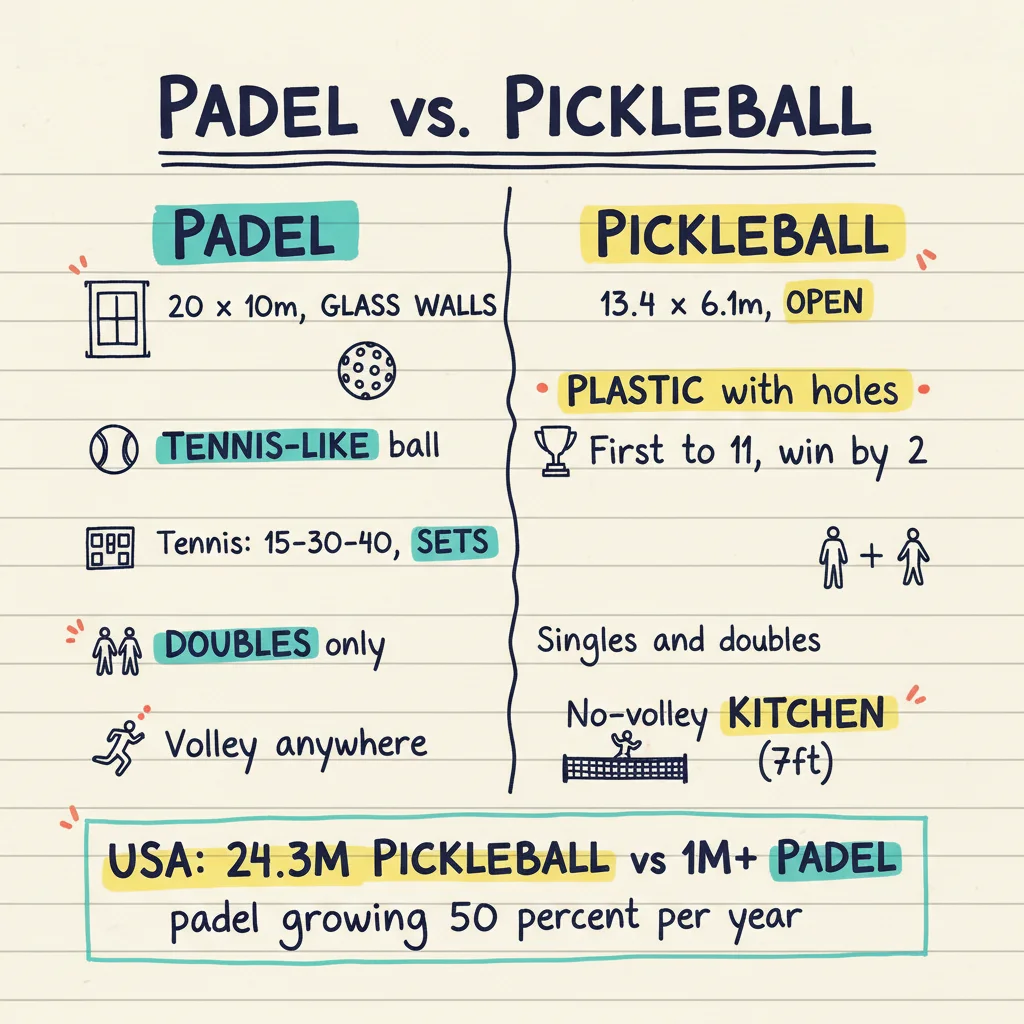
Padel and pickleball look similar from a distance — both use a paddle, both are racquet-style doubles, both grew explosively in the last five years — but they are not the same sport. Padel is played on a 20m × 10m enclosed glass court with a slightly depressurised tennis-like ball, using tennis scoring (sets, games, deuce). Pickleball is played on an open 13.41m × 6.10m court with a perforated plastic ball, scoring to 11 (win by 2), and includes a no-volley "kitchen" zone at the net. Pickleball is huge in the US (24.3 million American players); padel is the global heavyweight (30M+ players in 100+ countries).
Last updated: May 2026 · Court specs and rules verified against USA Pickleball and the FIP Rules of Padel.
The 30-Second Version
| Padel | Pickleball | |
|---|---|---|
| Court size | 20m × 10m, enclosed in glass + mesh | 13.41m × 6.10m, open, no walls |
| Ball | Pressurised, tennis-like | Hard plastic with holes (wiffle-style) |
| Paddle | Solid, perforated, no strings | Solid, perforated, no strings |
| Walls in play | Yes — the ball can bounce off glass | No — out of bounds is out |
| Scoring | Tennis (15/30/40/game, sets) | First to 11, win by 2 (rally scoring growing on the pro tour) |
| Serve | Underhand, must bounce first in service box | Underhand, below waist, diagonal |
| No-volley zone | None | 7-foot "kitchen" each side of the net |
| Format | Almost always doubles | Singles and doubles both common |
| US courts | 1,000+ across 37 states | 18,258 locations |
| US players | 1M+ | 24.3M |
Court — the biggest difference
Padel's defining feature is the cage. The court is enclosed by glass walls at the back, glass + mesh on the sides, and the ball stays in play after it hits any of them. A point can ricochet off three walls and still count. Roughly 25–30% of all padel shots are wall plays — they're the heart of the sport.
Pickleball has no walls. The court is open, painted on hard surface (often a converted tennis or basketball court). Shots that go past the lines are out. This makes pickleball look more like badminton or table tennis: short, sharp rallies, no chasing the ball into the back glass.
Court footprints are also very different. A padel court (20m × 10m = 200m²) is more than two and a half times the size of a pickleball court (13.41m × 6.10m ≈ 82m²). Many US clubs that previously built pickleball courts in 2022–2023 are now adding padel because the higher revenue per booking (4 players, 90-minute sessions) justifies the larger footprint.
The ball changes everything
Pickleball uses a hard plastic ball with 26 or 40 holes — basically a wiffle ball. It moves slower than a padel ball and bounces lower, which is why pickleball games stay close to the net and feature lots of "dinks" (soft drop shots into the kitchen).
Padel uses a pressurised ball nearly identical to a tennis ball — slightly smaller, slightly less internal pressure. It comes off the strings of a padel paddle (actually solid foam, no strings, but the racket face has a similar trampoline effect) at real tennis speeds. Pro padel smashes regularly exceed 200 km/h.
This is also why padel feels physically closer to tennis than pickleball does. If you've played tennis before, padel's bounce and pace feel familiar. Pickleball will feel deliberately slower.
Scoring — tennis vs ping-pong logic
Padel scoring is identical to tennis. Points go 15, 30, 40, game. Six games win a set (with a tiebreak at 6–6 or sometimes a "Golden Point" sudden death at deuce — depends on the league). Best of three sets. A typical padel match runs 60–90 minutes.
Pickleball scoring is closer to table tennis. Games go to 11, win by 2. Traditionally only the serving team can score (side-out scoring), but the PPA Tour and World Pickleball League adopted rally scoring (any team can score on any rally) for most 2025+ pro events, and recreational players are split between formats. Pickleball matches typically last 15–25 minutes per game.
The "kitchen" — pickleball's signature rule
The 7-foot zone in front of each side of the pickleball net is called the non-volley zone (NVZ) or "kitchen". You cannot volley the ball — hit it out of the air — while any part of your body or paddle is touching the kitchen line or inside the zone. This forces the soft, tactical "dink rally" that defines pickleball at every level.
Padel has nothing equivalent. You can volley anywhere on the court, including pressed right up against the net. The wall is what slows the game down, not a no-volley rule.
Serves are similar — but not the same
Both sports serve underhand. That's basically the only similarity.
Padel serve:
- Bounce the ball, hit it below waist height
- Must land in the diagonal service box on the opponent's side
- Two attempts (like tennis)
- The ball can be hit straight or after one bounce, depending on your style
Pickleball serve:
- Hit the ball below waist height, paddle moving in an upward arc
- The serve must clear the kitchen and land in the diagonal service box
- One attempt (no second serve)
- The two-bounce rule applies: the serve must bounce on the receiver's side AND the return must bounce on the server's side before either team can volley
The numbers — who's winning the race?
Pickleball owns the US. 24.3 million Americans played pickleball in 2025 — up 22.8% from 2024 — and the average player is now 34.8 years old, no longer the retirees-only stereotype. There are 18,258 court locations across the US, with another 2,300+ added in 2025 alone. Pickleball has been America's fastest-growing sport for five straight years, with participation up 311% from 2021 to 2025.
Padel owns the rest of the world. Globally, there are over 30 million padel players across 100+ countries, with around 70,000 courts projected by 2026. Padel grew from a niche Spanish/Argentine sport into the dominant racquet sport across Europe and Latin America. Spain alone has over 15,000 courts; Italy added more than 6,000 between 2020 and 2025.
The US is the contested market. Padel passed 1,000 courts across 37 states in April 2026, with Florida holding 41% of them, Texas 18%, California 10%, and New York 4.7%. Active US padel players are over 1 million, with club growth running at 51.5% year-over-year. If the USPA's projections hold, the US will have 30,000 padel courts and 10 million players by 2030 — putting it on a collision course with pickleball.
Which should you play?
If you're in the US and want to start hitting tomorrow, pickleball wins on convenience — courts are everywhere, equipment is cheap (~$30 paddle, $5 balls), and you can learn the basics in one session. The barrier to entry is the lowest in racquet sports.
If you want a sport that rewards strategy, footwork, and tennis-like rallies, padel is the deeper game. Walls turn every defensive position into a counter-attacking opportunity, and the doubles-only format makes it inherently social. The catch in the US right now: courts are still scarce in most metros outside Florida, Texas, and New York.
The honest answer: try both. They're not substitutes — they're complementary sports played by overlapping audiences. Most US players who pick up padel today already play pickleball, and vice versa.
Frequently Asked Questions
Never miss an edition
Weekly Monday issue. 3-minute read. Free. EN + ES.
Related Articles
What Is Padel? The Sport Everyone Is Playing, Explained
Padel explained in plain language: how it works, why the walls matter, what you need to play, and why 35 million people are hooked.
How Does Padel Scoring Work? Points, Games, Sets, and Tiebreaks Explained
Padel scoring uses 15-30-40-game points inside best-of-3 sets with tiebreaks, golden point, and the 2026 star point rule.
Can You Leave the Court in Padel? Out-of-Court Play Explained
Yes — padel players can sprint through the doors and return the ball from outside the cage. Here are the official FIP rules for out-of-court play.