How Does Padel Scoring Work? Points, Games, Sets, and Tiebreaks Explained
Padel scoring uses 15-30-40-game points inside best-of-3 sets with tiebreaks, golden point, and the 2026 star point rule.
Quick Answer
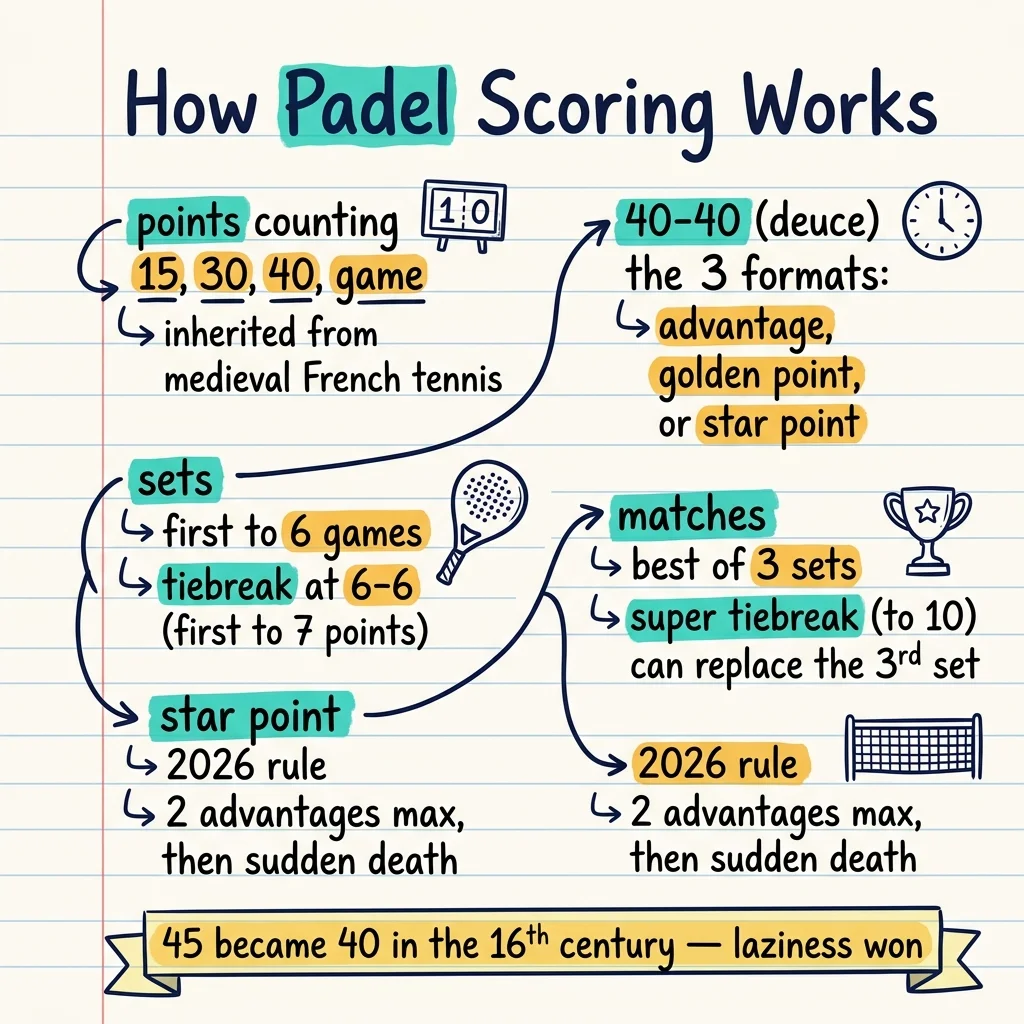
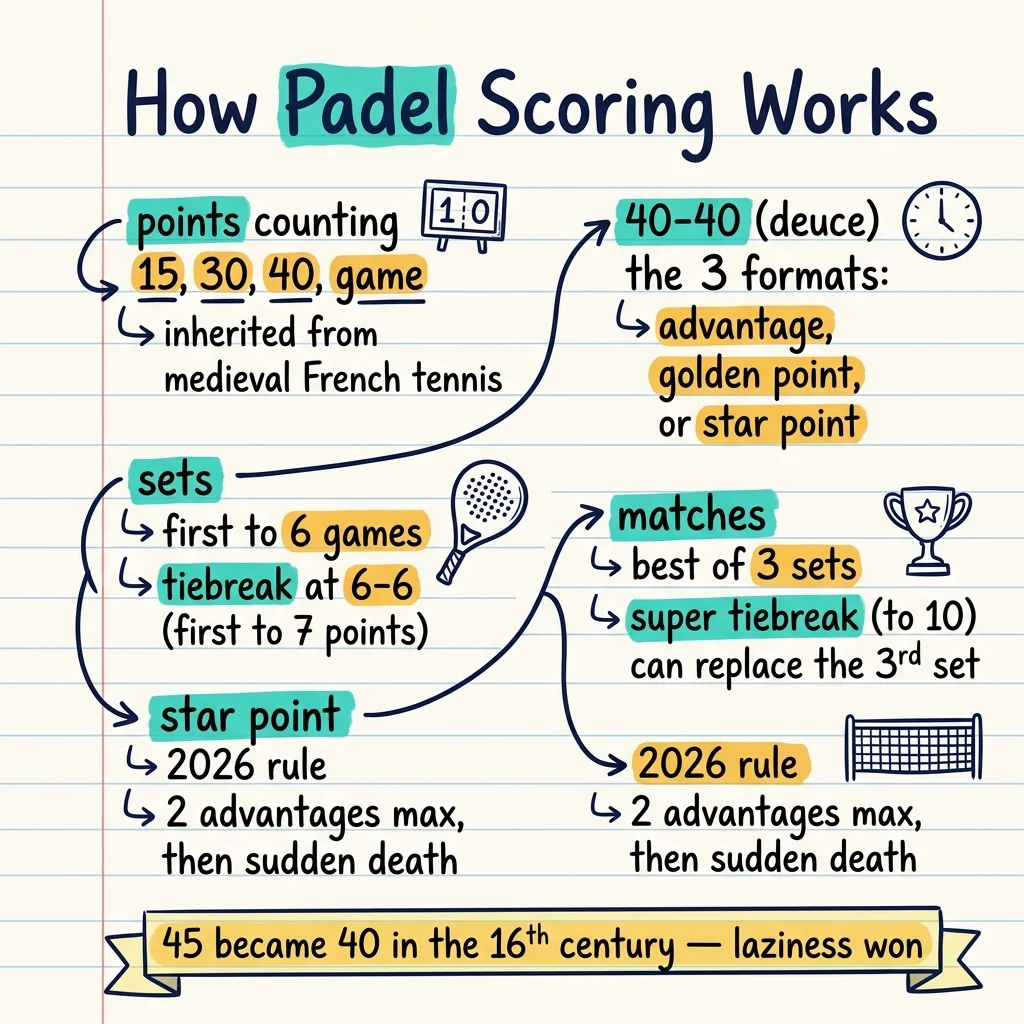
Padel scoring follows the tennis system: points count 15, 30, 40, game. Win 6 games (with a 2-game lead) to take a set, and win 2 out of 3 sets to win the match. At 40-40, the deuce format depends on the competition — traditional advantage, golden point (one sudden-death point), or the 2026 star point rule (up to 2 advantages, then sudden death). At 6-6 in a set, a 7-point tiebreak decides it. Some formats replace the third set with a super tiebreak to 10 points.
Last updated: April 2026 · Rules verified against FIP official regulations.
The 15-30-40 System: Why Not Just 1-2-3?
Padel borrowed its scoring from tennis. Tennis borrowed it from medieval French real tennis (jeu de paume), where players moved forward on a 60-foot court in 15-foot increments after each point.
The original sequence was 15, 30, 45. Somewhere around the 16th century, French players shortened 45 to 40. The most accepted reason? Pronunciation. "Quarante-cinq" (45) has three syllables. "Quarante" (40) has two. Laziness won.
So: 0 (love), 15, 30, 40, game. Four points win a game — unless the score reaches 40-40.
What Happens at Deuce (40-40)?
This is where padel gets interesting. Three systems exist, and which one you play depends on the competition.
Traditional Advantage
Both teams reach 40-40. The next point gives one team "advantage." If the team with advantage wins the next point, they take the game. If they lose it, the score resets to deuce. This can go on for a long time — 15, 20, even 30+ points in extreme cases.
Golden Point (Punto de Oro)
At 40-40, one single point decides the game. No advantage, no reset. The receiving team chooses which side to receive on. Golden point was the standard in the World Padel Tour and early Premier Padel events. It's fast, dramatic, and punishes conservative play at deuce.
Star Point (2026 Rule)
Premier Padel introduced the star point rule in 2026. It works as a middle ground: teams play up to 2 advantages at deuce. If the score is still tied after those 2 advantages, the next point is sudden death — like golden point. This keeps matches moving but gives teams a chance to earn the game on their own terms.
Games, Sets, and Match
Winning a Game
Score 4 points (15, 30, 40, game) with a lead based on the deuce format in play. The server stays the same for the entire game.
Winning a Set
Win 6 games with at least a 2-game lead. If the score reaches 5-5, a team needs to win 7-5. At 6-6, the set goes to a tiebreak.
The Tiebreak (at 6-6)
A tiebreak is first to 7 points, win by 2. Points count 1, 2, 3, 4 (normal numbers, not 15-30-40). The serve rotates: the first server hits one point, then each team alternates every 2 points. Teams switch ends every 6 points.
Winning the Match
Win 2 out of 3 sets. In most professional padel (Premier Padel, FIP events), all three sets are played in full if needed.
The Super Tiebreak: When There's No Third Set
In club play, amateur tournaments, and some professional formats, the third set is replaced by a super tiebreak. Instead of playing a full set, teams play a single tiebreak to 10 points, win by 2.
The FIP officially recognizes the super tiebreak (also called "match tiebreak") as an alternative format under Rule 1. It keeps match length predictable — a full 3-set padel match can run 90 minutes or more, but a super tiebreak wraps up in 10-15 minutes.
Serve rotation follows the same pattern as a regular tiebreak: one point for the first server, then 2 points each. Switch ends every 6 points.
Serve Rotation: Who Serves When?
At the start of the match, a coin toss or draw decides. The winning team chooses to serve or receive. The other team picks their side.
Each team decides its own serve order at the start of each set. Player A might serve first, Player B second — but that order stays fixed for the entire set. The pattern alternates between teams: Team 1 Player A → Team 2 Player A → Team 1 Player B → Team 2 Player B → repeat.
After each odd-numbered game (1, 3, 5...), teams switch ends.
Scoring in Practice: A Quick Example
Game starts. Server's team scores: 15-0. Receiving team scores: 15-15. Server's team scores twice: 40-15. Server's team scores again: game.
Set continues. The team that received now serves the next game. At 6-4, the leading team wins the set.
Second set: the losing team fights back, wins 6-3. Score is now 1 set each.
Third set (with super tiebreak): instead of a full set, teams play to 10 points. Score reaches 9-8. The leading team scores: 10-8. Match over.
Which Format Will You Play?
| Format | Deuce Rule | Third Set | Where Used |
|---|---|---|---|
| Traditional | Advantage (unlimited) | Full set | Club play, some national leagues |
| Golden point | Sudden death at 40-40 | Full set or super tiebreak | World Padel Tour (legacy) |
| Star point | 2 advantages then sudden death | Full set | Premier Padel 2026 |
| Time-limited | Golden point | Super tiebreak to 10 | Amateur tournaments, Americano format |
Most club-level padel uses golden point with a super tiebreak for the third set. If you're playing a casual match, agree on the format before the first serve.
Frequently Asked Questions
Never miss an edition
Weekly Monday issue. 3-minute read. Free. EN + ES.
Related Articles
What Is the Star Point in Padel? The New 2026 Scoring Rule Explained
The Star Point system caps deuce games at 2 advantages before a sudden-death point. Here's how it works in 2026.
How Long Does a Padel Match Last?
Padel matches last 60-90 minutes on average — here's what determines whether yours wraps up fast or drags into a third set.
Padel Rules for Beginners: Everything You Need to Know
The complete guide to padel rules — scoring, serving, walls, and everything a new player needs to step on court with confidence.