Best Padel Rackets for Beginners in 2026
Our picks for the best beginner padel rackets in 2026 — what to look for, what to avoid, and 5 rackets that'll get you started right.
Why Your First Racket Actually Matters
Here's what nobody tells beginners: a bad racket will actively teach you bad habits. Pick something too heavy, too head-heavy, or too stiff, and you'll compensate with poor technique that takes months to unlearn. Get this right from the start.
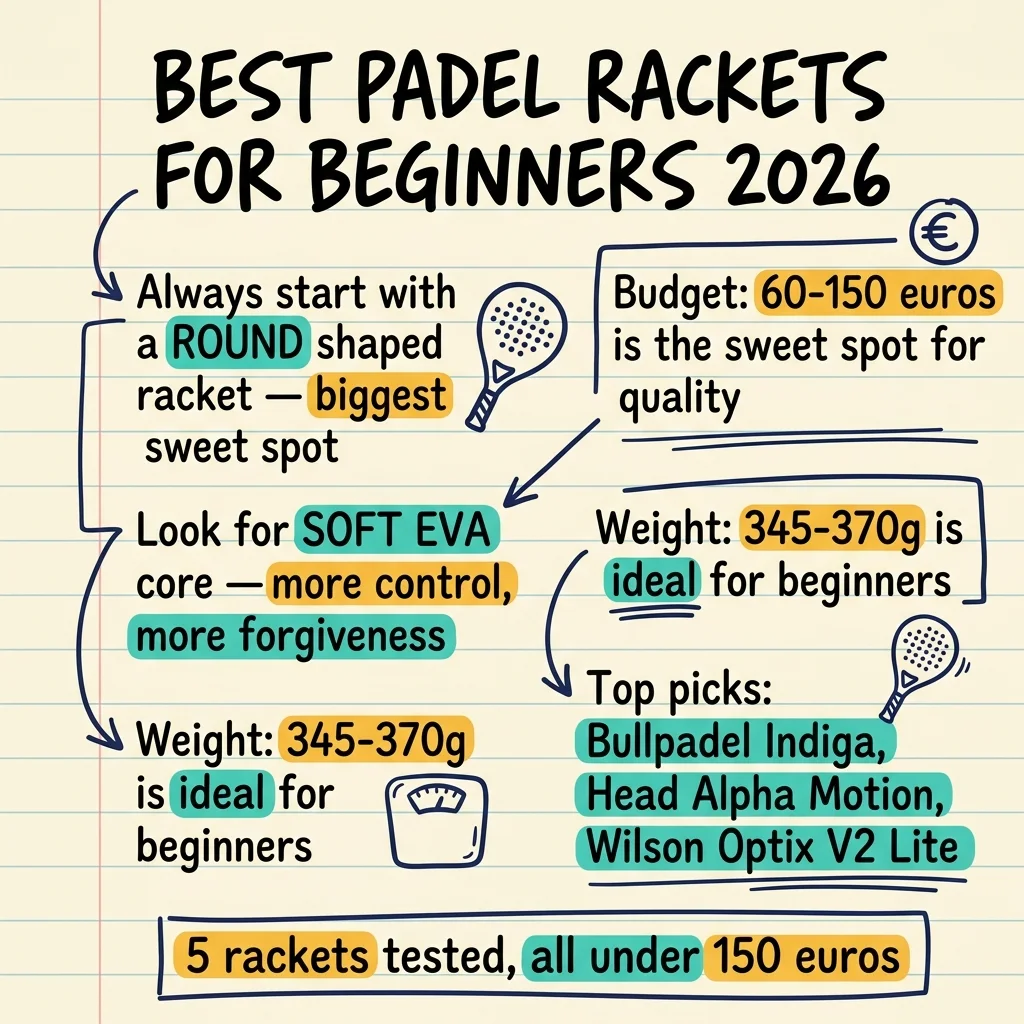
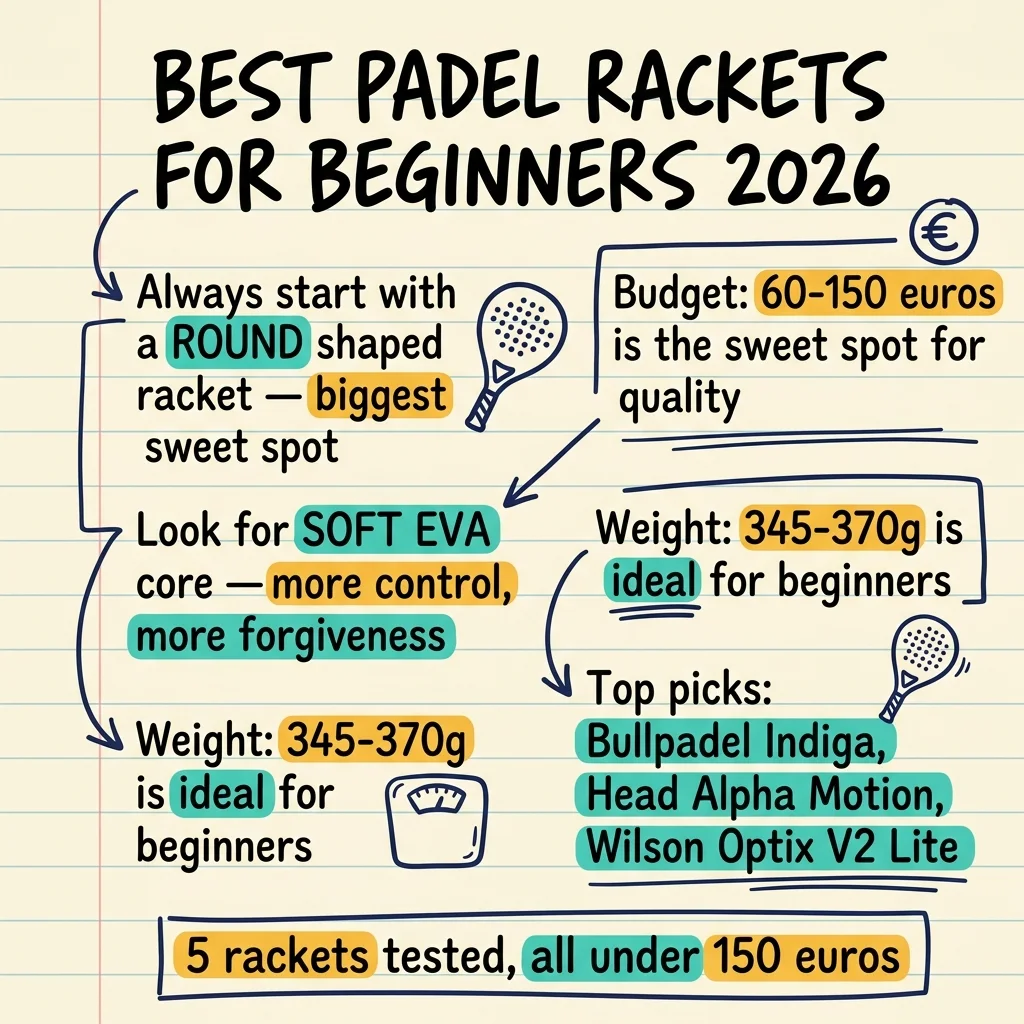
The good news? You don't need to spend a fortune. The best beginner rackets in 2026 sit between €60 and €150, and some of them are genuinely excellent.
What to Look For (The Non-Negotiables)
Before we get to specific models, here's the checklist every beginner should use:
Shape: Round
Round rackets have a centered sweet spot and low balance point, meaning the weight sits closer to the grip. This gives you more control, faster reactions at the net, and a bigger margin for off-center hits. Diamond and teardrop shapes are for intermediate and advanced players chasing power — you're not there yet, and that's fine.
Weight: 345–370g
Heavier rackets generate more power but fatigue your arm faster and are harder to maneuver. Lighter rackets are easier to handle but can feel unstable on hard shots. The sweet range for most adult beginners is 345–370g. If you're smaller-framed or coming from zero sports background, lean toward the lighter end.
Core: Soft EVA
The core material determines how the racket feels when you hit the ball. Soft EVA gives you a forgiving, comfortable feel with good control. Medium EVA adds a touch more power. FOAM cores are bouncier and more powerful but harder to control. Start soft — you can always move to harder cores later.
Surface: Fiberglass or Composite
Carbon fiber faces are stiffer and more powerful — and more expensive. Fiberglass and composite surfaces offer a softer touch that's more forgiving for beginners. They also cost less. Win-win for a first racket.
Our 5 Picks for 2026
1. Bullpadel Indiga CTR 2026 — Best Overall for Beginners
Price: ~€85–100 | Shape: Round | Weight: ~355g | Core: EVA Soft
The Indiga CTR is Bullpadel's purpose-built beginner weapon, and it nails the brief. Round shape, low balance, ultralight construction, and a Polyglass surface that delivers a massive sweet spot. Control is exceptional — rated 7.4/10 in independent reviews — and the soft EVA core means your arm won't scream after a two-hour session.
If you're buying one racket and want the safest choice, this is it.
2. Head Alpha Motion — Best Budget Option
Price: ~€80 | Shape: Round | Weight: ~360g | Core: EVA
Head's Alpha Motion has been a beginner staple for good reason. It's comfortable, forgiving, and does nothing wrong. The round shape and medium weight make it easy to handle, and the price point is hard to argue with. Not the flashiest choice, but it gets the fundamentals right.
3. Wilson Optix V2 Lite 2026 — Lightest and Most Forgiving
Price: ~€100–140 | Shape: Round | Weight: ~340g | Core: EVA Soft
Wilson's 2026 entry is specifically designed for new players. At around 340g, it's the lightest on this list — perfect if you've never played a racket sport before or want something ultra-easy to swing. The oversized sweet spot makes off-center hits feel decent instead of terrible, and the soft core keeps everything comfortable. Available in multiple colors, which shouldn't matter but somehow always does.
4. Adidas RX Series 2026 — Best Value for Money
Price: ~€70–90 | Shape: Round | Weight: ~360g | Core: EVA Soft
The Adidas RX Series punches well above its price tag. Under €100, you get a round shape, soft EVA core, and Structural Power reinforcements that add stability without adding stiffness. It's marketed toward intermediate players, but the forgiving feel and control make it equally suitable for beginners who want a racket they won't outgrow in three months.
5. Kuikma PR Metal Control 2026 — Best from Decathlon
Price: ~€50–70 | Shape: Round | Weight: ~355g | Core: EVA
If you're shopping at Decathlon — and in Europe, why wouldn't you — the Kuikma PR Metal Control is the standout. It's the most affordable racket on this list without feeling cheap. The soft feel, generous sweet spot, and low balance check every beginner box. It's a brilliant "I'm not sure if I'll stick with padel" racket that won't hold you back if you do.
What to Avoid
A few common beginner traps:
- Diamond-shaped rackets. They're built for power players with solid technique. You'll mishit constantly and get frustrated.
- Pro player signature models. The Bela or Lebron rackets look cool, but they're designed for world-class players with world-class swings. They'll feel terrible in beginner hands.
- Anything under €40. Below this price point, quality drops fast — poor cores, flimsy frames, and rough surfaces that wear out in weeks.
- Buying online without checking weight. Manufacturer weights can vary ±10g from the listed spec. If possible, hold the racket in a store before buying.
When to Upgrade
You'll know it's time when you start feeling limited by your racket rather than your technique. Typically that's 6–12 months of regular play (2–3 times per week). Signs you're ready: you're consistently hitting the sweet spot, you want more power on smashes, or you're moving toward a more attacking play style.
When that happens, consider stepping up to a teardrop shape with a medium EVA core — but that's a guide for another day.
The Bottom Line
Your first padel racket should be round, lightweight, soft, and forgiving. Spend €60–150, pick any of the five rackets above, and focus your energy on getting on court and playing. The racket matters, but not as much as the hours you put in with it.
Frequently Asked Questions
Never miss an edition
Weekly Monday issue. 3-minute read. Free. EN + ES.
Related Articles
Best Padel Rackets for Intermediate Players in 2026
The best intermediate padel rackets of 2026 by use case: all-round control, power, spin, sweet spot, budget, and a premium frame that grows with you.
Pádel Shoes: What Makes Them Different? A Complete Guide
Pádel shoes have herringbone soles, reinforced lateral support, and are built for artificial grass — not hard courts. Here's what to look for.
How to Take Care of Your Padel Racket (and Make It Last)
A practical guide to padel racket care: how to clean it, where to store it, how to protect the frame, when to change the overgrip, and when the racket is done.