Pádel Shoes: What Makes Them Different? A Complete Guide
Pádel shoes have herringbone soles, reinforced lateral support, and are built for artificial grass — not hard courts. Here's what to look for.
Quick Answer
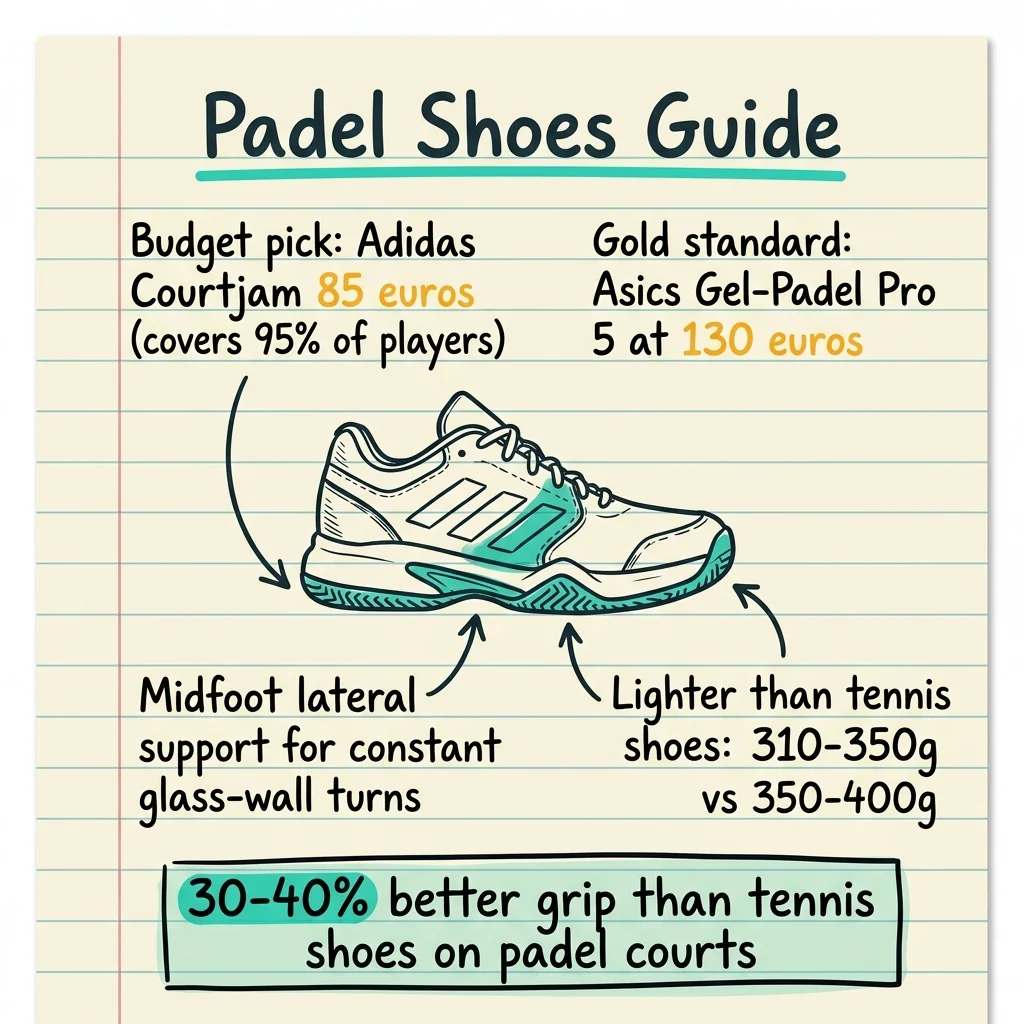
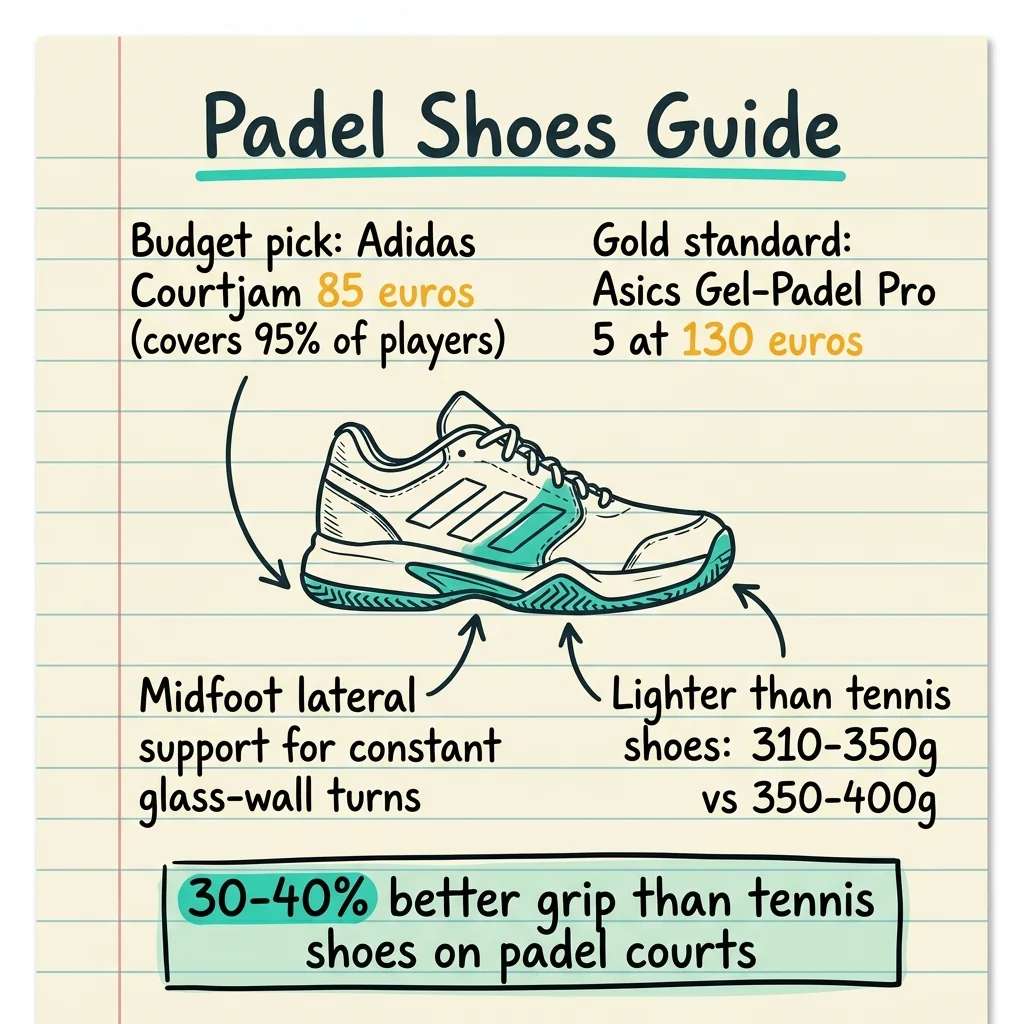
Pádel shoes are built for artificial grass with sand infill — not hard courts. The herringbone sole grips sand-filled turf while allowing controlled slides. Lateral support reinforces the midfoot for rotational movements (you turn toward the glass constantly). They're lighter than tennis shoes (310-350g vs 350-400g). Entry point: Adidas Courtjam Bounce at 85 euros covers 95% of recreational players. Gold standard: Asics Gel-Padel Pro 5 at 130 euros.
Last updated: March 2026 · Sourced from Wilson, Novor, The Padel School, PadelShop.com, and Padel USA.
Why Pádel Shoes Exist
Pádel is played on artificial grass filled with sand. Tennis is played on hard courts, clay, or natural grass. Different surfaces need different shoes.
Tennis shoes on a pádel court = not enough grip. You'll slip on sharp turns. Running shoes on a pádel court = no lateral support. Your ankles take the hit.
Pádel shoes solve both problems with three key features.
Feature 1: The Herringbone Sole
The zigzag tread pattern on the bottom. It's called herringbone because it looks like a fish skeleton.
On sand-filled artificial grass, herringbone provides grip when you need it and sliding when you want it. Push off hard and it grips. Slide into a wide shot and it lets you move. That balance is the whole point.
Three sole types:
- Herringbone — the standard. Best for indoor and most outdoor courts. 80% of players use this.
- Omni — small circular studs. More grip, less slide. Better for wet outdoor courts.
- Hybrid — herringbone in front, omni in back. Compromise for all conditions.
For most players: herringbone. It's the default for a reason.
Feature 2: Lateral Support in the Midfoot
In pádel, you rotate toward the glass walls constantly. Turn, hit, recover, turn again. The stress is on the midfoot bridge — the arch between heel and toes.
Pádel shoes reinforce this area with a rigid plate or Speedtruss system (Asics). It prevents twisting while keeping the forefoot flexible for quick steps.
Tennis shoes put lateral support in the side walls instead, because tennis movement is more side-to-side across a baseline. Different movement pattern, different reinforcement.
Feature 3: Weight
Pádel shoes average 310-350 grams. Tennis shoes average 350-400 grams. That 50-gram difference adds up over a match with hundreds of small, explosive movements.
The Babolat Jet Premura 3, the lightest pádel shoe in 2026, weighs just 305 grams. It uses a Matryx Micro upper to cut weight without sacrificing structure.
Best Pádel Shoes in 2026
| Shoe | Price | Weight | Best For |
|---|---|---|---|
| Adidas Courtjam Bounce | €85 | 340g | Budget pick — covers 95% of recreational players |
| Asics Gel-Padel Pro 5 | €130 | 330g | Gold standard — best overall for serious players |
| Babolat Jet Premura 3 | €160 | 305g | Speed and agility — lightest shoe on the market |
| Asics Gel Resolution X | €150 | 350g | Maximum stability — best for heavy players or ankle issues |
Can You Use Tennis Shoes?
For your first session? Sure. Long term? No. Tennis shoes give you about 30-40% less grip on artificial grass. The lateral support is in the wrong place. And they're heavier.
If you're going to play pádel more than twice a month, get pádel shoes. The Adidas Courtjam at 85 euros is a small investment that makes a real difference.
Frequently Asked Questions
Never miss an edition
Weekly Monday issue. 3-minute read. Free. EN + ES.
Related Articles
The Most Popular Padel Balls of 2026
The padel balls people actually play with in 2026 — the tour ball, the club favorites, and the budget pick — with what each one is best for.
Best Padel Rackets for Beginners in 2026
Our picks for the best beginner padel rackets in 2026 — what to look for, what to avoid, and 5 rackets that'll get you started right.
Best Padel Rackets for Intermediate Players in 2026
The best intermediate padel rackets of 2026 by use case: all-round control, power, spin, sweet spot, budget, and a premium frame that grows with you.
Related Newsletter Editions
Nike enters padel?
Nike's Swoosh appeared on padel rackets at Drake's NOCTA Manor. Three rumors, no official statement. Plus: the biggest week ever for padel in US business media.
Nike Is Coming for Padel — and They Want Tapia
Nike plans to enter padel in 2027 with world #1 Agustín Tapia as their target star. QSI champions women's padel at the UN. Reserve Cup Marbella makes history with first women's competition. Paquito Navarro admits his game is becoming obsolete.