Padel Rules for Beginners: Everything You Need to Know
The complete guide to padel rules — scoring, serving, walls, and everything a new player needs to step on court with confidence.
What Is Padel?
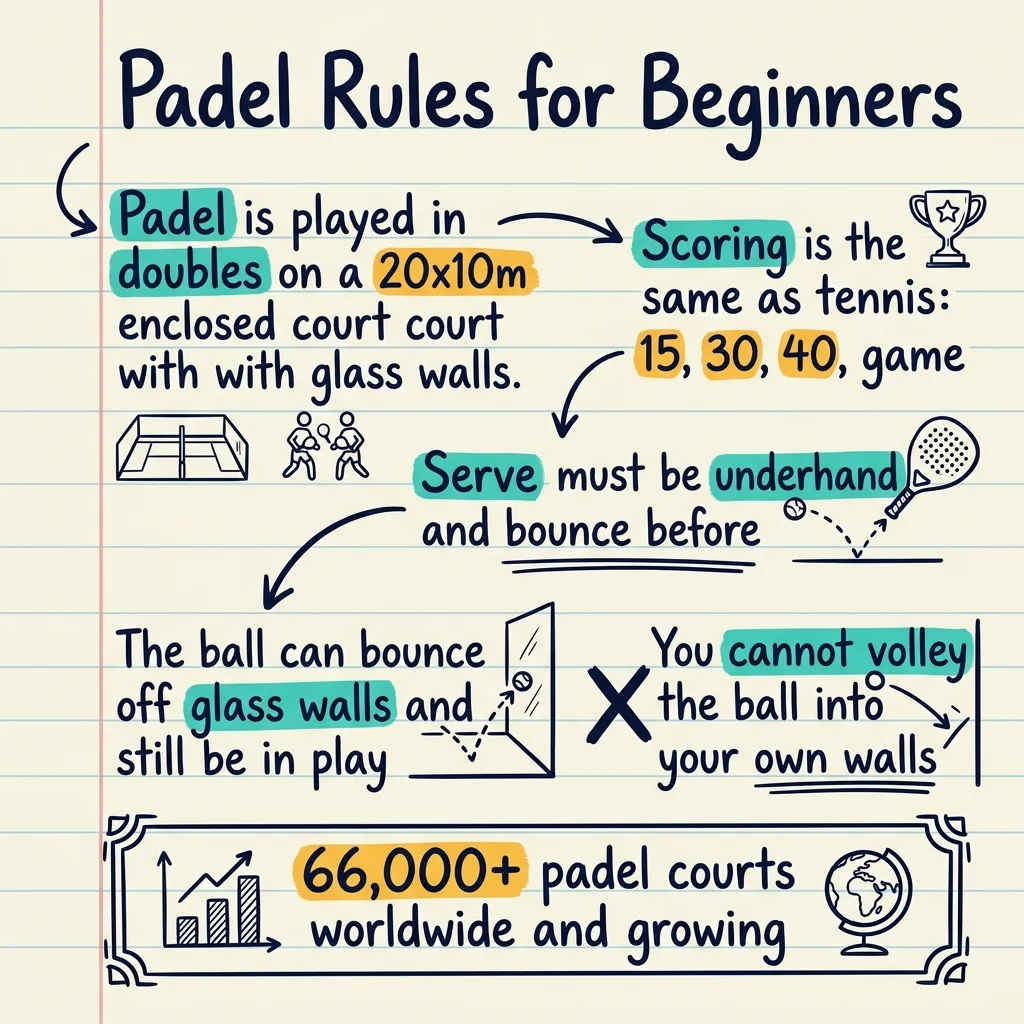
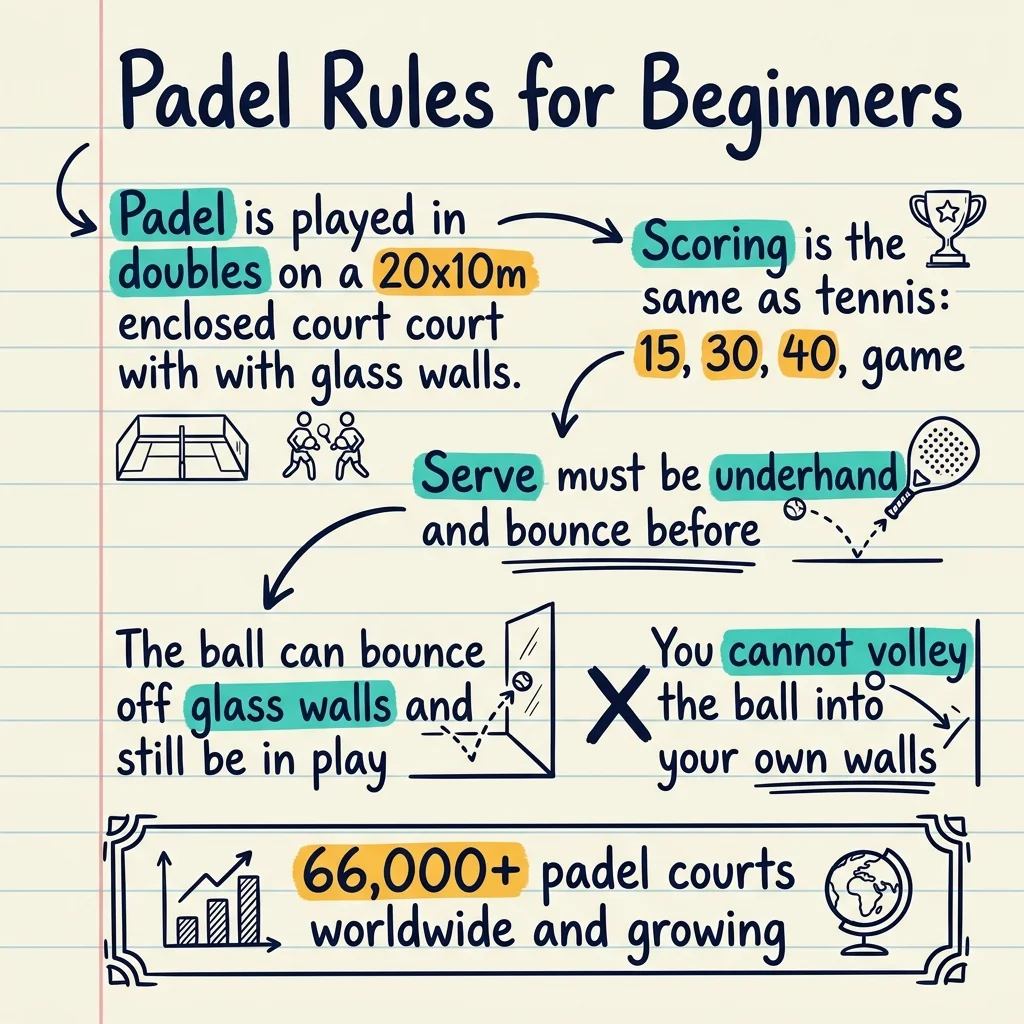
Padel is a racket sport that combines elements of tennis and squash. It's played on an enclosed court about one-third the size of a tennis court, with walls made of glass and metal mesh that are part of the playing field. The sport is almost always played in doubles.
Born in Mexico in 1969, padel has exploded globally — it's the fastest-growing sport in Europe and is rapidly gaining ground in the United States, Middle East, and Asia.
The Court
A padel court measures 20 meters long by 10 meters wide. The net divides the court in half, sitting at 88cm in the center and 92cm at the posts. The court is enclosed by walls — the back wall is typically 3 meters of glass topped by 1 meter of mesh, while the side walls combine glass and mesh sections.
The service boxes work similarly to tennis, with a service line 6.95 meters from the net.
Scoring
Padel uses identical scoring to tennis:
- Points: 15, 30, 40, game
- Deuce: At 40-40, a team must win by two points (or "golden point" in some formats)
- Sets: First to 6 games wins the set, with a tiebreak at 6-6
- Match: Best of 3 sets
The Serve
The serve in padel must be underhand. The ball must bounce behind the service line before being struck below waist height. The serve goes diagonally to the opponent's service box, and the ball must bounce in the box before hitting the back wall. If it bounces and hits the side wall before crossing the service line — it's a fault.
Each server gets two attempts, just like tennis.
Wall Play — The Unique Element
This is what makes padel special. After the ball bounces on the ground, it can hit any wall and still be returned. Players regularly retrieve balls off the back glass, creating spectacular rallies. You can even exit through the side door to play a ball that's bounced out of the court.
Key wall rules:
- The ball must bounce on the ground before hitting a wall (on the receiving side)
- You cannot volley the ball into a wall on your own side
- If the ball hits the mesh/fence above the glass on your opponent's side after your shot, it's out
Starting to Play
The best way to learn padel is to rent a court with three friends and hit around. The underhand serve makes it accessible from day one, and the smaller court means you're in the action immediately. Most padel clubs offer beginner clinics and will match you with players at your level.
Welcome to the fastest-growing sport in the world.
Frequently Asked Questions
Never miss an edition
Weekly Monday issue. 3-minute read. Free. EN + ES.
Related Articles
How Does Padel Scoring Work? Points, Games, Sets, and Tiebreaks Explained
Padel scoring uses 15-30-40-game points inside best-of-3 sets with tiebreaks, golden point, and the 2026 star point rule.
How Long Does a Padel Match Last?
Padel matches last 60-90 minutes on average — here's what determines whether yours wraps up fast or drags into a third set.
How to Serve in Padel: Rules, Technique, and 2026 Changes
Master the padel serve — underhand technique, placement tactics, slice vs flat, and the new 2026 FIP serve rules explained.