How Long Does a Padel Racket Last? Signs It's Time to Replace
A padel racket lasts 12-24 months of casual play, but as little as 4-9 months if you play five times a week. How to spot a dead core before you buy.
How Long Does a Padel Racket Last?
Quick Answer
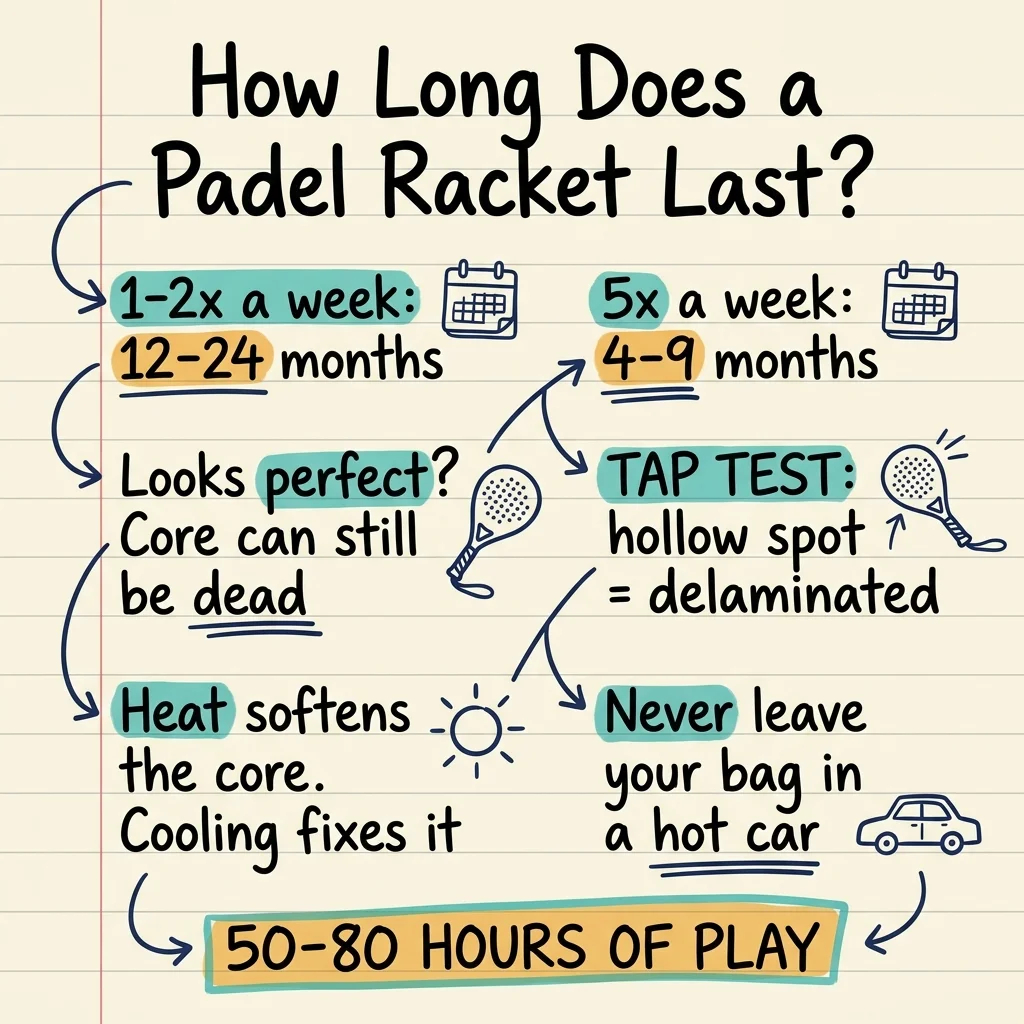
A padel racket lasts 12-24 months if you play once or twice a week. Three or four sessions a week cuts that to 9-18 months, and five or more brings it down to 4-9. In playing time that is roughly 50-80 hours of competitive padel. The frame almost always outlives the EVA foam core, which loses its elasticity through repeated compression and gives no external warning. Before you replace anything, rule out heat: foam softens in high temperatures and firms back up when it cools.
Last updated: July 2026 · Prices and availability verified at time of writing.
Ask five padel shops how long a pala lasts and you will get five different answers. That is not a conspiracy to sell you rackets. It is because the honest answer depends on how hard you hit, how often you play, and what temperature you play in.
August is when most people buy. It is also when rackets feel their worst, for a reason almost nobody explains.
Here is how to tell a genuinely dead racket from one having a bad month.
The Real Numbers, by How Often You Play
Playing frequency matters far more than the date on the receipt.
- Once or twice a week: 12-24 months
- Three or four times a week: 9-18 months
- Five or more times a week: 4-9 months
- Competitive, near-daily play: 6 months or less
Be aware that published figures vary a lot. All For Padel puts casual players at 10-14 months. Padel Scout says 18-24 months for the same usage. That gap tells you something useful: nobody is measuring this in a lab, so treat any single number as a rough guide.
Hour counts are more honest than months. Padel Scout estimates a racket is done after 50-80 hours of competitive play, or around 10,000 hits. Past that point the EVA core starts to rupture at a microscopic level.
Your style shifts the number too. A player who smashes everything burns through a core faster than someone who plays chiquitas and lobs all afternoon.
Why Palas Die and Tennis Rackets Don't
This is the bit that catches people coming from tennis.
A tennis racket is a hollow frame strung with replaceable string. The frame lasts years. When performance drops you restring it and carry on.
A pala has no strings. The hitting surface is a solid face bonded to a foam core, usually EVA. That foam does the job strings do in tennis: absorb the impact and return energy to the ball.
Here is the catch. String springs back. Foam does not. Every smash and every volley leaves the EVA a fraction flatter, and after a few thousand impacts the core is softer than new.
So a pala has an expiry date and a tennis racket effectively does not. There is no equivalent of restringing.
"It's Not Cracked" Is Not a Health Test
This is the part that costs people money, in both directions.
The EVA foam inside your racket degrades through repeated compression. Every ball you hit squashes it slightly, and eventually it stops springing back. According to All For Padel, the signs are unusual vibration, loss of power, less control and a dull feeling on impact.
None of that is visible. A racket can look showroom-fresh with a completely flat core.
Watch for four things:
- Power drop. Balls that used to reach the back cristal now land short.
- Control drop. The ball leaves the face unpredictably, especially on volleys.
- More vibration. Your forearm aches after 15 minutes when it never used to.
- A changed sound. A healthy face gives a sharp crack. A dead one thuds.
That last one is the most reliable, and it is free.
The Tap Test: Two Seconds, No Tools
There is one genuine diagnostic you can run in the car park before a match.
Tap a knuckle lightly across the whole face of the racket. In the words of ELPADEL's guide: "A consistent tone means the face is intact. A hollow or noticeably different-sounding spot reveals a delaminated area."
Work in a grid. Centre, then out toward each edge. A single dull patch means the carbon has separated from the foam underneath, and that patch will only spread.
The Heat Trap: Why Your Racket "Died" in July
Now the part that saves you a purchase.
EVA foam is thermally sensitive. Heat makes the material expand and soften, and a softer core sends the ball off the face faster with less control. Nox describes exactly this in its own guidance. In hot conditions the materials soften, the ball flies out more, and the game gets faster and harder to control.
So a racket that felt crisp and precise in March can feel soft and vague by late July. That is the core reacting to temperature, not the core dying.
Cold does the reverse. Materials harden, the ball comes off the face with less pop, and the sweet spot shrinks. ELPADEL warns that playing below 10°C makes face materials brittle.
Two practical consequences:
Do not judge a racket during a heatwave. Give it a cooler week before you decide it is finished. If the crispness returns in September, your core was fine all along.
Stop leaving your bag in the car. A boot in summer is the single worst place to store a pala, and that damage does not reverse when it cools. Nox sells thermal-lined bags for exactly this reason, and any insulated bag does the same job.
What's Repairable and What Isn't
Worth knowing before you pay anyone to fix something.
Terminal — replace the racket:
- Cracks in the frame or face, especially any crack running between the holes
- Delamination (that hollow spot from the tap test)
- A collapsed foam core
- Rattling debris inside the frame
No adhesive or patch restores the structural properties of a frame or a foam core. A repaired crack is a crack that will reopen.
Cosmetic — fix it for under €15:
- Worn overgrip
- Missing or shredded edge protector, which ELPADEL suggests replacing every 2-3 months for frequent players
- Scuffed paint
The edge protector is the highest-value €8 in padel. It takes the wall and floor scrapes that would otherwise reach the frame.
How to Make It Last Longer
None of this is exotic, and all of it works.
- Keep it out of the heat. No car boots, no sun-baked benches between matches.
- Use a cover. A thermal section is better, a sleeve is fine.
- Fit an edge protector and replace it when it wears through.
- Stop scraping the floor when you dig out low balls. The frame takes the damage.
- Rotate two rackets if you play four or more times a week. Two rackets alternated last longer than one played into the ground, and you get a spare when one cracks mid-match.
When Replacing Is Actually the Right Call
Sometimes the racket really is finished, and sometimes it was never right for you.
Replace it if you have put 50-80 hours of real play through it and the tap test finds a dull patch. Replace it if the power loss survives a cool week. Both mean the core is gone.
Also replace it if your game has moved past the racket. Maybe you bought a round, low-balance beginner pala 18 months ago and now hit a proper bandeja. That is an upgrade decision, not a repair decision. Our racket shape and weight guides cover what to move to, and the intermediate racket picks are the usual next step.
One thing not to do: copy a pro. They replace rackets every few weeks because sponsors send them free, not because the foam gives out that fast.
The Bottom Line
Most club players get 12-24 months out of a pala. Most of the ones who think theirs died in August are feeling the weather instead.
Run the tap test. Wait for a cooler week. If the power still is not there, the core has gone and no amount of tape brings it back.
And keep the bag out of the car. That habit alone buys you months.

Frequently Asked Questions
Never miss an edition
Weekly Monday issue. 3-minute read. Free. EN + ES.
Related Articles
Padel Racket Shapes Explained: Round vs Diamond vs Teardrop
Round, teardrop, or diamond? The shape of your padel racket determines power, control, and sweet spot size. Here's how to pick the right one for your level.
How Heavy Should a Padel Racket Be? Weight Guide by Level
Padel rackets weigh 340-385g. Lighter means faster hands; heavier means more power. Here's how to pick the right weight for your level and playing style.