How to Serve in Padel: Rules, Technique, and 2026 Changes
Master the padel serve — underhand technique, placement tactics, slice vs flat, and the new 2026 FIP serve rules explained.
Quick Answer
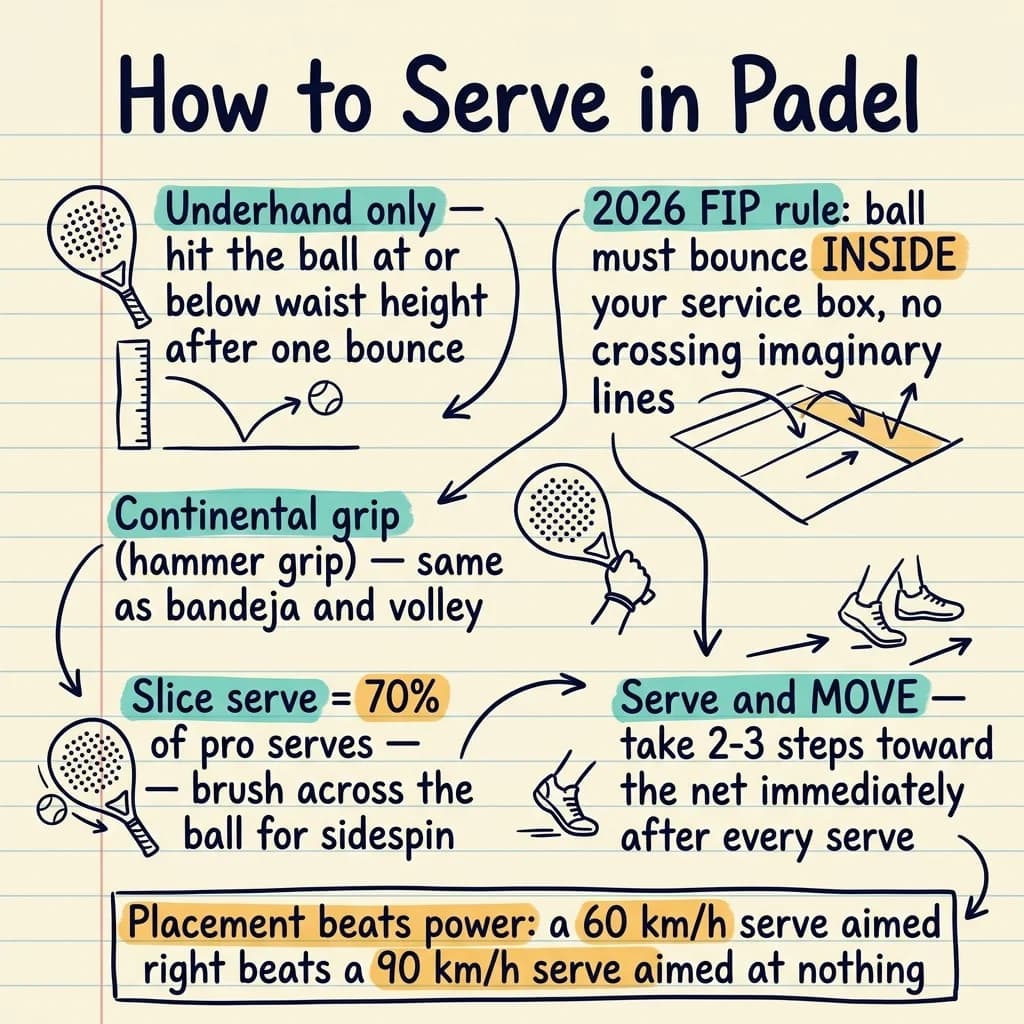
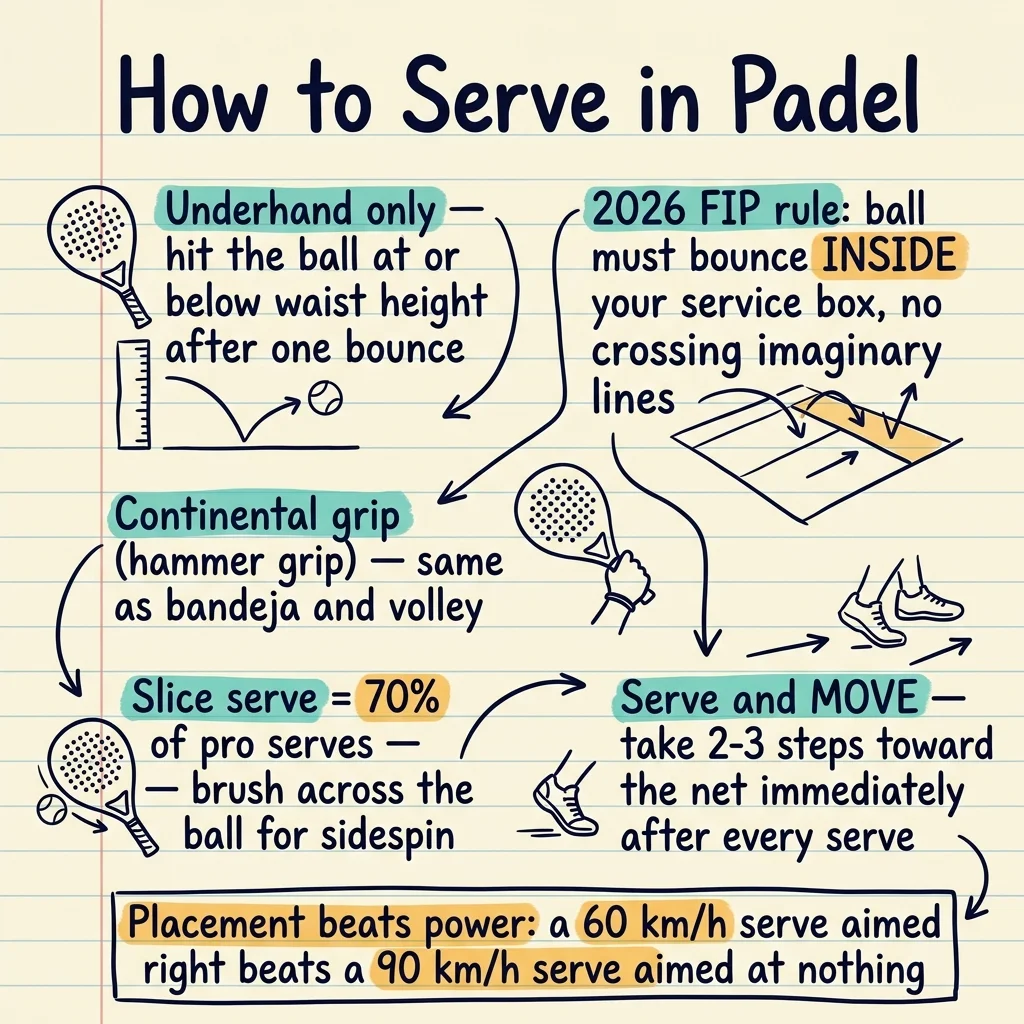
The padel serve is always underhand — you bounce the ball once and hit it at or below waist height. It must land in the diagonal service box. You get two attempts per point. In 2026, the FIP tightened the rules: the ball must now bounce inside your own service box and cannot cross any line (including imaginary extensions) before contact. The serve isn't about power — it's about placement, spin, and getting to the net fast.
Last updated: March 2026 · Rules verified against the FIP 2026 regulations effective January 1, 2026.
The Basic Rules of Serving in Padel
Padel's serve looks nothing like tennis. There's no ball toss, no overhead motion, no 200 km/h bombs. Here's what the FIP rulebook requires:
- Underhand only. Contact must happen at or below waist height.
- Bounce first. Drop the ball and let it bounce once before striking.
- Both feet behind the service line. At least one foot must stay on the ground until contact.
- Diagonal target. The ball must land in the opposite service box.
- Two attempts. First serve fault? You get another. Two faults? Point lost.
The serve alternates between partners each game, and you switch service boxes each point — just like tennis.
What Changed in the 2026 FIP Rules
The FIP updated Article 6 of its rulebook, effective January 1, 2026. The key change targets where the ball can bounce before you strike it.
The new rule: The ball must bounce within your corresponding service box. It cannot cross the service line or the center line — including their imaginary extensions — before you make contact.
Why it matters: Before 2026, some players bounced the ball slightly forward of the service line or past the center line "in the air." That's now a fault. The FIP wants cleaner, more standardized serves and easier calls for referees.
The catch: Enforcing imaginary lines is tricky. A referee in the center chair has a poor angle on whether the ball crossed an invisible boundary at match speed. Expect debates.
These rules apply across Premier Padel, CUPRA FIP Tour, FIP Promises, and FIP Beyond events in 2026.
Serve Technique: Step by Step
Grip: Continental
Use the continental grip — the same one you'd use for a bandeja or a volley. Place the V between your thumb and index finger on top of the handle. This gives you control on flat serves and enough wrist freedom for slice.
Stance: Sideways, Balanced
Stand behind the service line with your non-dominant shoulder facing the net. Feet shoulder-width apart, knees soft. Your front foot points toward the diagonal service box.
The Bounce
Drop the ball gently in front of your body. Let it bounce once — don't throw it, don't flick it. The bounce should land close to your body and slightly ahead of your lead foot.
Under the 2026 rules, keep the bounce well inside your service box. Give yourself a margin from the lines.
The Strike
Swing like a pendulum. Your racket starts behind your hip, swings forward, and makes contact at or below waist height. The motion is smooth and compact. Don't try to muscle the ball.
Contact point: slightly in front of your body, around belt-buckle height. Hit through the ball for flat serves. Brush across it for slice.
The Follow-Up
Serve and move. The instant you strike, take 2-3 quick steps toward the net. In doubles padel, the serving team starts at a disadvantage — you're at the baseline, your opponents own the net. Every serve should be followed by forward movement.
Three Serve Types Every Player Needs
1. Flat Serve — The Foundation
Hit with a neutral racket face, straight through the ball. Low spin, clean contact, predictable bounce.
Use it for: Consistency under pressure. Targeting corners with precision. Setting up your net approach.
2. Slice Serve — The Weapon
Brush the racket across the ball from high-right to low-left (right-handers). The sidespin makes the ball curve in flight and skip low after bouncing.
Use it for: Pulling receivers wide. Hitting the side glass for unpredictable bounces. Forcing defensive returns.
Pro players use slice on roughly 70% of their serves. It's the bread-and-butter serve at every level above beginner.
3. Body Serve — The Disruptor
Aim at the receiver's belt buckle — right between their forehand and backhand. It jams their swing and limits their return options.
Use it for: Breaking a returner's rhythm. Disrupting aggressive opponents who like to move early.
Placement Beats Power
In padel, a 60 km/h serve aimed at the right spot beats a 90 km/h serve aimed at nothing. Here's where to put it:
Deep to the back glass. A serve that bounces and carries into the back glass forces the receiver to play an awkward return off the glass. This is the most common placement at club level.
Wide to the side wall. Slice the serve wide with sidespin so it kicks off the side glass. The receiver has to handle two bounces — the floor and the wall — in quick succession.
Short in the service box. Drop the ball just over the net into the front of the box. The receiver has to rush forward, which pulls them out of position. High-risk, high-reward.
At the body. The body serve removes angles. The receiver can't extend their arm fully, which means weaker returns and more pop-ups.
Mix all four targets. Predictable servers get punished.
Common Mistakes (and How to Fix Them)
Bouncing too far forward. Under the 2026 rules, this is a fault. Keep the bounce well inside your service box. A good habit: bounce the ball directly below your non-dominant hand.
Hitting above the waist. The most common beginner fault. If you're not sure, aim lower. Drop the ball from a lower height so the bounce stays low.
Standing still after serving. The serve is just the start. If you serve and plant your feet, you're handing the net to your opponents. Serve, split-step, move forward.
Using only flat serves. A flat serve alone is readable. Add slice. Even a small amount of sidespin makes your serve harder to anticipate.
Aiming for power over placement. A hard serve that goes long or hits the fence is worse than a soft serve that lands on the T. Place it first. Add pace later.
What the Pros Do Differently
Watch Arturo Coello or Ale Galan serve. You'll notice three things:
They serve and sprint. The serve is a launching pad. By the time the ball crosses the net, they've already taken 3-4 steps forward.
They vary constantly. Slice, flat, body, wide, short, deep. The receiver never knows what's coming. Predictability is the enemy.
They aim for the glass. At the pro level, serves that catch the side glass wall generate the most uncomfortable returns. The ball changes direction off the glass, and the receiver has a split second to adjust.
The padel serve won't win you points by itself. But a bad serve hands free points to your opponents — and a smart serve gives your team the first move in every rally.
Frequently Asked Questions
Never miss an edition
Weekly Monday issue. 3-minute read. Free. EN + ES.
Related Articles
How to Play Off the Walls in Padel: Glass, Mesh, and Rebound Technique
Learn how to read and play off the back glass, side walls, and mesh in padel. Positioning, timing, and rebound technique for every level.
How to Do a Bandeja in Padel: Step-by-Step Technique Guide
Learn the bandeja shot in padel — grip, footwork, slice technique, and common mistakes. The complete step-by-step guide to padel's most important overhead.
Can You Volley in Padel? Rules, Exceptions, and Net Technique
Yes, you can volley in padel — except on the serve return. Learn the volley rules, the one big exception, and how pros win 70-80% of points from the net.