How to Play Off the Walls in Padel: Glass, Mesh, and Rebound Technique
Learn how to read and play off the back glass, side walls, and mesh in padel. Positioning, timing, and rebound technique for every level.
Quick Answer
In padel, the walls aren't boundaries — they're part of the court. After the ball bounces on the ground, it can rebound off the back glass, side glass, or mesh, and you play it on the way back. The back wall is 4 meters tall (3 meters of 12mm tempered glass plus 1 meter of mesh on top), and learning to read those rebounds is the single biggest skill jump a beginner can make. Stand 1-1.5 meters from the glass, let the ball come to you, and hit it after the wall does the work.
Last updated: March 2026 · Court specifications per FIP regulations.
Why Walls Change Everything
Padel is the only mainstream racket sport where the walls are in play. Tennis has baselines. Squash has walls but no partner. Padel gives you glass, mesh, and a teammate — and that combination creates a game that rewards patience over power.
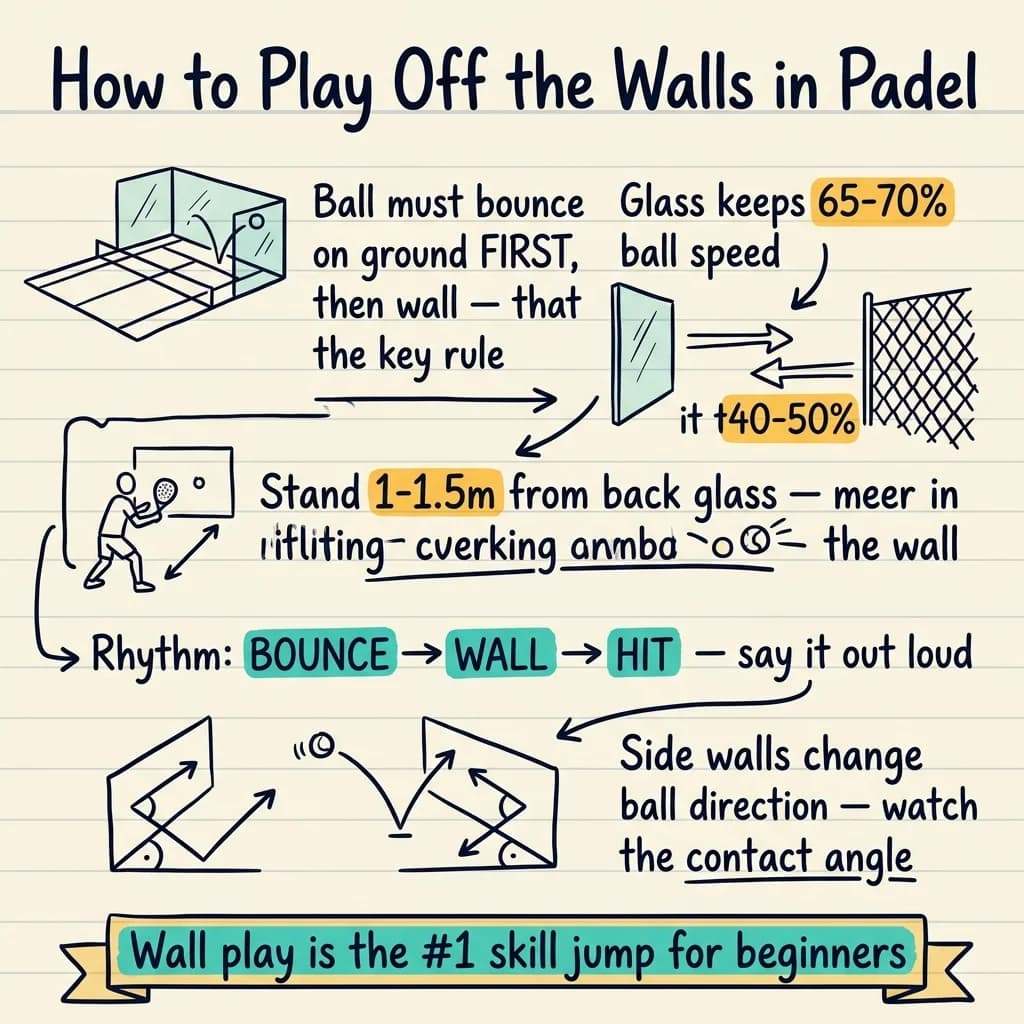
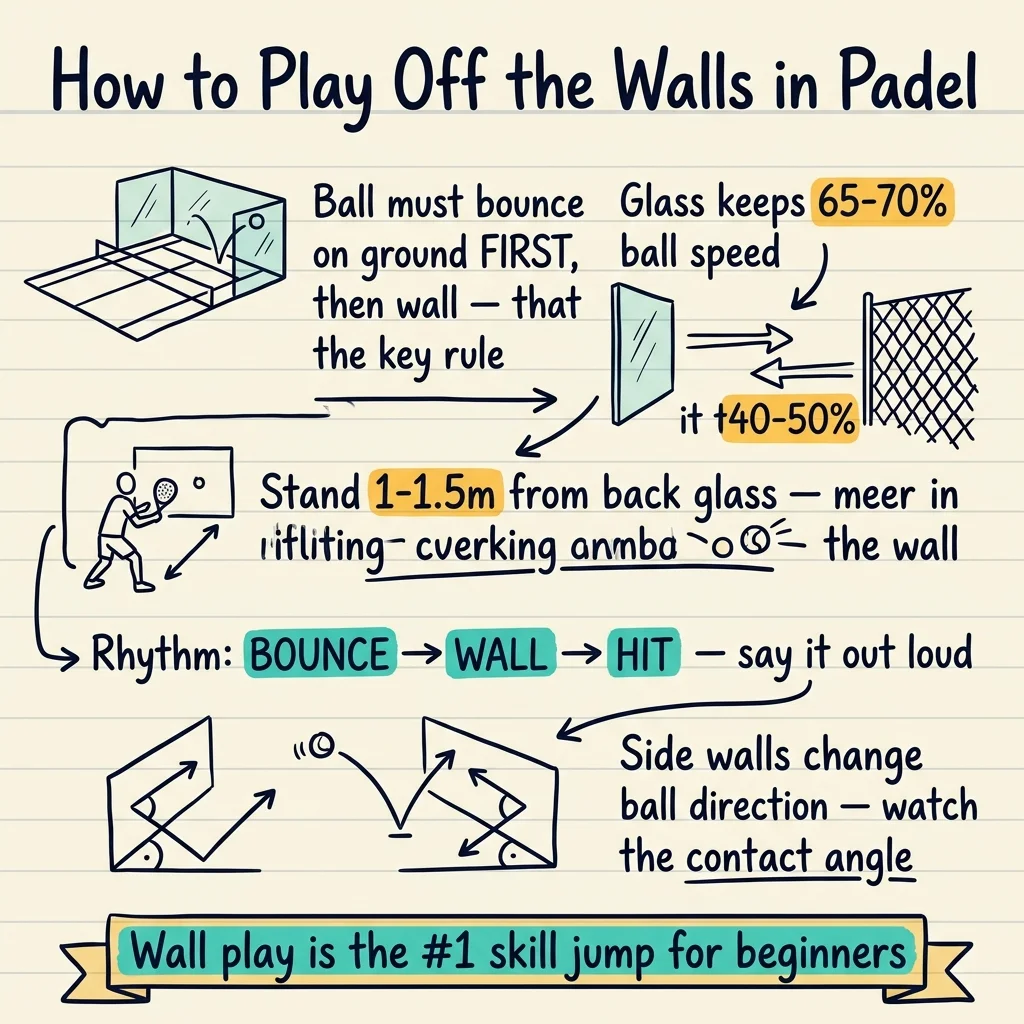
Here's the key rule: the ball must bounce on the ground first, then it can hit any wall on your side. A ball that hits your glass without a ground bounce first is your opponents' point. After that ground bounce, though, the walls are fair game.
This single rule is what makes padel feel different from everything else. A ball that looks like a winner in tennis — deep, fast, low — becomes a setup in padel. The glass sends it right back to you.
The Three Wall Surfaces
A standard padel court (20m x 10m per FIP regulations) uses three wall materials, each with a different rebound:
Back Glass (Cristal)
The back wall spans the full 10-meter width of the court. The bottom 3 meters are 10mm or 12mm tempered glass. It's smooth, hard, and predictable.
A 2021 study published in the International Journal of Performance Analysis in Sport found that glass surfaces produce faster, longer, and more accelerated rebounds than concrete. The ball keeps roughly 65-70% of its incoming speed off glass, compared to just 40-50% off concrete. That extra pace gives you more time to set up your shot.
Glass rebounds follow a simple physics rule: the angle of incidence roughly equals the angle of reflection. Hit the glass at 45 degrees, it comes back at 45 degrees. This makes glass the most readable wall surface.
Side Glass
Each side has 3 meters of glass running from the back wall toward the net, with an additional stepped section. Side glass behaves the same as back glass — predictable, fast rebounds. The difference is the angle: side-wall rebounds send the ball toward the center of the court, not back toward you.
Mesh (Metalica)
Above the glass sits 1 meter of wire mesh on the back wall, and the front sections of the side walls are entirely mesh. The mesh absorbs energy on contact. The ball loses 50-60% of its speed and drops quickly.
When a ball hits mesh, expect it to die. Step forward immediately. Most mesh rebounds don't travel more than a meter from the wall.
Positioning: Where to Stand
Your default defensive position should be 1-1.5 meters in front of the back glass, roughly midway between the service line and the wall. This "base" position lets you:
- Step forward to intercept short balls before they reach the glass
- Step backward to let deep balls rebound off the glass
- Move laterally to cover side-wall shots
The worst place to stand is right against the glass. You have zero room to swing, and the ball rebounds straight into your body.
The second worst place is at the service line with your back to the net. You're too far from the glass, so deep lobs bounce off the wall and die before reaching you.
How to Play the Back Glass: Step by Step
1. Read the Ball Early
As soon as your opponent hits, make a quick decision: will this ball reach the back glass, or should I take it before it gets there? The higher and deeper the ball, the more likely it reaches the glass.
Deep lobs that land within 2 meters of the back glass will almost always rebound. Fast drives that stay low usually won't — they die on the second bounce before reaching the wall.
2. Turn Sideways and Create Space
If the ball is heading for the glass, turn your body sideways (just like for any groundstroke) and move 1.5-2 meters from the wall. You need space between you and the glass so the ball has room to come back.
The critical mistake: standing at the wall and reaching for the ball as it rebounds. You end up jammed, with no backswing and no control.
3. Let the Ball Come to You
This is the hardest part for beginners. Every instinct from tennis, badminton, or table tennis says "go to the ball." In padel, the wall brings the ball to you. Let it bounce on the ground, hit the glass, and come back into space. Then strike it.
Say "bounce — wall — hit" out loud. Ground bounce, wall contact, then your shot. That rhythm solves 80% of wall-play timing problems.
4. Hit with Control, Not Power
Your goal after a wall rebound is to get the ball deep into your opponents' court and buy time to recover your position. A controlled lob to the back glass on their side is usually the best option.
Don't try to hit a winner off a wall rebound. You're in a defensive position — play the percentages and reset the point.
Side-Wall Rebounds
Side-wall shots are trickier because the ball changes direction. A ball coming cross-court hits the side glass and bounces toward the center of the court (or even toward the opposite side).
The fix: watch where the ball contacts the glass and adjust your feet sideways. Side-wall rebounds send the ball roughly 45-60 degrees from the glass surface, so a ball that hits the side glass from a sharp angle will shoot back toward the center.
For double-wall rebounds (ball hits back glass then side glass, or vice versa), give the ball even more space. These rebounds are slow because the ball loses energy on each contact. Step in and take it early when it's floating.
Glass vs. Mesh: Adjusting Your Game
| Glass | Mesh | |
|---|---|---|
| Speed | 65-70% retained | 40-50% retained |
| Bounce height | Medium-high | Low, drops fast |
| Predictability | High | Medium-low |
| Your response | Wait, let it come back | Step forward, take it early |
| Best shot after | Deep lob, cross-court | Low lift, soft lob |
When you see the ball heading for the mesh section (the top meter of the back wall), move forward immediately. The ball will die. If you wait in your normal position, the ball drops at the base of the wall and you're reaching down desperately.
Three Drills That Build Wall Instincts
Drill 1: Solo glass rally. Stand 2 meters from the back glass. Hit the ball into the ground so it bounces up to the glass and comes back. Rally with yourself. Start with 10 consecutive returns. Work up to 30.
Drill 2: Lob-and-recover. Have a partner hit lobs from the net to the back glass. Your job is to let every ball rebound off the glass before returning a deep lob. Focus on footwork, not power. 20 reps per side.
Drill 3: Decision drill. Partner alternates between short balls (that won't reach the glass) and deep lobs (that will). You must decide in real time: take it before the wall, or let it rebound. This builds the read-and-react instinct faster than anything else.
Pro Wall Play to Watch
Arturo Coello — at 20 years old, Coello reads the glass like a veteran. Watch how he creates space by moving away from the wall before the ball arrives. He's never jammed.
Ale Galan — the master of turning defense into attack. Galan lets balls rebound off the back glass and sends deep, heavy lobs that pin opponents at their own back wall. His patience off the glass is unmatched on the Premier Padel tour.
The Bottom Line
Wall play is what makes padel, padel. Every other racket sport ends when the ball passes you. In padel, the glass gives you a second chance — but only if you trust it.
Stand off the wall. Read the ball early. Let the rebound do the work. Hit with control. Recover forward.
The first time you let a ball you'd normally chase fly past you, watch it cannon off the glass, and calmly return a deep lob — that's the moment you stop playing tennis on a padel court and start playing actual padel.
Frequently Asked Questions
Never miss an edition
Weekly Monday issue. 3-minute read. Free. EN + ES.
Related Articles
How to Serve in Padel: Rules, Technique, and 2026 Changes
Master the padel serve — underhand technique, placement tactics, slice vs flat, and the new 2026 FIP serve rules explained.
How to Do a Bandeja in Padel: Step-by-Step Technique Guide
Learn the bandeja shot in padel — grip, footwork, slice technique, and common mistakes. The complete step-by-step guide to padel's most important overhead.
How to Smash in Padel: Flat, Topspin, X3, and X4 Explained
Learn the four types of padel smash — flat, topspin, x3, and x4. When to use each, technique breakdown, and common mistakes.