How to Do a Bandeja in Padel: Step-by-Step Technique Guide
Learn the bandeja shot in padel — grip, footwork, slice technique, and common mistakes. The complete step-by-step guide to padel's most important overhead.
Quick Answer
The bandeja is a controlled overhead shot played with underspin — and it's the most important overhead in padel. While beginners obsess over the smash, pros hit bandejas far more often. It accounts for roughly 25% of all overhead shots in professional padel, and for good reason: it lets you neutralize lobs while keeping your position at the net.
Think of it as the overhead equivalent of a chess move. You're not trying to end the point — you're keeping control of it.
Last updated: March 2026. Technique breakdown based on current Premier Padel and World Padel Tour match analysis.
What Is a Bandeja?
The word "bandeja" means "tray" in Spanish — picture the motion of carrying a tray of drinks overhead, and you've got the basic idea.
In the overhead family, the bandeja sits between the smash and the vibora:
- Smash — pure power, point-ending. Speed: 100-140 km/h
- Vibora — sidespin, aggressive, pulls opponents wide
- Bandeja — underspin, controlled, maintains net position. Speed: 60-80 km/h
The bandeja travels slower than a smash but that's the point. It's a shot built for control, consistency, and court position — not for highlights.
When to Use the Bandeja
You'll reach for the bandeja more than any other overhead. Here's when it's the right call:
- The lob is too short for a smash — most lobs in recreational padel don't reach the back glass, making a full smash risky or impossible
- You're slightly off-balance — didn't quite get set in time? The bandeja's compact motion forgives poor positioning better than a smash
- You want to keep the net — unlike a smash (which often forces you backward), the bandeja lets you hit and immediately recover forward
- The ball is at an awkward height — too high to volley, too low or flat for a clean smash? Bandeja territory
If you play three times a week, you'll probably hit 30-50 bandejas per session. It's that fundamental.
How to Do a Bandeja: Step by Step
Step 1: Read the Lob and Turn Sideways
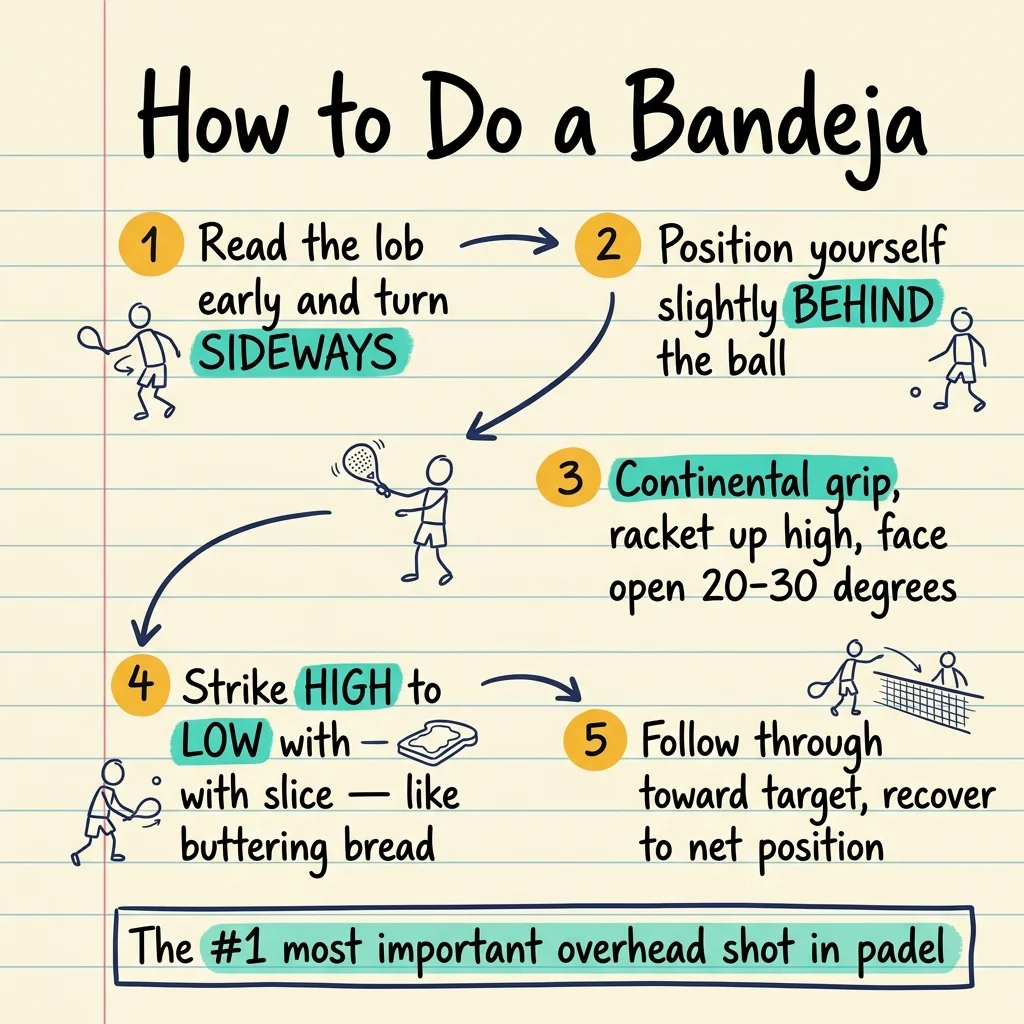
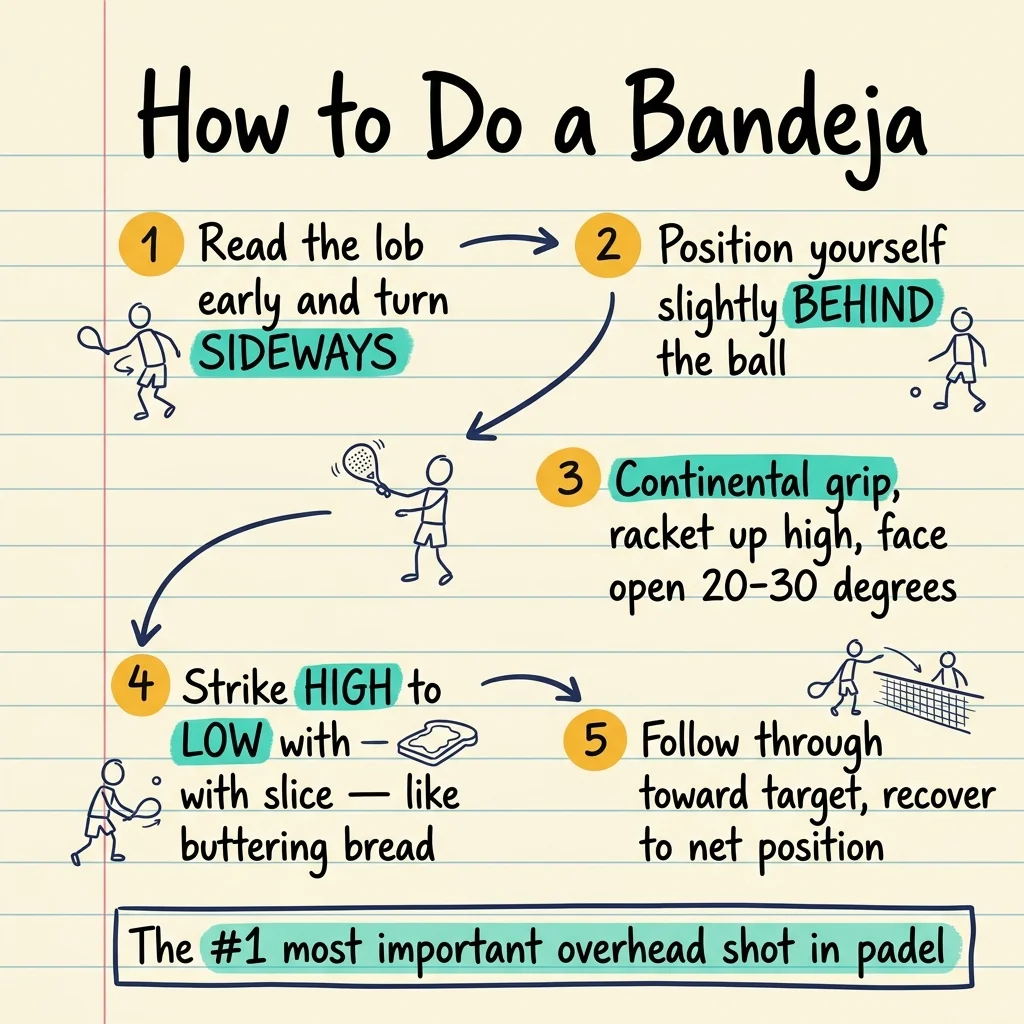
As soon as your opponent sends a lob, turn your body sideways with your non-dominant shoulder facing the net. This is the same preparation as a serve in tennis — if you're facing the net square-on, you've already lost.
Track the ball early. The quicker you read the lob, the more time you have to set up properly.
Step 2: Position Yourself Under and Slightly Behind the Ball
Move your feet so the ball will drop just in front of your hitting shoulder. The most common beginner mistake is standing directly underneath the ball — you want to be slightly behind it at contact.
Small adjustment steps are critical. Don't take big lunges. Quick, choppy footwork gets you into the right spot.
Step 3: Prepare Racket High with Continental Grip
Use a continental grip: the V between your thumb and index finger sits on top of the handle, like holding a hammer. Keep the racket face open at roughly 20-30 degrees.
Bring the racket up early — elbow above shoulder height, racket head above your hand. If you prepare late, you'll rush the swing and lose control.
Step 4: Strike with a High-to-Low Slicing Motion
This is where the bandeja becomes the bandeja. Swing from high to low, making contact at roughly the 2 o'clock position above your head. The motion is a controlled slice — you're cutting under the ball to generate underspin, not hitting through it.
Key difference from a smash: the wrist stays firm. No snap, no pronation. The power comes from your shoulder rotation and the downward angle, not from wrist speed.
Typical bandeja speed sits around 60-80 km/h — less than half of a full smash. That's fine. You're placing the ball, not punishing it.
Step 5: Follow Through Across Your Body
After contact, let the racket follow through compactly across your body, finishing near your opposite hip. The follow-through should feel short and controlled.
If your racket finishes high or out wide, you're probably swinging too hard. Rein it in.
Step 6: Recover Immediately to Net Position
This is the step most players forget. As soon as you complete the shot, take 2-3 quick steps forward to recover your position at the net. The bandeja is a transitional shot — if you stay back after hitting it, you've given up the strategic advantage it was supposed to create.
Aim your shot 1-2 meters past the opponents' service line, into the body or toward the side glass. Then close back in.
Common Mistakes
Hitting flat instead of slicing. If there's no underspin on the ball, it's not a bandeja — it's a bad smash. Focus on the high-to-low cutting motion.
Swinging too hard. The bandeja is about placement, not power. If you're grunting, you're doing it wrong.
Contact point too far back. If you let the ball get behind you, you lose all control and the ball flies long. Get your feet set early so you contact the ball slightly in front.
Not recovering to the net. Hit and stand still? Your opponents send the next ball to your feet while you're stuck in no-man's land. Always move forward after the bandeja.
Standing square to the net. The sideways turn isn't optional. Facing the net kills your range of motion and makes the slice nearly impossible.
Bandeja vs Vibora vs Smash
| Bandeja | Vibora | Smash | |
|---|---|---|---|
| Spin | Underspin (slice) | Sidespin | Flat or topspin |
| Speed | 60-80 km/h | 70-90 km/h | 100-140 km/h |
| Goal | Control, maintain net | Pull wide, aggressive | End the point |
| When | Most lobs | Off-balance but want aggression | High, deep lobs |
| Risk | Low | Medium | High |
Master the bandeja first. The vibora and smash are more exciting but you'll use them far less often.
Pro Players to Watch
Ale Galan — widely considered the best bandeja on the Premier Padel tour. His placement is surgical — he consistently lands the ball in the body of opponents, giving them no angle to attack. Watch how little effort he seems to use.
Paquito Navarro — brings his signature flair to the bandeja with disguised variations. One of the few players who can make the bandeja an outright weapon rather than just a control tool.
Federico Chingotto — at 1.68m, Chingotto proves you don't need height to own the overhead game. His bandeja technique is textbook: compact swing, early preparation, instant recovery forward.
The Bottom Line
The bandeja is the first overhead you should learn in padel, and probably the last one you'll truly master. It's not the flashiest shot — you won't see it on highlight reels. But it's the backbone of net play.
Pro players execute 30-50 bandejas per match. Club players should aim for the same frequency. Every time you're tempted to go for a hero smash on a mediocre lob, ask yourself: would a bandeja keep me in control of this point?
The answer is almost always yes.
Frequently Asked Questions
Never miss an edition
Weekly Monday issue. 3-minute read. Free. EN + ES.
Related Articles
How to Smash in Padel: Flat, Topspin, X3, and X4 Explained
Learn the four types of padel smash — flat, topspin, x3, and x4. When to use each, technique breakdown, and common mistakes.
How to Serve in Padel: Rules, Technique, and 2026 Changes
Master the padel serve — underhand technique, placement tactics, slice vs flat, and the new 2026 FIP serve rules explained.
How to Play Off the Walls in Padel: Glass, Mesh, and Rebound Technique
Learn how to read and play off the back glass, side walls, and mesh in padel. Positioning, timing, and rebound technique for every level.