The 7 Most Common Padel Injuries (And How to Prevent Them)
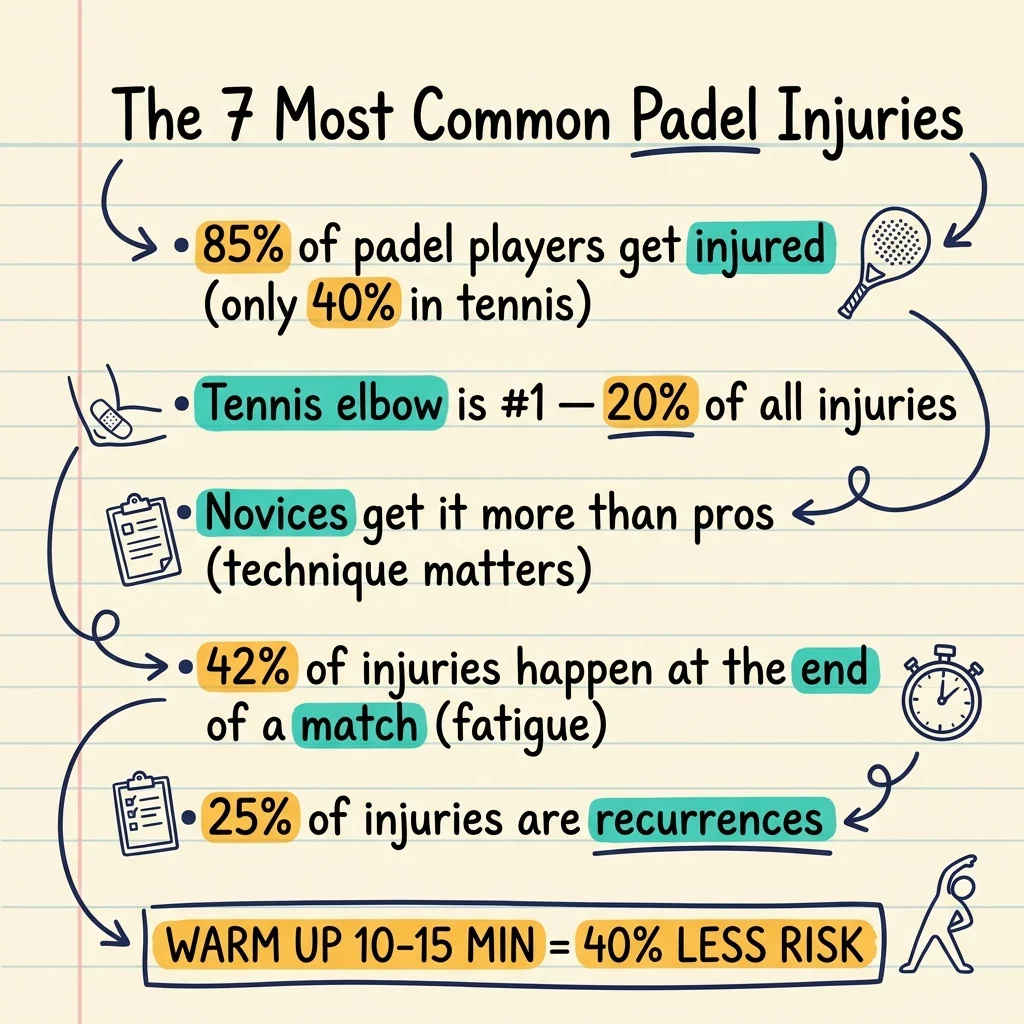
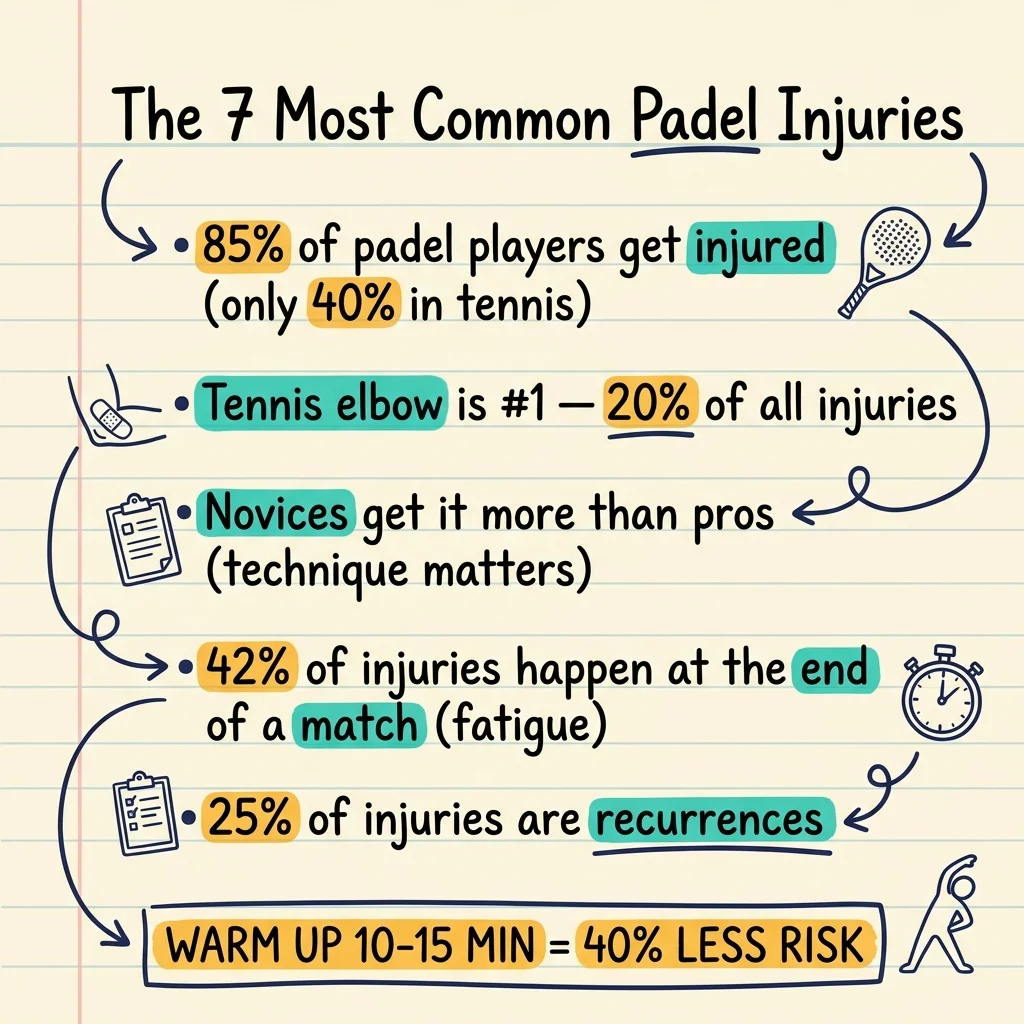
85% of padel players get injured. Tennis elbow leads the list, followed by calf tears and rotator cuff. Here's what hurts most, why, and how to prevent it.
Quick Answer
Roughly 85% of padel players get injured at some point — nearly double the rate in tennis. The seven most common injuries: tennis elbow (the #1, around 20% of all cases), calf tears, rotator cuff tendinopathy, lower back strain, jumper's knee, ankle sprains, and abdominal strains. Prevention comes down to three things: a real dynamic warm-up (cuts risk ~40%), strength work twice a week on calves and rotator cuff, and stopping when you're fatigued — because 42% of injuries happen in the final stage of a match.
Last updated: May 2026 · Data sourced from peer-reviewed epidemiology studies and Spanish sports-medicine clinics.
How Bad Is It, Really?
Padel injury prevalence is 85% among regular players, against 39-46% for tennis (systematic review of padel, tennis and squash injuries, 2025).
The rate per hour is closer — 3 injuries per 1,000 training hours, 8 per 1,000 match hours (Castillo-Lozano & Casuso-Holgado, PMC10277135). The gap with tennis comes from cumulative exposure and the specific demands of padel: short, explosive movements, repeated overheads, and constant trunk rotation in a confined space.
One number to keep in mind: 25% of padel injuries are recurrences. If you've been hurt before, you're the most likely candidate to get hurt again (García-Fernández et al., Universidad Complutense de Madrid).
1. Tennis Elbow (Lateral Epicondylitis)
The undisputed #1. Five of five major epidemiology studies put the elbow at the top of the list. Common extensor tendinopathy accounts for around 20% of all padel injuries, with elbow problems hitting 30-74% of players depending on the cohort (Demeco et al., Musculoskeletal disorders in padel).
The mechanism: repetitive eccentric load on the ECRB tendon during backhands and wall shots. Wrist-led technique makes it worse.
Counterintuitive finding: novices get tennis elbow more than pros. Better technique distributes load through the kinetic chain instead of dumping it on the forearm.
Recovery: 4-12 weeks of conservative treatment is standard (JOSPT clinical guidelines on lateral elbow pain).
2. Calf Tear (Tennis Leg)
Second on every list. A medial gastrocnemius strain caused by an explosive forward lunge — the move you make to dig out a low ball at the net. Players over 30 are at higher risk because tendon elasticity drops with age (Demeco et al.).
It often happens on the first hard point of a session — proof that warming up matters.
3. Rotator Cuff Tendinopathy
Shoulder injuries account for 8-13% of padel cases, with rotator cuff tendinitis specifically at 7.8% (García-Fernández et al.).
The bandeja, víbora, and smash all load the supraspinatus and the subacromial space. Add a service motion every two minutes for an hour, and the shoulder starts complaining.
4. Lower Back Strain
Between 9% and 27.5% of injuries depending on the study. Driven by trunk rotation during overheads and forward lunges from a flexed-spine position (Castillo-Lozano & Casuso-Holgado).
Recreational players with weak core musculature are the typical sufferers. Pro players load their hips and rotate from the pelvis — most amateurs rotate from the lumbar spine.
5. Patellar Tendinopathy and Knee Injuries
Knee complaints make up 10.8-22.9% of injuries. Jumper's knee from repeated smash landings, meniscus damage from rapid direction changes, and patellofemoral pain from poor mechanics on lateral push-offs (PMC review).
6. Ankle Sprains
Lateral inversion sprains — the classic "rolled ankle" — from quick side-to-side movements and the occasional collision with the perimeter wall. More common on artificial turf than on harder synthetic surfaces (Costa Health review).
7. Abdominal Strain
Trunk injuries account for around 20% of padel cases by body region (García-Fernández et al.). Most happen during the cocking phase of a smash, when the abdominal wall is loaded eccentrically. Once strained, it takes 3-6 weeks before serving is comfortable again.
Who Gets Hurt the Most
Three risk factors are well-supported across studies:
- Age over 30 independently predicts injury (recreational players study, n=457)
- Previous injury — 25% of all injuries are recurrences (García-Fernández et al.)
- Poor sleep — the same 457-player study found sleep disturbance was a stronger predictor than weekly playing volume
Gender data is mixed and inconsistent across studies, so don't read too much into single-cohort findings.
How to Stay on the Court
Seven prevention rules with evidence behind them:
- Dynamic warm-up, 10-15 minutes. Skip static stretching before play — it reduces muscle power and increases injury risk. Use leg swings, arm circles, lunges, and gradual rally pace. A proper warm-up cuts injury risk by roughly 40% (Padel Magazine prevention summary).
- Strength train twice a week. Calves, glutes, rotator cuff (elastic band external rotations), and a brick-solid core. This is the single highest-leverage protection.
- Stop when you're tired. 42% of injuries happen in the final stage of a session. The "one more game" point is the one that hurts you.
- Fix your backhand and overhead technique. A coaching session is cheaper than physio. The lower the wrist involvement, the safer the elbow.
- Match your racket to your body. Lighter heads (under 370g) and a grip size that fills your hand reduce wrist and elbow load. If you're flaring up, drop a few grams.
- Sleep. Padel-specific data shows sleep is one of the strongest modifiable factors. Skip the supplements and fix your bedtime.
- Respect recurrence. If you've had tennis elbow before, do daily eccentric wrist work even when pain-free. The injury comes back.
Bottom Line
Padel is hard on the body — harder than tennis, by every published measure. But almost every common injury maps to one of three causes: undertrained body, untrained technique, or fatigue ignored. Fix those, and most of this list goes away.
Frequently Asked Questions
Never miss an edition
Weekly Monday issue. 3-minute read. Free. EN + ES.
Related Articles
Is Padel a Good Workout? Calories, Heart Rate, and the Muscles It Trains
Padel keeps you at 70-80% of max heart rate and burns roughly 400-700 calories an hour. Here's the science on the workout you actually get.
Padel Etiquette: The Unwritten Rules Every Player Should Know
The unwritten rules of padel: when to switch sides, tapping palas, fetching balls from the next court, net cord apologies, and the amateur smash code.
What Is Padel? The Sport Everyone Is Playing, Explained
Padel explained in plain language: how it works, why the walls matter, what you need to play, and why 35 million people are hooked.