Where to Stand in Padel Doubles: The Complete Positioning Guide
Master padel doubles positioning — net zones, defensive depth, unit movement, and the three court zones that decide 80% of points.
Quick Answer
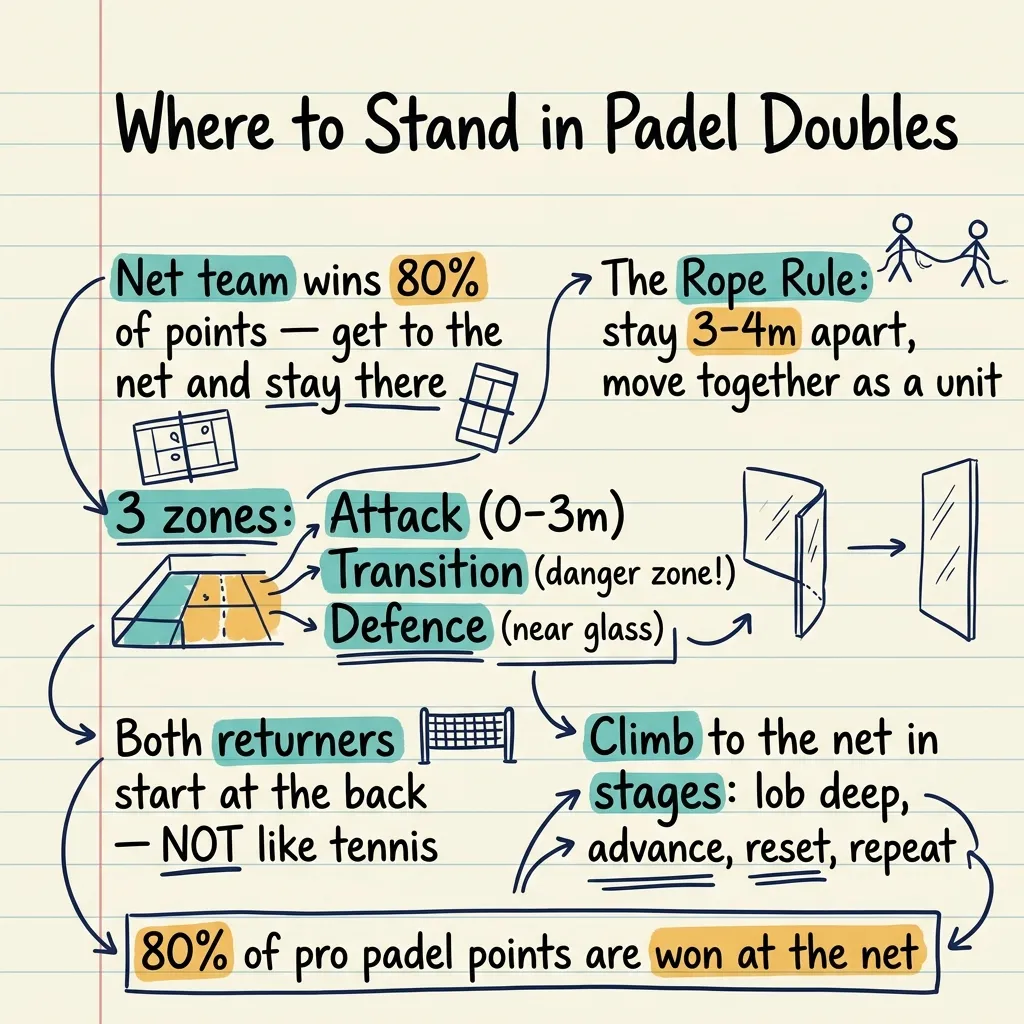
In padel doubles, the team at the net wins roughly 80% of points (Applied Sciences, 2024). Your entire game should revolve around two goals: get to the net and stay there. Both partners move as a single unit — 3–4 metres apart, shifting together like they're tied by a rope. The court splits into three zones: attack (0–3 m from the net), transition (around the service line), and defence (near the back glass). Know where you belong in each phase and you'll beat players with better shots than yours.
Last updated: April 2026 · Court dimensions and positioning data verified at time of writing.
Net Position Wins Padel Matches — Here's the Data
Padel is not tennis. In tennis, baseliners win Grand Slams. In padel, the back of the court is where you go to survive — not to win.
Research published in Applied Sciences (2024) found that up to 80% of points in professional padel are won from a position close to the net. Volleys account for 20–25% of winning shots. The bandeja and smash together add another 12–18%.
Padel Telegraph's 2025 match analysis backs this up: players who control the net win over 70% of rallies.
The message is clear. If you're stuck at the back, you're defending. If you're at the net, you're dictating.
The Three Court Zones
Babolat's coaching team breaks the padel court into three zones. Every player should know which zone they're in and what to do there.
Attack Zone (0–3 metres from the net)
This is home base. When you're here, you control the point.
Stand 1–2 metres from the net. Keep your racket up in front of your chest. Split step before every opponent shot. Aim at your opponents' feet, not for flashy winners.
One mistake beginners make: standing too close to the net. If you're glued to the net tape, any lob sails over your head. Give yourself room to react.
Transition Zone (3–7 metres from the net)
The service line area. This is no man's land — the worst place to stand on a padel court.
You're too far from the net to volley with authority. You're too far from the glass to use it. Balls landing at your feet are almost impossible to return cleanly.
The rule: move through this zone, never stop in it. After you serve, walk through it to reach the net. After a good defensive lob, advance through it with your partner.
Defence Zone (1–2 metres from the back glass)
When the opponents have the net, you'll be here. Stand 1–2 metres from the glass — close enough to play balls off the walls, far enough to have reaction time.
Your job from this zone: hit deep lobs, wait for a short ball, then climb forward together.
Unit Movement: The Rope Rule
The single most important tactical concept in padel doubles. Imagine a 3–4 metre rope connecting you and your partner at the hips.
When the ball goes left, both players slide left. When the ball goes right, both shift right. When one player advances, the other advances. When one retreats, both retreat.
This means:
- Never have one player at the net and the other at the back glass. That split formation creates a massive gap through the middle.
- Always shift together laterally to track the ball. If your partner chases a wide ball, you cover the centre.
- Match depth. If your partner drops back to play a lob off the glass, you drop back to the service line area, not stay planted at the net.
Professional pairs like Ale Galan and Arturo Coello move in near-perfect synchronisation. Watch any Premier Padel final — their lateral movement looks choreographed.
Serving Positioning: How to Start Every Point Right
The Server
Start behind the service line, roughly in the centre of your half. Serve to the opponent's body or the T (centre line) — this limits return angles and buys you time.
After the serve, walk forward immediately. Your serve is your ticket to the net. If you serve and stay back, you've wasted the biggest positional advantage in padel: the serving team starts with one player already at the net.
The Server's Partner
Start at the net, 1–2 metres back, centred in your half. Your racket should be up and ready.
Your job: intercept any weak return that floats through the middle. If the return goes wide to your partner's side, hold your position and let them handle it.
Communication matters here. Top-level pairs signal before each point — a hand behind the back telling the server whether the net player plans to poach (cut across) or hold their line.
Returning Positioning: Why Both Players Start Back
This trips up every new padel player. In tennis, the returner's partner stands at the net. In padel, both returners start near the baseline.
Why? Because the serving team already has the net. Putting your partner at the net while you return from the back creates that dangerous split formation — and the server's partner at the net will punish any loose return with a volley.
The Returner
Stand just behind the service box, near the centre of the receiving area. After your return:
- If the return was deep and low — move forward together with your partner.
- If the return sat up high — stay back and prepare to defend.
The Returner's Partner
Stay back, roughly level with the returner, in your half of the court. Move forward only when the returner does. You advance as a pair or not at all.
From Defence to Net: The Transition Climb
Getting pushed back doesn't mean losing the point. It means you need to earn the net back.
Step 1: Hit a deep, high lob. Aim past the service line. This forces the net team to retreat and play an overhead.
Step 2: As the lob travels, both players advance to around the service line.
Step 3: Read the opponent's reply. If they hit a bandeja or short ball, keep advancing to the net. If they smash deep, hold position or retreat.
Step 4: Repeat until you reach the net.
The key word: stages. Never sprint from the back glass to the net in one rush. You'll arrive off-balance with your racket down. Climb in 2–3 forward steps, resetting your ready position between each advance.
Common Positioning Mistakes
Camping in no man's land. Standing around the service line because it "feels safe." It's the opposite. Move forward or fall back — don't hover.
Split formation. One player at the net, the other at the back. This leaves a highway through the middle of the court. Every intermediate opponent will exploit it.
Chasing wide balls across your partner's half. Trust your partner. If a ball goes to their side, they take it. You cover the centre. Crossing over creates chaos.
Standing flat-footed. A split step — a small hop that lands on the balls of both feet — before every opponent shot is non-negotiable. Without it, you can't react to volleys or change direction quickly enough.
Ignoring lateral movement. Shifting forward and back but forgetting to slide sideways with the ball. The rope rule applies in all directions.
Frequently Asked Questions
Never miss an edition
Weekly Monday issue. 3-minute read. Free. EN + ES.
Related Articles
How to Serve in Padel: Rules, Technique, and 2026 Changes
Master the padel serve — underhand technique, placement tactics, slice vs flat, and the new 2026 FIP serve rules explained.
How to Play Off the Walls in Padel: Glass, Mesh, and Rebound Technique
Learn how to read and play off the back glass, side walls, and mesh in padel. Positioning, timing, and rebound technique for every level.
5 Pádel Mistakes Every Beginner Makes (And How to Fix Them)
Standing too far back, hitting too hard, ignoring the glass — these beginner pádel mistakes cost you points. Here's how to fix all five.