Padel Balls vs Tennis Balls: What's the Difference?
Padel balls look like tennis balls but play differently — lower pressure, less bounce, and built for walls.
Quick Answer
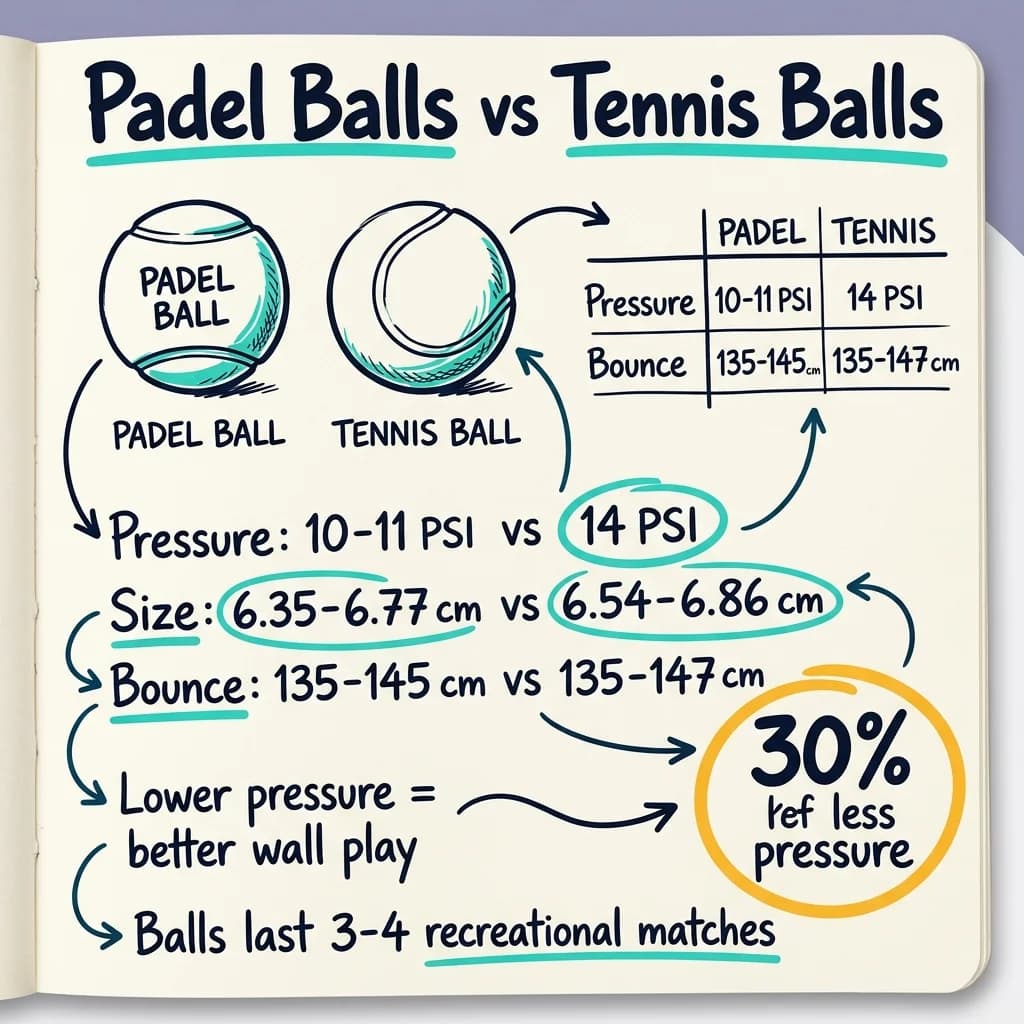
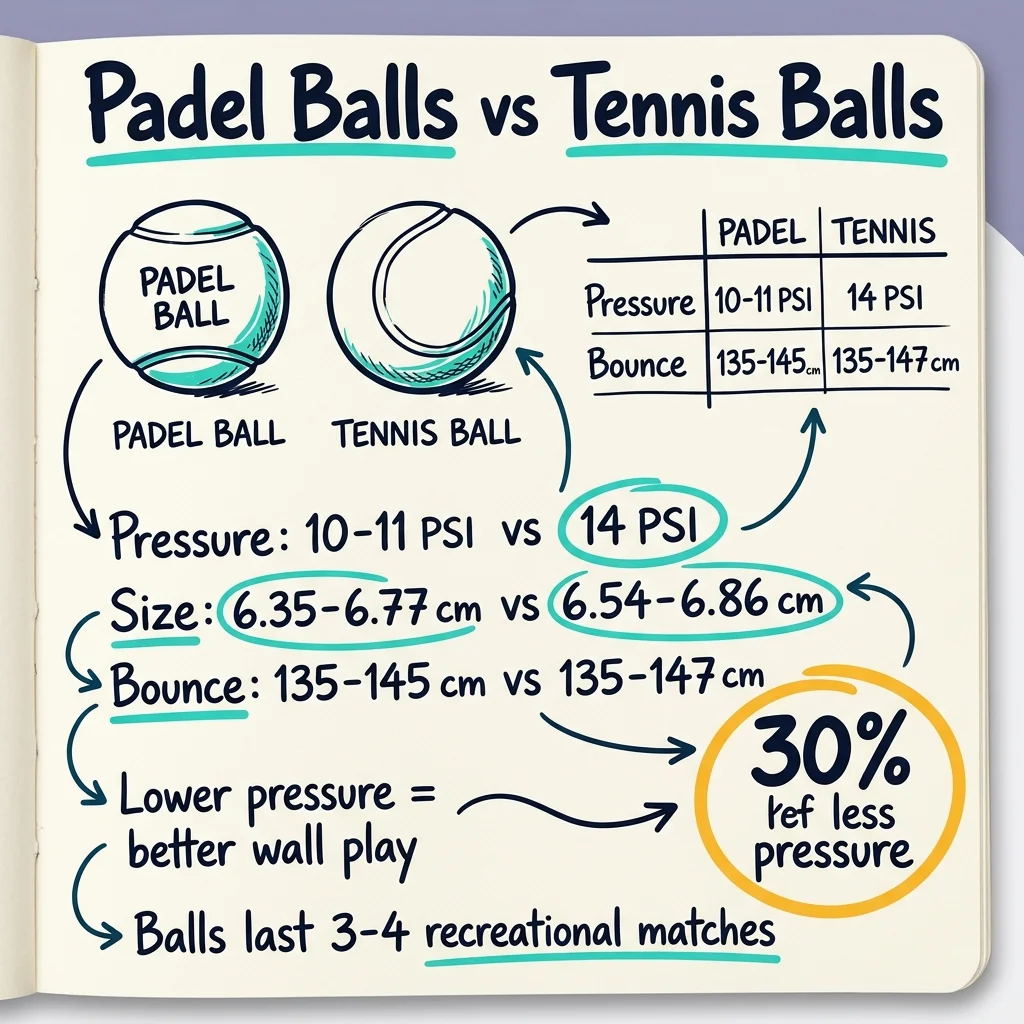
Padel balls and tennis balls look almost identical, but they're built for different games. Padel balls run at 10–11 PSI internal pressure compared to 14 PSI in tennis balls. That 30% pressure gap means padel balls bounce lower and travel slower — exactly what you need on a 20×10-meter court with glass walls. The size difference is minimal (padel balls are up to 8% smaller), but the feel on court is night and day.
Last updated: April 2026 · Prices and availability verified at time of writing.
The Specs, Side by Side
Both balls are rubber spheres covered in felt. Both weigh 56–59.4 grams. From a distance, you'd never tell them apart. Up close, three things separate them.
Pressure. FIP regulations set padel ball pressure at 4.6–5.2 kg/cm² (roughly 10–11 PSI). ITF tennis balls sit at about 14 PSI. Pick up a padel ball and squeeze it — it gives more than a tennis ball does.
Size. Padel balls measure 6.35–6.77 cm in diameter (FIP rules, updated January 2026). Tennis balls span 6.54–6.86 cm. There's overlap in the middle, but a padel ball at the small end is noticeably compact.
Bounce. Drop both from 2.54 meters onto a hard surface. A padel ball bounces 135–145 cm. A tennis ball bounces 135–147 cm. The ranges overlap on paper, but combine lower pressure with the smaller size and padel balls consistently sit at the low end.
Why the Pressure Gap Matters
Padel courts are enclosed. Glass walls, metal mesh, and a net — all inside a space one-third the size of a tennis court. A high-bounce, high-pressure ball on that court creates chaos. Balls fly off walls at sharp angles, rallies end in two shots, and control disappears.
Lower pressure fixes that. At 10–11 PSI, the ball stays predictable off glass. Wall rebounds are readable. Players have time to set up, move into position, and play the tactical game padel rewards.
Pro players at Premier Padel events use Wilson Premier Padel Balls — tuned with Dura-Weave felt and a core designed for consistent response on glass-walled courts. At the recreational level, Head Padel Pro and Bullpadel Next Pro are popular FIP-approved options. A can of three runs €5–8 depending on the brand.
Can You Use Tennis Balls for Padel?
Technically, yes. The ball will bounce and you can play points. But the experience suffers fast.
Tennis balls bounce too high off the glass. Lobs become unplayable when the ball rockets off the back wall. The extra speed compresses reaction time on a court that's already small. And the faster wear pattern on enclosed-court felt means tennis balls lose their fuzz quicker than padel balls do.
Every padel club, school, and federation recommends using actual padel balls. At €5–8 per can, the cost difference from tennis balls is negligible.
How Long Do Padel Balls Last?
Padel balls lose pressure from the moment you open the can. How fast depends on how hard you play.
Recreational players get 3–4 matches from one set of balls. The felt holds up and the bounce stays playable for about 4–6 hours of court time.
Competitive and tournament play burns through a set in 1–2 matches. Pros at Premier Padel events swap balls every few games.
Pressurizer tubes extend ball life. These sealed containers maintain internal pressure when you're not playing. Brands like Pascal Box and Head sell pressurizers for €15–25. They won't restore dead felt, but they keep the bounce consistent between sessions.
The quick test: hold the ball at shoulder height and drop it. If it bounces below your knee, open a new can.
What Ball Should You Buy?
For most recreational players, any FIP-approved ball works fine. Three popular options in 2026:
- Wilson Premier Padel — the tour ball, consistent bounce, premium price (~€7–8 per can)
- Head Padel Pro — widely available, solid all-rounder (~€5–6 per can)
- Bullpadel Next Pro — good durability, slightly slower pace (~€5–6 per can)
If you play in cold weather or on slow surfaces, Wilson also makes a Premier Padel Speed Ball with higher rebound for those conditions.
One tip: buy in bulk. Most retailers discount packs of 12–24 cans. For a group that plays twice a week, a 24-can box lasts roughly two months and costs 15–20% less per can.
Frequently Asked Questions
Never miss an edition
Weekly Monday issue. 3-minute read. Free. EN + ES.
Related Articles
The Most Popular Padel Balls of 2026
The padel balls people actually play with in 2026 — the tour ball, the club favorites, and the budget pick — with what each one is best for.
Pádel Shoes: What Makes Them Different? A Complete Guide
Pádel shoes have herringbone soles, reinforced lateral support, and are built for artificial grass — not hard courts. Here's what to look for.
Padel Etiquette: The Unwritten Rules Every Player Should Know
The unwritten rules of padel: when to switch sides, tapping palas, fetching balls from the next court, net cord apologies, and the amateur smash code.
Related Newsletter Editions
Nike enters padel?
Nike's Swoosh appeared on padel rackets at Drake's NOCTA Manor. Three rumors, no official statement. Plus: the biggest week ever for padel in US business media.
Nike Is Coming for Padel — and They Want Tapia
Nike plans to enter padel in 2027 with world #1 Agustín Tapia as their target star. QSI champions women's padel at the UN. Reserve Cup Marbella makes history with first women's competition. Paquito Navarro admits his game is becoming obsolete.