How to Hit the Lob (Globo) in Padel: The Shot That Steals the Net
The lob (globo) pushes opponents off the net and flips the point. Learn when to lob, where to aim, and how to execute flat and topspin lobs.
Quick Answer
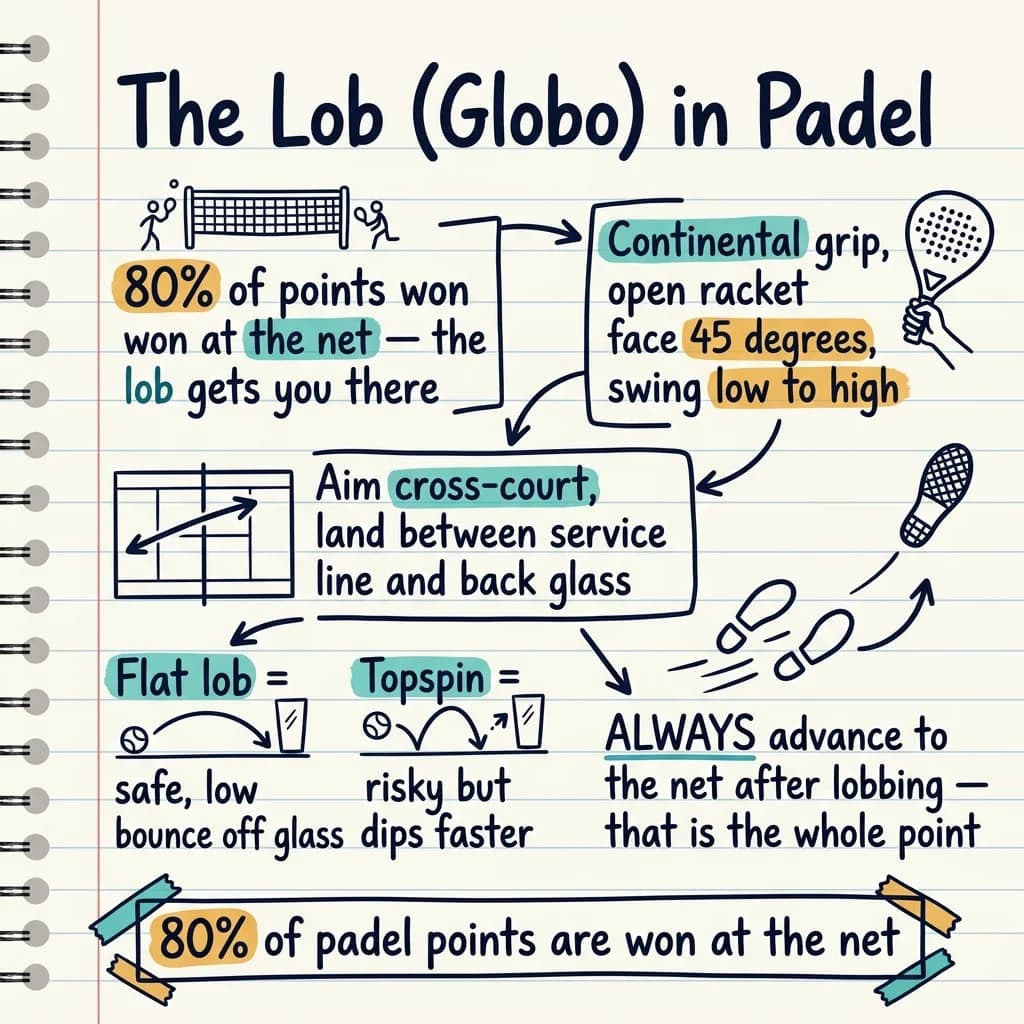
The lob (globo) is a high, deep shot that sails over your opponents' heads and lands near the back glass. It's the main way to push net players backward and steal the net position yourself. Use a continental grip, open racket face, and swing low to high. Aim cross-court, landing the ball between the service line and back glass. In professional padel, 80% of points are won at the net (Applied Sciences, 2024) — the lob is how you get there.
Last updated: April 2026 · Technique sourced from LTA Padel, NXPadel, and peer-reviewed studies in Applied Sciences.
Why the Lob Matters More Than the Smash
Every beginner wants to smash. But the lob wins more points.
Here's why: 80% of points in padel are won by the pair at the net, according to a 2024 study published in Applied Sciences. The net is where you win. The lob is how you get there.
A deep lob forces your opponents to retreat from the net. They have to turn, run backward, and play a difficult shot off the back glass. While they scramble, you and your partner walk forward and take the net.
The smash ends individual points. The lob controls entire matches.
When to Use the Lob
The lob works in three situations:
1. You're stuck at the back and opponents own the net. This is the classic scenario. They're at the net, hitting volleys and smashes. A hard drive? They volley it. A chiquita? They cover it. The lob goes over their heads and resets the point.
2. On the return of serve. In professional padel, players use the lob as their return about 28% of the time (Applied Sciences, 2020). Female pros use the lob return 12% more often than men. A lob return buys time and prevents the serving team from holding the net position.
3. To break rhythm. When opponents expect pace, a high, slow lob changes the tempo. It forces them to stop, look up, retreat. That mental reset creates openings.
How to Hit the Lob: 5 Steps
1. Continental Grip, Open Racket Face
Get behind the ball early. Continental grip — the same grip you use for volleys and the bandeja. Open the racket face about 45 degrees toward the sky.
The open face is what sends the ball upward. You don't need to muscle it.
2. Swing Low to High
Start the racket below the ball. Swing upward in a smooth arc. The power comes from your legs pushing up and the path of the racket. No wrist flick, no snap.
Think "lift." Not "hit."
3. Aim High and Deep
Your target: the ball peaks at 3-4 meters above the court and lands between the service line and the back glass. FIP regulations require a minimum 6-meter ceiling clearance for indoor courts — that's how important height is to this shot.
Too short? They smash it. Too deep? The ball bounces high off the back glass and floats back to them for an easy overhead.
4. Go Cross-Court
Cross-court lobs travel a longer diagonal distance. That gives you more margin for error. A cross-court lob also forces both opponents to reposition, not just one.
The LTA Padel coaching program recommends cross-court as the default lob direction. Go down the line only when the angle is blocked.
5. Move Forward After the Lob
This is the step beginners forget. The lob is a transition shot. After you hit it, walk forward toward the net.
If your lob lands deep, opponents retreat. You and your partner take the net. If you stand still at the back, you wasted the entire purpose of the lob.
Flat Lob vs. Topspin Lob
Two versions exist:
Flat lob (with slight backspin): Safer. The ball floats high, dips slowly, and bounces low off the back glass. Opponents struggle to attack it because the low bounce keeps the ball below smash height. This is the default for most players.
Topspin lob: Riskier. Brush up the back of the ball to add topspin. The ball dips faster after its peak, which helps against tall opponents who might reach a flat lob. The trade-off: topspin lobs bounce higher off the glass, giving opponents a better angle.
Most coaches recommend the flat lob until you're comfortable with the shot. Add topspin once your depth is consistent.
Common Lob Mistakes
Lobbing under pressure. The lob needs balance. If you're stretched or off-balance, the lob will be short. Hit a drive or chiquita instead and reset.
Standing still after lobbing. You hit a great lob. Opponents retreat. And you... stay at the back. That's like unlocking the door and refusing to walk through it.
Always lobbing to the same spot. Predictable lobs get read and punished. Mix cross-court and down the line. Vary the height.
Lobbing when opponents are already at the back. The lob moves people backward. If they're already there, the lob just gives them time. Use a drive or drop shot instead.
The Pro Move
Gemma Triay uses the lob as an offensive weapon, not just a defensive escape. Her lobs land within centimeters of the back glass, giving opponents almost no angle to work with. Arturo Coello and Agustín Tapia read the lob early and use it to set up their signature transitions from defense to attack — lobbing once, advancing, then finishing at the net.
Frequently Asked Questions
Never miss an edition
Weekly Monday issue. 3-minute read. Free. EN + ES.
Related Articles
What Is the Chiquita in Pádel? The Shot That Wins You the Net
The chiquita is a soft, low shot aimed at the net player's feet — and it's how you take the net from the back of the court. Here's how to hit it.
What Is the Vibora in Pádel? Technique, Timing & Step-by-Step Guide
The vibora is pádel's most aggressive overhead — a sidespin shot that forces weak returns. Here's how it works and when to use it.
How to Smash in Padel: Flat, Topspin, X3, and X4 Explained
Learn the four types of padel smash — flat, topspin, x3, and x4. When to use each, technique breakdown, and common mistakes.