How to Smash in Padel: Flat, Topspin, X3, and X4 Explained
Learn the four types of padel smash — flat, topspin, x3, and x4. When to use each, technique breakdown, and common mistakes.
Quick Answer
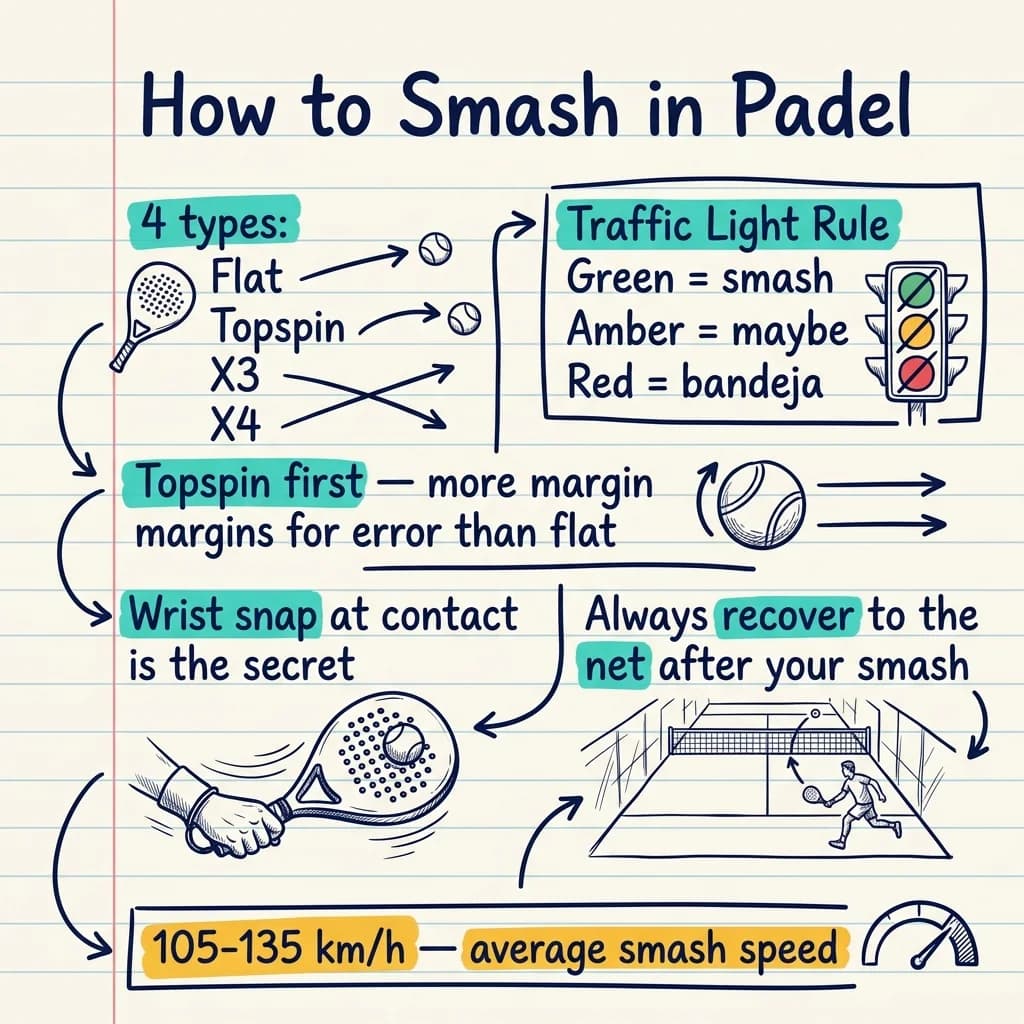
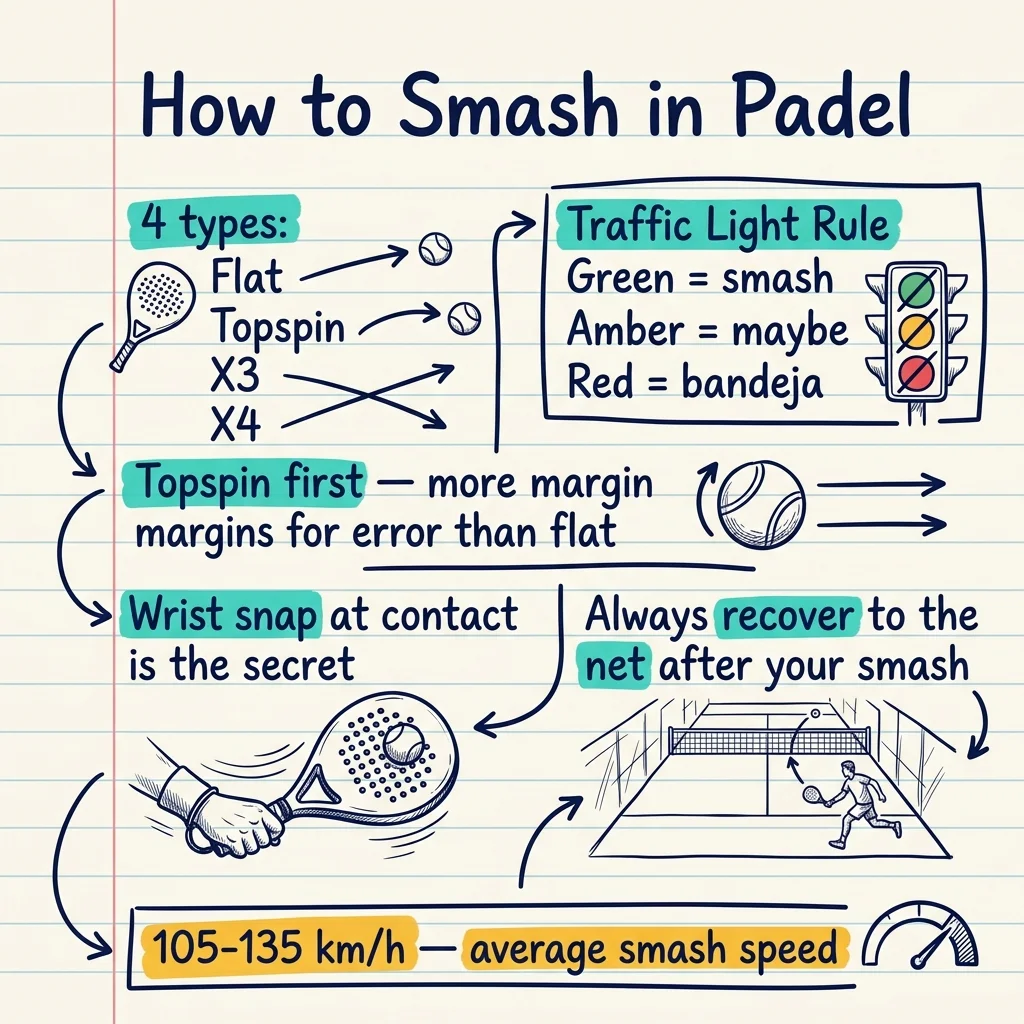
The padel smash comes in four types: flat (power finish), topspin (kick off the glass), x3 (ball exits over the 3m side fence), and x4 (ball exits over the 4m back wall). Amateur smashes travel 105–135 km/h. The key to all four is position first, power second — get under the ball, turn sideways, and snap the wrist at the highest contact point.
Last updated: April 2026 · Prices and availability verified at time of writing.
The Smash Is Not What You Think
Most beginners treat the smash like a free winner. Hit hard, win the point, celebrate. But padel coaches will tell you the opposite: the smash loses more points than it wins at amateur level.
Why? Walls.
In tennis, a smash that clears the baseline is gone. In padel, that same ball rebounds off the back glass and floats back to your opponents. A bad smash gives them an easy counter.
The best players — Agustin Tapia, Arturo Coello, Ale Galan — smash less often than beginners. But when they do, they pick the right type for the right moment.
The Four Types of Padel Smash
1. Flat Smash (Remate Plano)
The classic power shot. You hit the ball flat with maximum force, aiming to end the point before the ball reaches the glass.
When to use it: You're at the net, the ball is high, and both opponents are on the same side or deep in the court.
Target: Aim straight down the line (parallel). The short distance gives opponents the least reaction time.
Technique: Continental grip, contact at full extension, wrist snaps forward and through. The ball should bounce twice before the glass, or hit so hard it stays low after the rebound.
2. Topspin Smash (Remate con Efecto)
Instead of ending the point outright, you hit with heavy topspin. The ball kicks upward off the glass, making it hard to play off the rebound.
When to use it: You're at mid-court and want to keep pressure without risking an error. The topspin gives you margin.
Target: Aim toward the back glass. The topspin makes the ball bounce high and unpredictable after the rebound.
Technique: Eastern grip, contact slightly in front of the body. Roll the wrist over the ball to create forward spin. Think of brushing the top of the ball, not punching through it.
3. The X3 Smash
This is the crowd-pleaser. An x3 smash hits the back glass (or side glass), and the topspin carries the ball up and over the 3-meter side fence. The point is over — opponents cannot leave the court to play it.
When to use it: Mid-court position, high ball, and room to generate spin. You need both technique and power.
How it works: The heavy topspin makes the ball bite the glass and jump upward. It clears the wire mesh on the side (3 meters high) and exits the court.
Why it's hard: You need to combine the right spin direction, enough power, and precise placement on the glass. Miss the angle, and the ball stays in play with you stuck mid-court.
4. The X4 Smash
The x4 is pure aggression. Hit from close to the net, the ball hammers into the floor, bounces into the back glass, and flies out over the 4-meter back wall.
When to use it: Close to the net, high ball, and you want to end the rally.
How it works: The steep downward angle creates a fast floor bounce. The ball hits the glass with so much speed it clears the 4-meter wall behind the court.
Key detail: This shot requires an explosive wrist snap directed downward. The power comes from your hand, not your shoulder.
The Traffic Light Rule: When to Smash
Spanish padel coaches use a "traffic light" system to decide shot selection:
Green zone (net to service line): Smash freely. You have time, angle, and position. Flat or x4 work best here.
Amber zone (service line to mid-court): Smash only if the ball is high and you're balanced. Topspin or x3 are safer bets. A bandeja might be smarter.
Red zone (behind mid-court): Do not smash. Play a bandeja or vibora. Forcing a smash from deep is how you gift points to your opponents.
Three Common Smash Mistakes
1. Smashing off-balance. If you're leaning backward or reaching above your head while moving, the ball goes long or into the glass at a bad angle. Set your feet first.
2. Going full power every time. A controlled smash at 70–80% effort with good placement beats a 100% swing that lands in no-man's land. Accuracy wins.
3. Not recovering after the smash. You hit a topspin smash and admire it. The ball rebounds off the glass, your opponents scoop it up, and you're stuck behind the service line. Always push back to the net after contact.
Flat vs. Topspin: Which to Practice First?
Start with topspin. Counter-intuitive, but topspin smashes have a higher margin for error. The spin keeps the ball in play even when your placement is off.
Flat smashes demand precise power and angle. One degree off, and the ball sails out or rebounds to a perfect counter. Save flat smashes for when your topspin is consistent.
Professional padel bears this out. Watch Agustin Tapia on Premier Padel — he uses topspin smashes to build pressure and reserves the flat finish for clear-cut chances.
Frequently Asked Questions
Never miss an edition
Weekly Monday issue. 3-minute read. Free. EN + ES.
Related Articles
How to Do a Bandeja in Padel: Step-by-Step Technique Guide
Learn the bandeja shot in padel — grip, footwork, slice technique, and common mistakes. The complete step-by-step guide to padel's most important overhead.
How to Serve in Padel: Rules, Technique, and 2026 Changes
Master the padel serve — underhand technique, placement tactics, slice vs flat, and the new 2026 FIP serve rules explained.
How to Play Off the Walls in Padel: Glass, Mesh, and Rebound Technique
Learn how to read and play off the back glass, side walls, and mesh in padel. Positioning, timing, and rebound technique for every level.