Is Padel a Good Workout? Calories, Heart Rate, and the Muscles It Trains
Padel keeps you at 70-80% of max heart rate and burns roughly 400-700 calories an hour. Here's the science on the workout you actually get.
Quick Answer
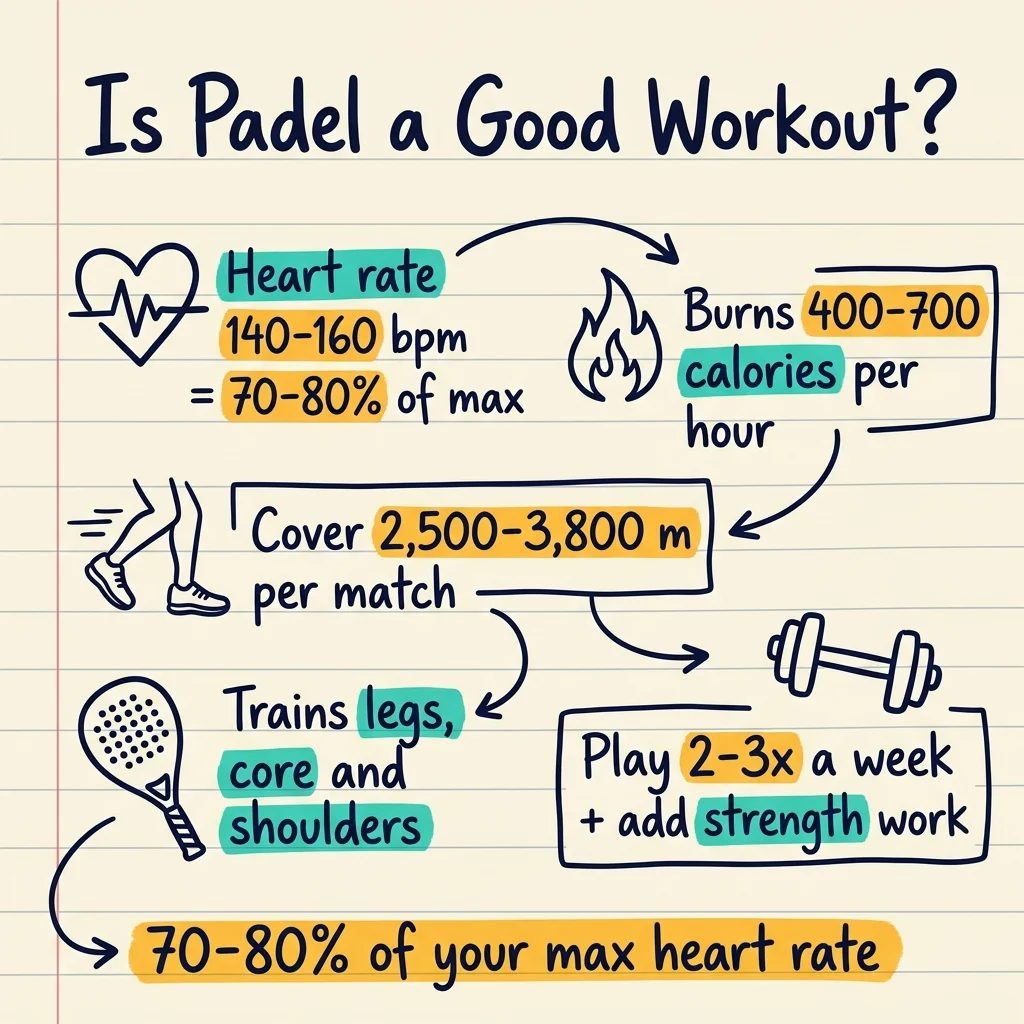
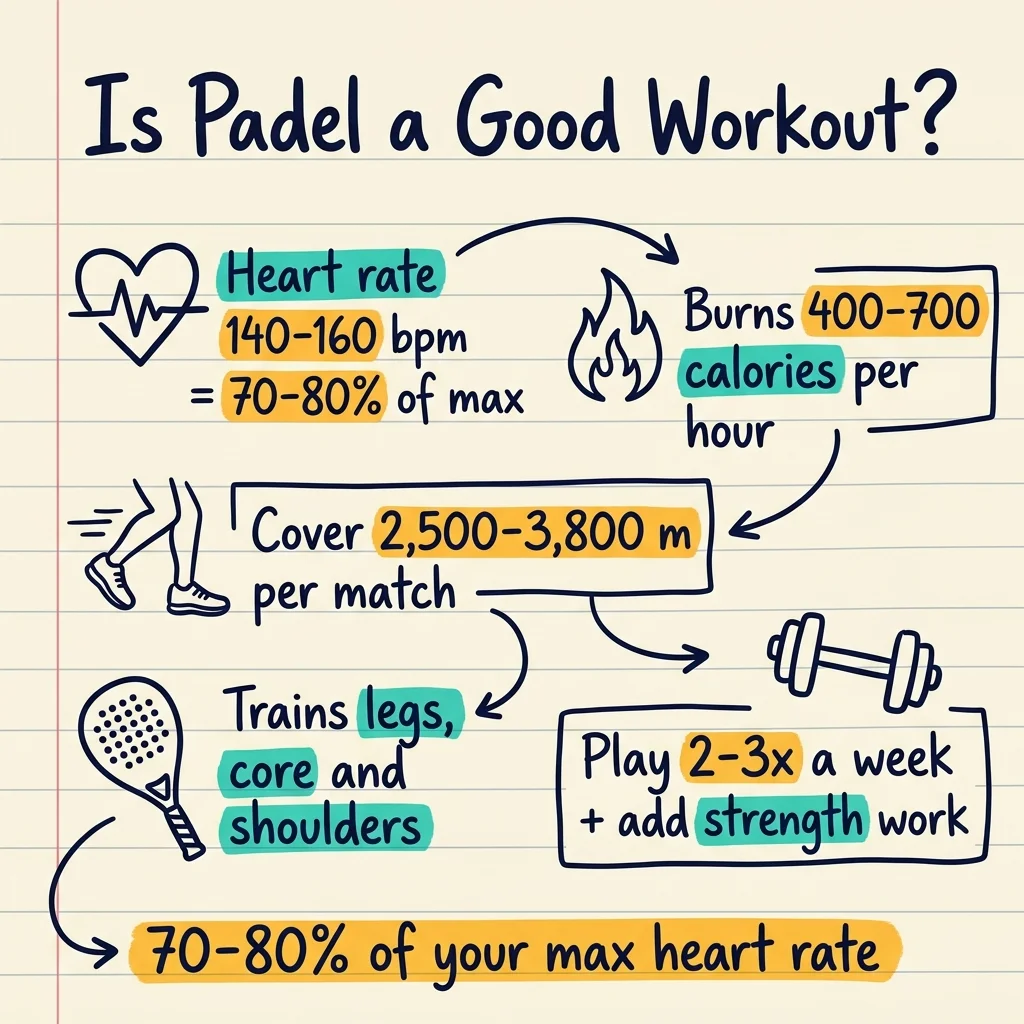
Yes, padel is a genuinely good workout. A match holds your heart rate at 140-160 bpm — roughly 70-80% of maximum — for most of the session, which is moderate-to-vigorous aerobic exercise by any health guideline. You'll cover 2,500-3,800 metres and make 600-plus accelerations and direction changes in a single match, burning an estimated 400-700 calories an hour. It trains your legs, core, and shoulders together, and it does it without the relentless sprinting of singles tennis. The catch: it's aerobic and uneven, so it complements strength training rather than replacing it.
Last updated: June 2026 · Physiological figures sourced from peer-reviewed systematic reviews; calorie estimates derived from standard metabolic equivalents.
How Hard Is Padel, Really?
The honest measure of a workout isn't how tired you feel — it's what your heart and lungs are doing. On that score, padel holds up well.
Across the research, mean heart rate during a match lands at 140-160 bpm, about 70-80% of maximum, with peaks near 180 bpm on long rallies (narrative review, International Journal of Environmental Research and Public Health). That's the zone fitness guidelines call moderate-to-vigorous — the same target you'd aim for on a brisk run or a spin class.
Oxygen use tells the same story. Players work at 40-50% of their VO2 max during play, with measured VO2 max values of 43-59 ml/kg/min in men and 40-53 in women (systematic review, Martín-Miguel et al., 2025). Padel doesn't max out your engine, but it keeps it running steadily for an hour or two.
The movement load is where it gets interesting. One match means roughly 2,500-3,800 metres covered, over 600 accelerations, and around 420 metres of explosive distance (activity-profile systematic review, Kinesiology). Rallies last 10-15 seconds with a work-to-rest ratio near 1:1.2 — short bursts, brief recovery, repeated for the whole match. That intermittent pattern is exactly what makes it accessible: you're never sprinting flat-out, but you rarely stop.
How Many Calories Does Padel Burn?
Here's where you should be slightly skeptical of round numbers. Most "padel burns 800 calories" claims come from fitness blogs, not labs — the studies measure heart rate and oxygen, not calorie output.
A defensible estimate uses metabolic equivalents (METs). Intermittent racket sports run around 6-7 METs. For a 75kg player, that works out to roughly 450-550 calories an hour; a lighter player burns less, a heavier or more competitive one more. The realistic range:
- Recreational social game: ~400-500 calories/hour
- Competitive match, longer rallies: ~600-700 calories/hour
So the popular "500-800" figure isn't fantasy, but the top end only applies to fit players in fast, full matches. Treat 400-700 as the honest window.
Which Muscles Does Padel Work?
Padel is a full-body effort, but the load isn't evenly spread.
Legs do the heavy lifting. The 600-plus accelerations, lunges to dig out low balls, and constant push-offs hammer the calves, quads, and glutes. This is also why calf tears are one of the most common padel injuries — the forward lunge is explosive and repetitive.
The core works on every overhead. Trunk rotation on the bandeja, víbora, and smash, plus the rapid changes of direction, load the abdominals and lower back continuously rather than in big single efforts.
The shoulders and forearms take the upper-body share. Serving and hitting overheads every couple of minutes loads the rotator cuff, while wall shots and backhands work the forearm extensors.
What padel doesn't do is build raw strength. The resistance is your own bodyweight and a 360g racket — useful for muscular endurance, not for getting stronger.
What Padel Does for Your Fitness Over Time
Single matches are one thing; what does regular play actually change? The research on recreational players is encouraging, if still early.
Women who play padel regularly show lower waist and hip measurements, better balance, stronger abdominal endurance, and higher cardiovascular capacity than sedentary peers (narrative review, PMC9180804). Male recreational players post good marks for cardiorespiratory fitness, upper-body power, handgrip strength, speed, and agility.
Francisco Pradas, a sports-science professor at the University of Zaragoza who studies the sport, puts it bluntly: padel "could become the best tool in the 21st century to combat sedentary lifestyles" (National Geographic). The reason is adherence — people show up for padel two to three times a week because it's fun and social, and the workout that actually happens beats the perfect one you skip.
The Brain Workout Nobody Mentions
Padel taxes more than your legs. Tracking the ball off two glass walls, reading your partner, and timing a volley keeps your brain busy the whole match.
There's early biological evidence for this. A study measuring blood markers after competition found padel raised BDNF — brain-derived neurotrophic factor, a protein tied to brain health and learning (International Journal of Environmental Research and Public Health). The constant spatial problem-solving is part of why players describe padel as mentally absorbing in a way a treadmill never is.
Where Padel Falls Short
A fair answer needs the downsides. Padel is moderate-intensity, not maximal — if you want peak cardiovascular load, squash and badminton push heart rates higher. It builds almost no maximal strength, so it won't replace the gym.
And it carries a real injury cost. Around 85% of regular players report an injury at some point, with tennis elbow and calf tears leading the list. The uneven, rotation-heavy load is the trade-off for an accessible, fun sport. A proper warm-up and twice-weekly strength work are the fix, not optional extras.
How to Get the Most Out of It
Want padel to count as your main cardio? Play two to three times a week, 60-90 minutes a session — the frequency the research links to fitness gains. Warm up for ten minutes first; it cuts injury risk sharply and lets you play harder, longer.
Then add two short strength sessions a week aimed at calves, core, and rotator cuff. That covers padel's blind spot and keeps you on the court instead of on the sidelines. Done that way, padel is one of the rare workouts you'll actually look forward to.
Frequently Asked Questions
Never miss an edition
Weekly Monday issue. 3-minute read. Free. EN + ES.
Related Articles
The 7 Most Common Padel Injuries (And How to Prevent Them)
85% of padel players get injured. Tennis elbow leads the list, followed by calf tears and rotator cuff. Here's what hurts most, why, and how to prevent it.
Padel Etiquette: The Unwritten Rules Every Player Should Know
The unwritten rules of padel: when to switch sides, tapping palas, fetching balls from the next court, net cord apologies, and the amateur smash code.
What Is Padel? The Sport Everyone Is Playing, Explained
Padel explained in plain language: how it works, why the walls matter, what you need to play, and why 35 million people are hooked.