Pádel Grip Guide: Continental vs Eastern — Which One Should You Use?
The continental grip is pádel's default — but the eastern adds power on forehands. Here's how to find each grip and when to switch.
Quick Answer
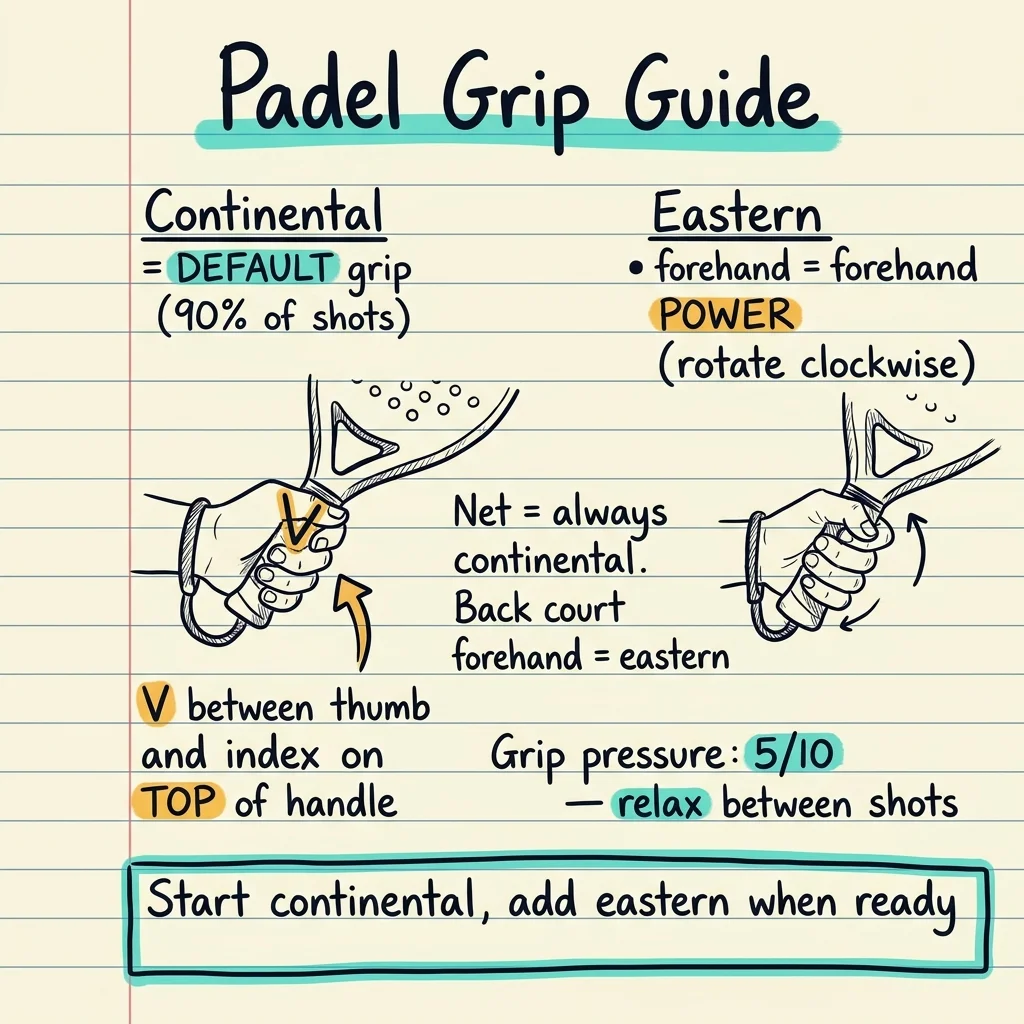
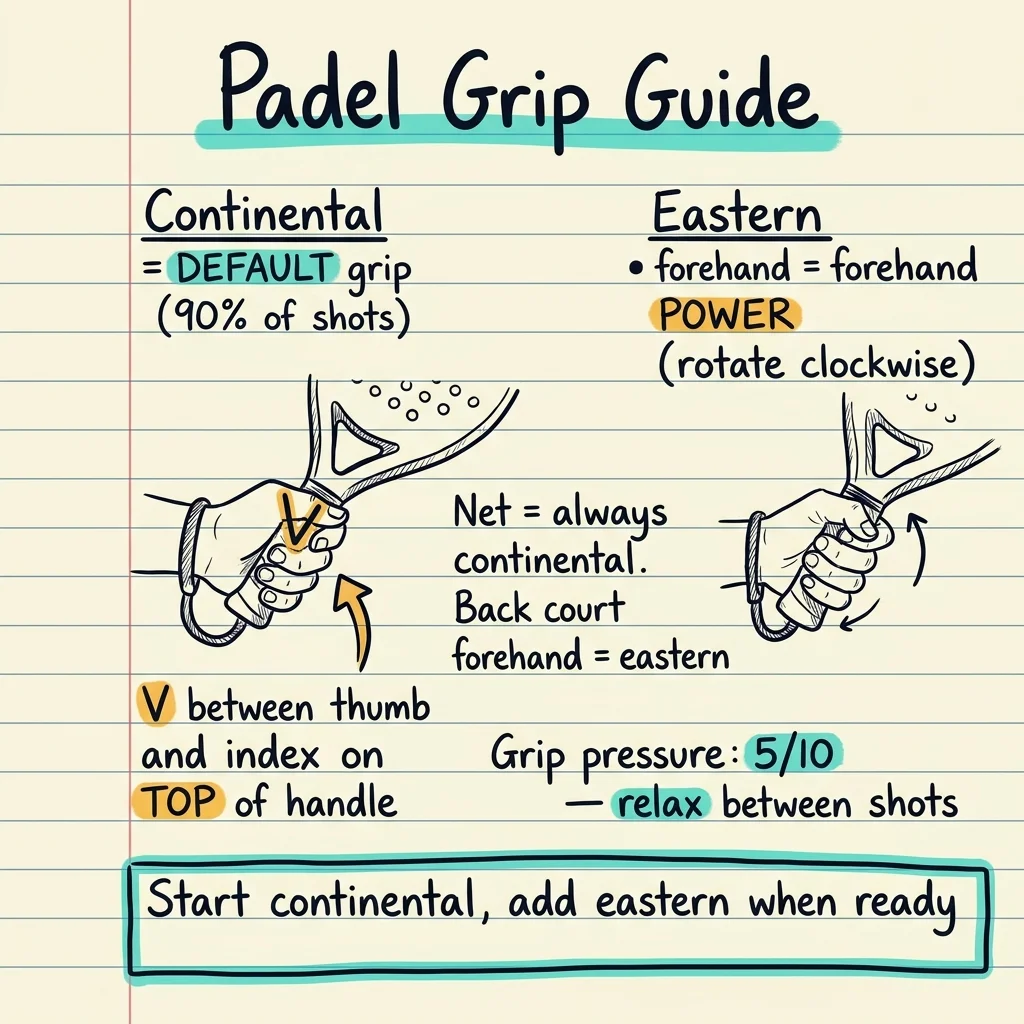
The continental grip is pádel's default. Place the V between your thumb and index finger on top of the handle — like shaking hands with the racket. It covers about 90% of shots: volleys, serves, bandejas, smashes, and both sides. The eastern grip rotates your hand slightly clockwise, adding power and topspin on forehand groundstrokes. Start with continental. Add eastern when you're ready for more forehand aggression.
Last updated: March 2026 · Grip technique verified against coaching resources from The Padel School, Hello Padel Academy, and Corcuera Padel Club.
The Continental Grip — Your Foundation
The continental is the grip you should learn first. It's the grip you hold 90% of the time.
How to find it: Hold the racket in front of you with the face perpendicular to the ground. Shake hands with the handle. The V formed between your thumb and index finger sits on top of the handle (bevel 2). That's it.
Why it works for pádel: The continental is neutral — it works for forehands, backhands, volleys, overheads, and serves without any adjustment. In pádel, rallies are fast and the ball comes off the glass unpredictably. You don't have time to switch grips between every shot.
What it's best for:
- Volleys (forehand and backhand)
- Serves (must be underhand)
- Bandejas and viboras
- Defensive shots off the glass
- Backhand groundstrokes
Grip pressure: About 5 out of 10. Tighten slightly at contact, relax between shots. A death grip kills your wrist mobility and touch.
The Eastern Grip — Forehand Power
The eastern grip adds power and topspin on forehand groundstrokes. It's the second grip every pádel player should learn.
How to find it: From the continental position, rotate your hand slightly clockwise (for right-handers). The base knuckle of your index finger moves to bevel 3. The V shifts slightly to the right.
Why it helps: The rotation gives you more leverage and wrist snap on forehand contact. This means more pace and more topspin — useful when hitting groundstrokes from the back of the court.
What it's best for:
- Forehand groundstrokes from the baseline
- Forehand drives with topspin
- Aggressive returns on the forehand side
What it's NOT for: Volleys, serves, bandejas, backhands, or anything at the net. Switch back to continental for those.
When to Switch
Here's the simple rule:
At the net → continental. Always. No exceptions. Volleys, bandejas, viboras, everything at the net is continental.
At the back, forehand side → eastern. When you have time to set up a forehand groundstroke and want extra power or spin.
At the back, backhand side → continental. The continental works better for backhand drives. Some players use an eastern backhand grip, but it's less common in pádel than tennis.
Transitioning → continental. When moving between net and baseline, default to continental. You can always adjust to eastern for a forehand if you have time.
Semi-Western: The Advanced Option
There's a third grip — the semi-western. Rotate further clockwise from eastern (bevel 4). It generates heavy topspin on forehands.
Most club players don't need it. It's a specialist grip for players who hit aggressive topspin forehands from the baseline. The trade-off: switching back to continental takes longer, which can cost you on fast exchanges.
The Beginner Mistake
New players often grip the racket like a frying pan — palm flat under the handle. This is the western grip. It feels natural but it kills your net game. Volleys become awkward, bandejas are impossible, and you can't serve properly.
If your palm is under the handle, rotate it toward the top. Continental is your friend.
Frequently Asked Questions
Never miss an edition
Weekly Monday issue. 3-minute read. Free. EN + ES.
Related Articles
How to Serve in Padel: Rules, Technique, and 2026 Changes
Master the padel serve — underhand technique, placement tactics, slice vs flat, and the new 2026 FIP serve rules explained.
How to Play Off the Walls in Padel: Glass, Mesh, and Rebound Technique
Learn how to read and play off the back glass, side walls, and mesh in padel. Positioning, timing, and rebound technique for every level.
How to Do a Bandeja in Padel: Step-by-Step Technique Guide
Learn the bandeja shot in padel — grip, footwork, slice technique, and common mistakes. The complete step-by-step guide to padel's most important overhead.