Padel vs Tennis: 9 Key Differences Every Player Should Know
Padel and tennis look similar but play completely differently — from court size and walls to scoring and rackets. Here are the 9 key differences.
If you've heard people talking about padel and thought "isn't that just tennis with walls?" — you're not alone. But step onto a padel court and you'll realize it's an entirely different sport. Same scoring, different everything else.
Here are the nine differences that matter.
1. The Court: Enclosed vs Open
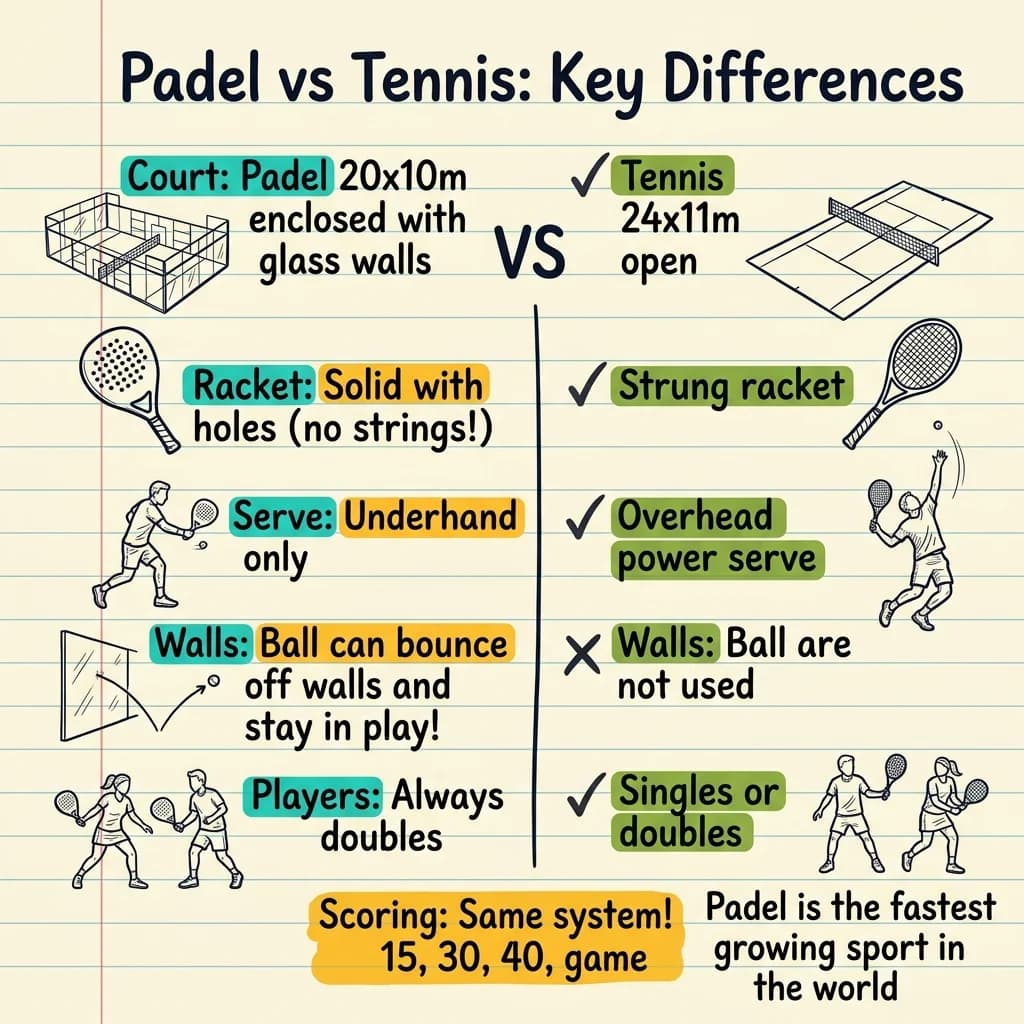
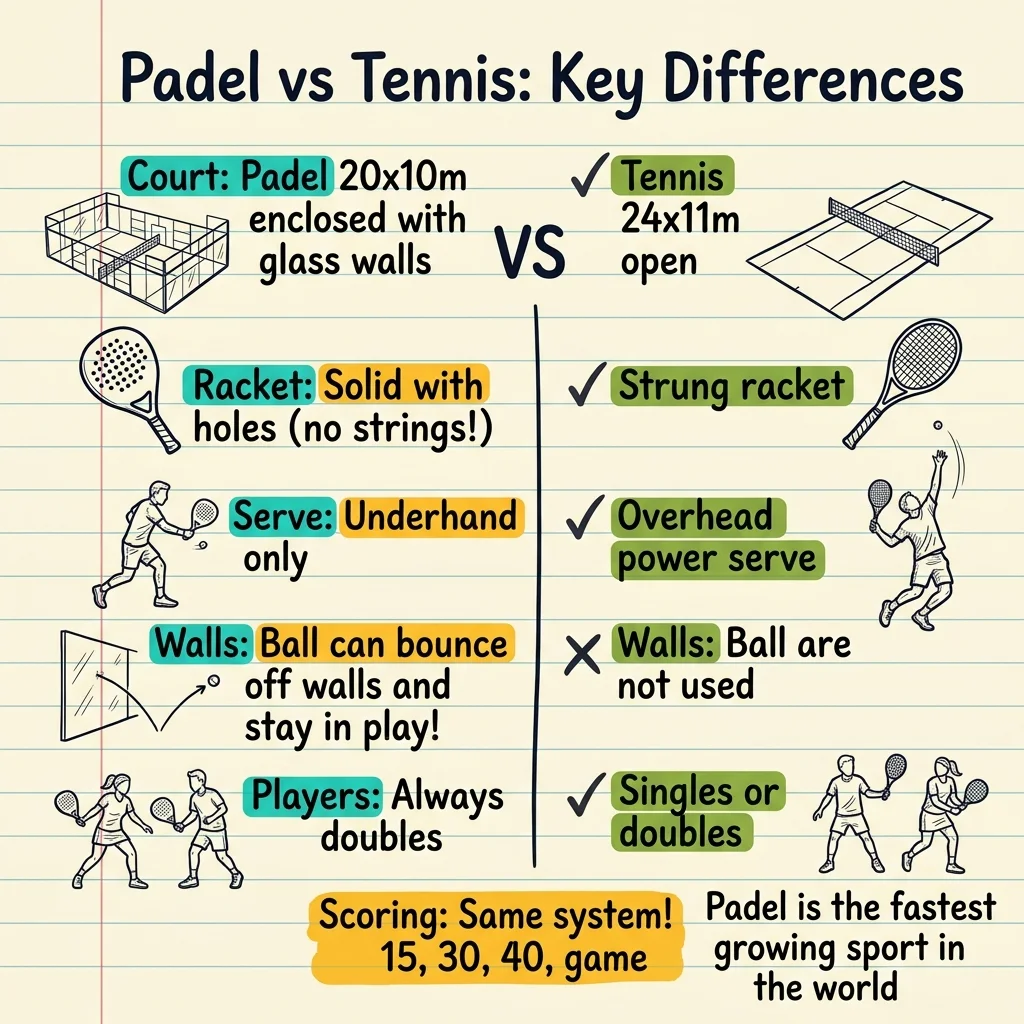
The most obvious difference. A padel court is enclosed by walls — 3 meters of glass at the back topped by 1 meter of metal mesh, with mixed glass and mesh on the sides. The walls aren't obstacles — they're part of the game.
A padel court measures 10 x 20 meters. A tennis doubles court is 10.97 x 23.77 meters. That's roughly 25% less playing area, which means you're always in the action.
2. The Racket: Solid vs Strung
Tennis rackets have strings. Padel rackets (called palas) are solid with a perforated face — small holes drilled through a composite or carbon fiber surface. No strings means a completely different feel: less power, more control, and a shorter learning curve.
Padel rackets are also much shorter (45-46cm vs 68-69cm for tennis), which changes how you generate power and spin.
3. The Serve: Underhand vs Overhand
In tennis, the serve is a weapon. Players like Carlos Alcaraz hit serves at 220+ km/h. In padel, the serve must be underhand — the ball bounces behind the service line and is struck below waist height.
This might sound less exciting, but it levels the playing field. You won't get aced in padel. Every point is earned through rallies, not serves.
4. The Walls: The Whole Game Changes
After the ball bounces on the ground, it can hit the back wall or side walls and still be in play. This single rule transforms everything.
In tennis, if a ball gets past you, the point is over. In padel, the glass gives you a second chance. You can retrieve balls off the back wall, play shots off the side glass, and even run out the side door to chase down a lob that bounced over the back wall.
The walls make defense possible in situations that would be winners in tennis. This is why padel rallies are longer and more spectacular — the point isn't over until you actually can't reach the ball.
5. Doubles Only (Mostly)
Padel is overwhelmingly a doubles sport — four players on court, two per side. Singles padel exists on smaller courts, but it's rare. The professional tours (Premier Padel, A1 Padel) compete exclusively in doubles.
Tennis has both singles and doubles at the professional level, though singles gets most of the attention.
This makes padel inherently social. You always need a group, which is part of why it spreads so fast — it's built for friend groups, not solo warriors.
6. The Scoring: Identical
Here's what IS the same: scoring. Padel uses the exact tennis scoring system:
- Points: 15, 30, 40, game
- Deuce: 40-40 requires winning by 2 points
- Sets: First to 6 games, tiebreak at 6-6
- Match: Best of 3 sets
Some padel tournaments use a golden point (punto de oro) at deuce — a single sudden-death point where the receiving team chooses which side to receive on. It speeds up matches and adds drama.
7. The Bounces: Same Rule, Different Feel
In both sports, the ball can only bounce once on the ground before you hit it. But because of the walls in padel, that one bounce opens up angles and trajectories that don't exist in tennis.
A ball that bounces and hits the back glass at chest height is an easy return. A ball that bounces and hits the back glass low and tight is nearly impossible. Learning to read these trajectories is what separates good padel players from great ones.
8. Physical Demands: Different, Not Easier
Tennis rewards power, speed, and endurance over long baseline rallies. Padel rewards reflexes, touch, positioning, and tactical intelligence.
A typical padel match lasts 60-90 minutes (vs 90 minutes to 3+ hours in tennis). The court is smaller, so you cover less ground per point. But the rallies are longer, the pace at the net is relentless, and the positional chess of deciding when to attack vs defend is constant.
Padel is accessible to players of all ages and fitness levels in a way tennis isn't — but at the professional level, players like Ale Galán are elite athletes by any standard.
9. The Community: Padel is Built for Groups
Tennis is often a solo endeavor — you and your racket against the world. Padel is inherently communal. You always need four people. Courts are typically rented in 90-minute blocks. After the match, you hang out at the club.
This social DNA is why padel is the fastest-growing sport in the world. Over 35 million people play across 150+ countries, up from 25 million just two years ago. Spain alone has over 6 million players and 17,000+ courts. Countries like Italy, Sweden, the Netherlands, and the UK are building courts as fast as they can.
So Which Should You Play?
Both. Seriously — they're different enough that one doesn't replace the other. If you already play tennis, padel will feel familiar but fresh. If you've never played either, padel has a much gentler learning curve.
The real question isn't padel or tennis. It's: when are you booking your first court?
Frequently Asked Questions
Never miss an edition
Weekly Monday issue. 3-minute read. Free. EN + ES.
Related Articles
How to Serve in Padel: Rules, Technique, and 2026 Changes
Master the padel serve — underhand technique, placement tactics, slice vs flat, and the new 2026 FIP serve rules explained.
Padel Rules for Beginners: Everything You Need to Know
The complete guide to padel rules — scoring, serving, walls, and everything a new player needs to step on court with confidence.
What Is Padel? The Sport Everyone Is Playing, Explained
Padel explained in plain language: how it works, why the walls matter, what you need to play, and why 35 million people are hooked.