What's New in Padel for 2026? Every FIP Rule Change Explained
The FIP's 2026 rulebook brings the Star Point, a stricter serve, a safety-cord penalty, new racket holes, and a faster clock. Here's every change.
Quick Answer
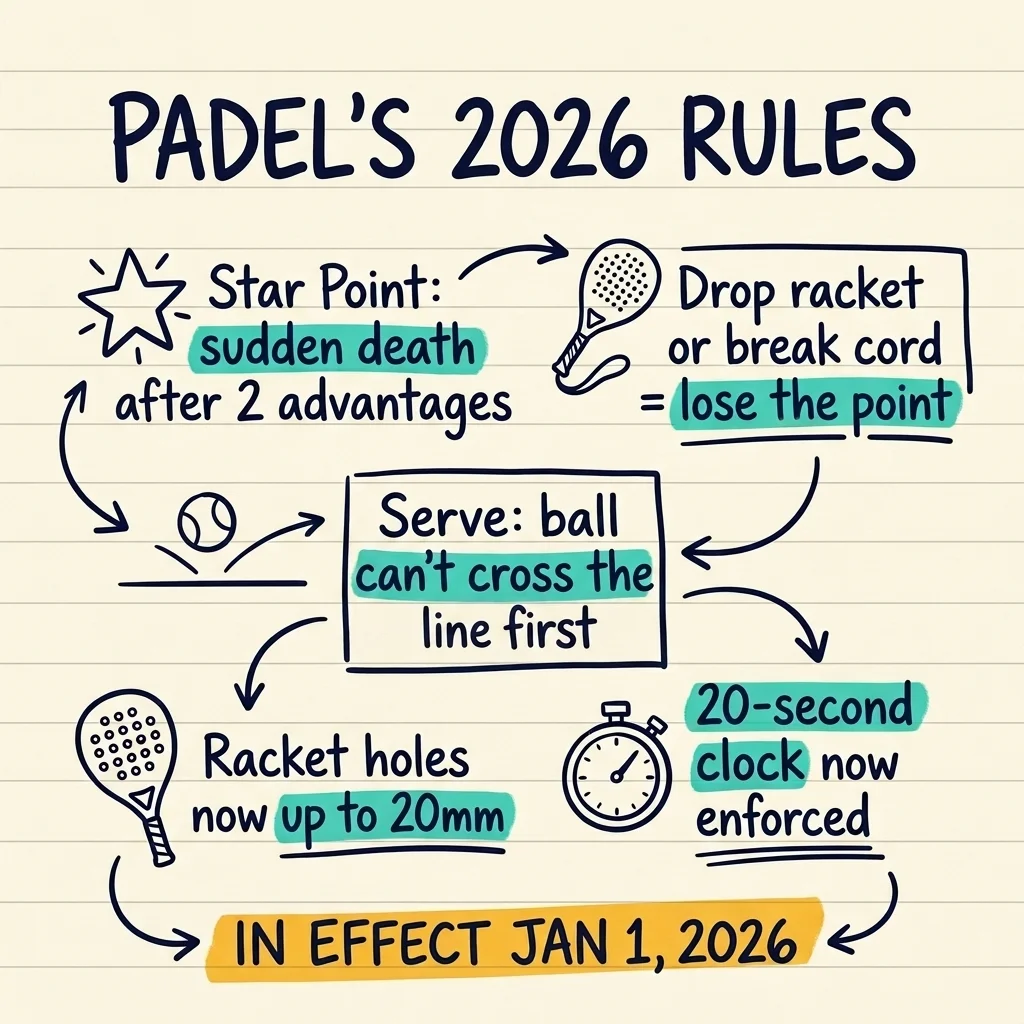
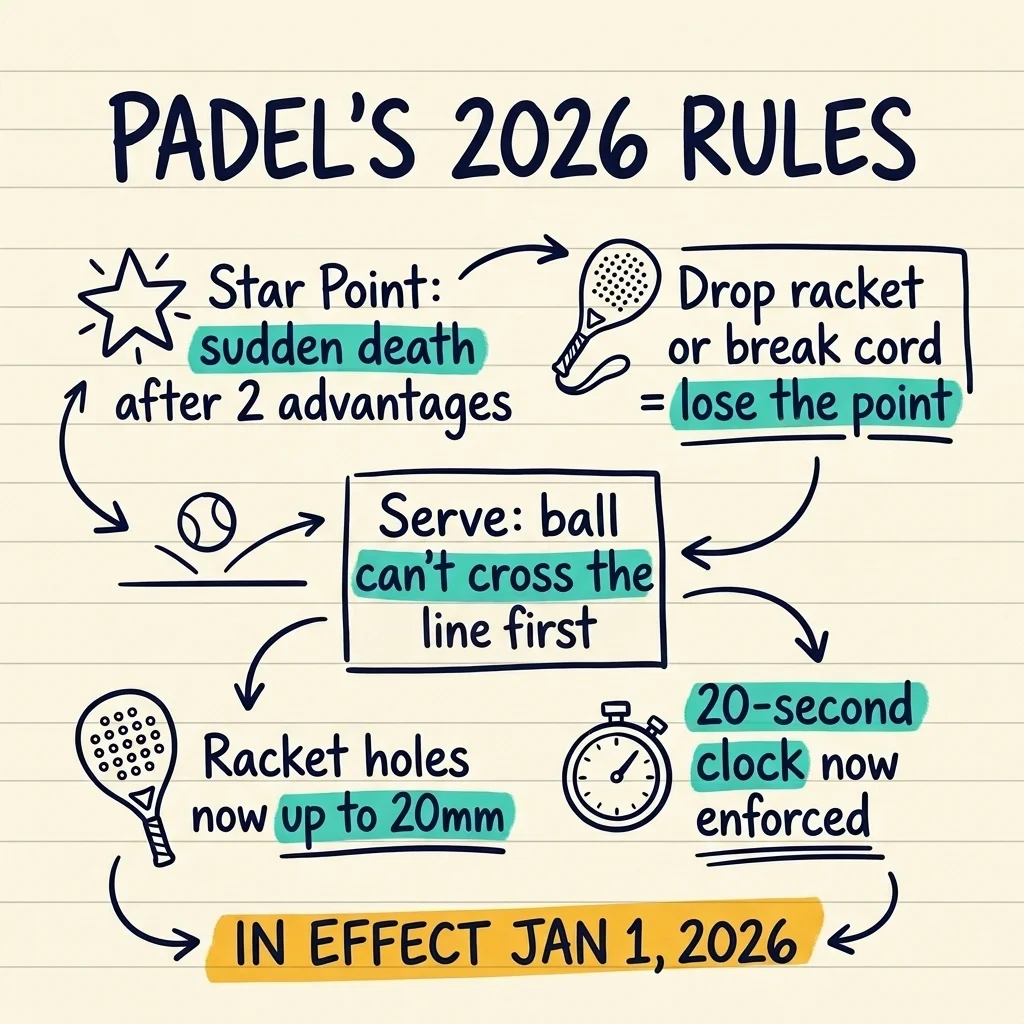
The FIP's 2026 padel rulebook took effect on January 1, 2026. Five changes matter most:
- Star Point — an optional sudden-death point at deuce, after two advantages
- Safety cord penalty — break your wrist cord or drop the racket mid-point, lose the point
- Clarified serve — the ball can't cross the service line before you hit it
- New racket holes — peripheral holes can be non-circular, up to 20mm wide
- A faster clock — strict 20-second enforcement and a 3-minute warm-up
Last updated: June 2026 · Rule details verified against the official FIP rulebook at time of writing.
Who Changed the Rules, and When
The International Padel Federation (FIP) published its updated rulebook in December 2025. The document is dated "Review of application 01.01.2026," and the rules apply to every FIP-sanctioned competition: Premier Padel, the CUPRA FIP Tour, and the FIP Beyond amateur circuit.
Most of the headlines went to one change. The rest fly under the radar but will still cost you points if you don't know them. Here's the full list.
1. The Star Point Lands at Deuce
The biggest change is how games end at 40-40. Padel used to trade advantages until one team won two points in a row. That could drag a single game past ten minutes.
The Star Point caps it. Teams play up to two advantage cycles, and if nobody converts, one sudden-death point decides the game. The receiving team picks which side takes the serve.
It sits between the two older options. Traditional advantage had no limit; golden point skipped advantage entirely and felt random. The Star Point splits the difference.
Tournaments choose between classic golden point and the Star Point, so club matches can keep playing however they like. We broke down the mechanics, the history, and the serve-side rule in our full Star Point guide.
2. Drop Your Racket, Lose the Point
This one surprised players. The wrist cord is no longer a formality.
Every padel racket needs a non-elastic cord, fixed in the handle, worn around the wrist, with a maximum length of 35cm. Its use is obligatory. Under the 2026 rules, breaking or detaching that cord during a point loses you the point. Dropping the racket does the same. The point simply goes to the other pair.
Before 2026 this was a grey area that triggered arguments. Now it's black and white. Check your cord before you play, because a frayed one can hand away a point at deuce.
3. The Serve Gets a Clearer Line
The serve clarification is subtle, and most players won't change a thing. The 2026 rulebook states that the ball must not cross the service line, or its imaginary extension, before you make contact with it.
The rest of the serve stays the same. You drop the ball, let it bounce, and strike it below waist height. The change mainly tightens enforcement for umpires, so pros feel it more than weekend players. If you toss the ball forward over the line and hit it there, that's now clearly a fault.
4. Racket Holes Get More Freedom
Equipment makers got a small win. Peripheral holes on the racket face — the ones near the frame edge — can now be non-circular shapes, as long as the diameter stays at or under 20mm.
That opens the door to new aerodynamic designs for the 2026 racket lineups. It won't change your game, but it explains the slotted and teardrop hole patterns appearing on this year's models.
5. The Clock Speeds Up
Padel wants to play faster, and the 2026 rules push pace in two ways.
First, the 20-second limit between points is now actively enforced. Stall in a sanctioned match and you'll get a warning, then a point penalty. Second, the pre-match warm-up drops from five minutes to three.
Both changes target tournament play. They keep matches tight for broadcasters and stop tactical time-wasting at key moments.
What It Means for You
If you play socially, three rules touch your game: the serve line, the safety cord, and the racket-hole spec on whatever pala you buy next. The Star Point and the strict clock are optional at club level.
If you compete under FIP rules, learn all five. The cord penalty alone can decide a tight match, and umpires are watching the serve line and the 20-second clock more closely than before.
For the bigger picture on how the pro circuit is structured this season, see our Premier Padel 2026 guide. New to the sport? Start with our padel rules for beginners.
Frequently Asked Questions
Never miss an edition
Weekly Monday issue. 3-minute read. Free. EN + ES.
Related Articles
What Is the Star Point in Padel? The New 2026 Scoring Rule Explained
The Star Point system caps deuce games at 2 advantages before a sudden-death point. Here's how it works in 2026.
How Does Padel Scoring Work? Points, Games, Sets, and Tiebreaks Explained
Padel scoring uses 15-30-40-game points inside best-of-3 sets with tiebreaks, golden point, and the 2026 star point rule.
How to Serve in Padel: Rules, Technique, and 2026 Changes
Master the padel serve — underhand technique, placement tactics, slice vs flat, and the new 2026 FIP serve rules explained.
Related Newsletter Editions
Golden at Roland Garros: Tapia & Coello's Four in a Row, and Ustero Makes History
On Philippe-Chatrier, Tapia and Coello pulled off one of padel's great escapes. Trailing 2-5 in the third against Galán/Chingotto, they clawed back and won the tiebreak 7-1 to seal a fourth consecutive Roland Garros title. In the women's final, Ari Sánchez and 19-year-old Andrea Ustero were ruthless: 6-2 6-0 in 71 minutes. Ustero is now the youngest Paris Major champion in history. A record 81,000 fans packed Roland Garros across the week.
Chingalan Reign in Madrid — and the City Says Goodbye to Its Queen
Galán and Chingotto beat Nieto/Yanguas 6-4 5-7 6-4 for the Madrid P1 title — their seventh of the season — while Triay/Brea came from a set down to win the women's event and Madrid gave Alejandra Salazar a legendary farewell. Paris Major starts today.
Calvo & Fernández Make History in London
Martina Calvo and Claudia Fernández become the youngest Premier Padel champions by beating Triay/Brea in London, while Coello/Tapia claim their eighth title of 2026.