Padel Etiquette: The Unwritten Rules Every Player Should Know
The unwritten rules of padel: when to switch sides, tapping palas, fetching balls from the next court, net cord apologies, and the amateur smash code.
Quick Answer
Padel etiquette comes down to ten unwritten rules: never enter or cross a court mid-rally; return a neighbor's ball with a gentle feed once their point ends; switch ends on odd games by walking around the net, not over it; tap palas with your partner after points; raise a hand to apologize for net cords and lucky winners; never smash at faces in social games; call your own lines honestly and replay genuine disputes; shout "mine" or "yours" on ambiguous balls; don't celebrate opponents' errors; and respect the booking clock. None of them appear in the official rulebook — all of them decide whether you get invited back.
Last updated: August 2026 · Conventions verified against club practice and the official FIP rules.
Why Padel Has a Second Rulebook
Padel is a social sport before it is a competitive one. Most matches happen at clubs, between people who met through an app or a group chat, on courts booked in 60- or 90-minute slots with the next four players watching you finish. That environment produced a code of conduct that Red Bull's etiquette guide calls the sport's "unspoken standards" — rules nobody writes down and everybody enforces.
Break the official rules and you lose a point. Break these and you lose invitations.
The Ten Unwritten Rules
1. Never enter a court mid-rally
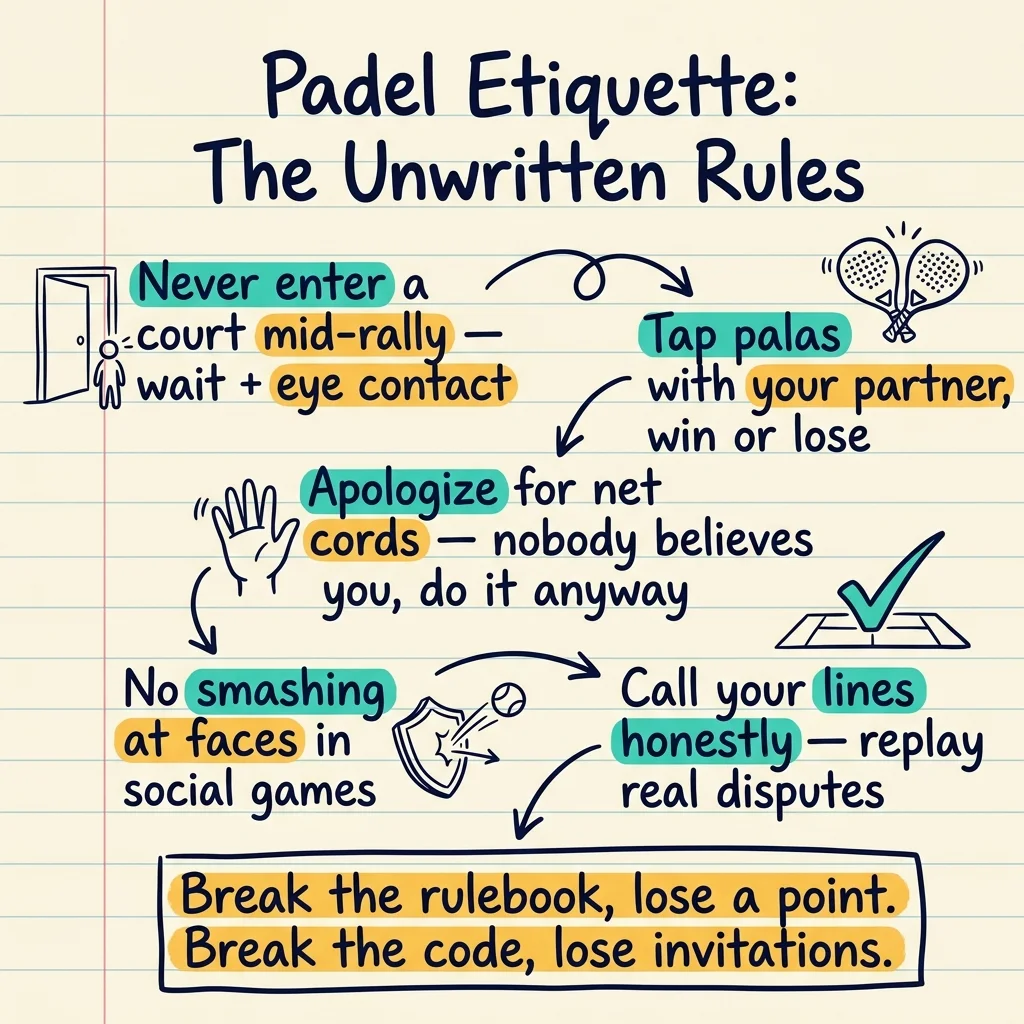
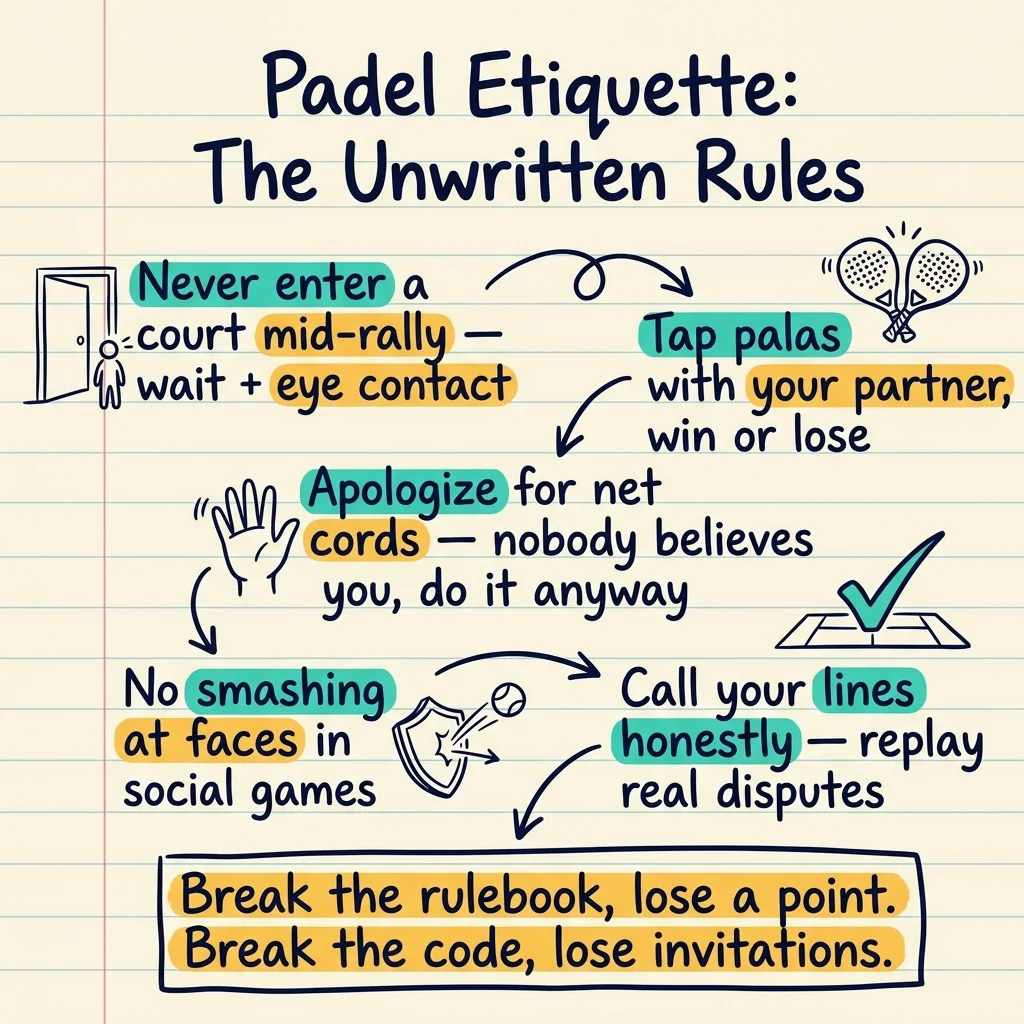
The doors at the back of a padel court open onto live play. Opening one mid-point — to retrieve a ball, to deliver water, to start your booking — kills the rally and occasionally causes a collision. Wait for the point to end, make eye contact, then move.
2. Return the neighbor's ball like an adult
A ball from the next court gets returned when their rally finishes, with a soft feed aimed at a player's hands. Not a full-swing clearance over the fence in a random direction. And the reverse: if your ball rolls into their court, ask for it — walking uninvited into someone else's game is the fastest way to become club-famous for the wrong reason.
3. Switch ends on odd games — through the doors
The official rule: teams change ends whenever the game count adds up to an odd number — after game 1, 3, 5, and so on. The unwritten part is how: walk around the net through the doors. Climbing over the net or squeezing across the net post damages the equipment and looks ridiculous in equal measure.
4. Tap palas with your partner
After a won point, after a lost point, after your partner buries a sitter into the net: pala tap. The gesture — carbon quietly clicking on carbon — says "still a team." All four players then meet at the net after the final point for taps or fist bumps. Pros on Premier Padel do it after every single point; a 20x10 court is too small a space to sulk in.
5. Apologize for net cords
When your shot clips the tape and dribbles dead on the other side, raise your pala or say a quick "sorry." Everyone knows you're not sorry. That's not the test. The gesture separates "I got lucky" from "I meant that," and skipping it reads as claiming credit for a coin flip.
6. No smashing at faces
Here is the rule beginners most need to hear: hitting an opponent with the ball is a legal way to win a point — and in social padel, aiming at someone's face or body from two meters away is unacceptable anyway. The amateur code says win with placement: smash toward the glass, the fence, the gaps, or go for the by-three or by-four angles. Save the body shot for tournaments where everyone signed up for it — and even then, expect exactly zero new friends.
7. Call your own lines, replay real disputes
Amateur padel has no umpire. Each team calls the lines on its own side, honestly, with the benefit of the doubt going to the opponent. When a call is genuinely disputed, the standard convention is simple: replay the point. Arguing over a line call in a Tuesday-night social match is a bigger loss than the point ever was.
8. Say "mine" or "yours" — every time
Every ball down the middle belongs to somebody, and the time to decide is before both of you swing. One word prevents the collision, the double-swing, and the silent blame that follows. It's the cheapest insurance in the sport, and it's also the fix for one of the most common beginner mistakes: assuming your partner has it.
9. Celebrate your winners, not their errors
A fist pump for your own vibora winner: great. A "vamos!" when a beginner double-faults: you've just guaranteed nobody enjoys the next 40 minutes. The distinction is invisible in a highlights reel and enormous on a Tuesday night court.
10. Respect the clock
Club courts run on tight bookings. Arrive early enough to warm up inside your slot, and when your time ends, gather balls and leave — the four players at the door paid for the minutes you're stealing. Overrunning a booking is the etiquette violation clubs actually track.
The One-Line Version
If you remember nothing else: padel etiquette is playing like you want these three people — and the four on the next court — to book with you again next week. That's the entire code. The other ten rules are just implementation details.
New to the sport? Start with our beginner rules guide for the official rulebook, then this one for everything the rulebook won't tell you.
Frequently Asked Questions
Never miss an edition
Weekly Monday issue. 3-minute read. Free. EN + ES.
Related Articles
Why Is Pádel the Fastest Growing Sport in the World?
35 million players, 77,000+ courts, 150 countries — pádel is the fastest growing sport in the world. Here are the 5 reasons why.
What Is Padel? The Sport Everyone Is Playing, Explained
Padel explained in plain language: how it works, why the walls matter, what you need to play, and why 35 million people are hooked.
Is Padel a Good Workout? Calories, Heart Rate, and the Muscles It Trains
Padel keeps you at 70-80% of max heart rate and burns roughly 400-700 calories an hour. Here's the science on the workout you actually get.